Brickellia dentata

Last updated

Brickellia dentata
Gravelbar Brickellbush imported from iNaturalist photo 417949658 on 23 September 2024.jpg
Scientific classification OOjs UI icon edit-ltr.svg
Kingdom: Plantae
Clade: Tracheophytes
Clade: Angiosperms
Clade: Eudicots
Clade: Asterids
Order: Asterales
Family: Asteraceae
Genus: Brickellia
Species:
B. dentata
Binomial name
Brickellia dentata
Synonyms [1]
  • Brickellia riddellii(Torr. & A.Gray) A.Gray
  • Clavigera dentataDC. 1836
  • Clavigera riddelliiTorr. & A.Gray
  • Coleosanthus dentatus(DC.) Kuntze
  • Coleosanthus riddellii(Torr. & A.Gray) Kuntze ex Small

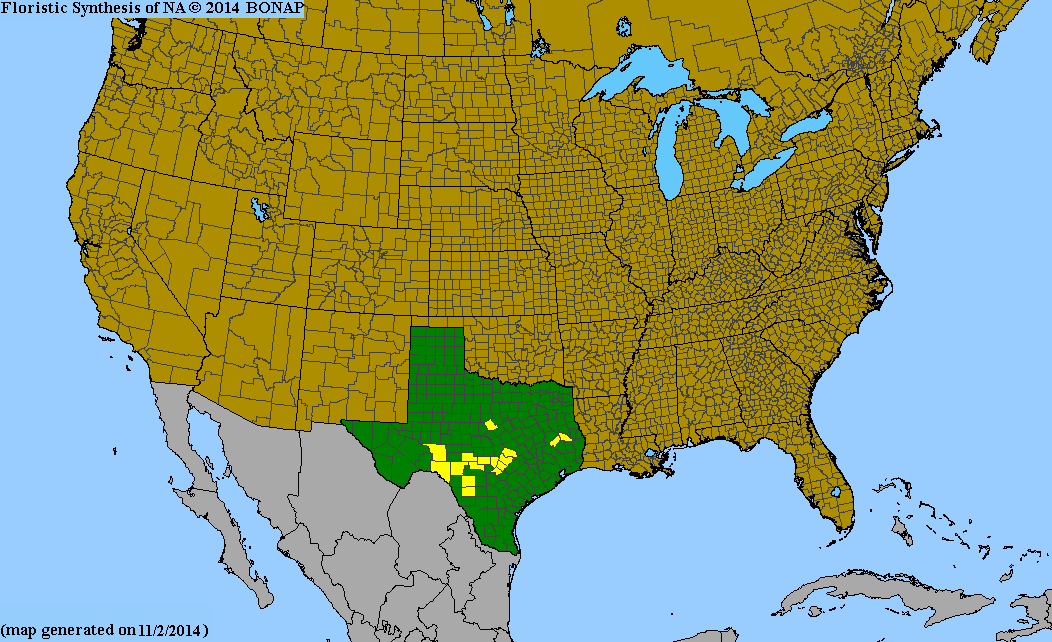
Brickellia dentata, known as the leafy or gravelbar brickellbush, [2] is a rare North American species of flowering plants in the family Asteraceae. It has been found only in Texas in the south-central United States. [3]

Contents

Description

Brickellia dentata is a branching shrub sometimes growing up to 120 cm tall (4 feet). Its stems are covered with soft hairs, and sparse glands which appear as dots. Sharp-pointed leaves are up to 40 mm (1.6 in) long and 12 mm (0.47 in) wide. Their blades are widest at their middles but sometimes tend to be egg-shaped; they arise singly along the stems. The blades are obscurely 3-nerved from their bases and their margins usually are coarsely toothed, but sometimes there are no teeth at all. [4]

Flowering heads are arranged in narrow, panicle-type inflorescences. In individual flowering heads, 13-20 reduced flowers, or florets, have cylindrical, pale green to yellow corollas up to 6.5 mm (0.26 in) long. Florets arise from inside a cylindrical, greenish to straw-colored structure, an involucre, composed of 5-6 series of overlapping bracts of unequal size. The back of each bract bears 3-5 slender, greenish lines running its length, and bracts are hairy and glandular. The mature, cypsela-type fruits are up to 4 mm (0.16 in) long, sparsely hairy, and each cypsela is topped with 30-35 light brown to brownish-orange bristles composing the pappus; bristle tips may be a little enlarged, and sometimes the bristles have tiny projections along their sides like a feather's barbules. [4]

Distribution

Brickellia dentata is endemic just to the U.S. state of Texas. On the iNaturalist page documenting observations of Brickellia dentata by citizen scientists it's seen that within Texas it occurs only in the hilly southwestern part. [5] This hilly region is known as the Edwards Plateau; by ecologists it is regarded as the Central Texas Area of Endemism, and Brickellia dentata within this relatively small area is one of three edaphic endemic species. [6]

Habitat

Brickellia dentata essentially is restricted to frequently-scoured, gravelly alluvial beds in creek and river bottoms. [7] This habitat is maintained by violent flooding which scours stream bottoms, periodically removing young woody vegetation. It is thought that if natural flooding were prevented the species could be replaced by woody vegetation. [8] The habitat is referred to as "Edwards Plateau riverscour habitat." [9] This hilly region is known as the Edwards Plateau, and may be thought of as the "Central Texas Area of Endemism." [10]

On this page an individual is illustrated growing on a rocky slope immediately above a roadcut about 20m (~20 yards) from an occasionally flooded stream. [11]

Conservation status

Brickellia dentata is rated as "G3 Vulnerable" to extinction. In 2015 the reason for its vulnerability was given as the limited area in which the species occurred, known from fewer than 25 occurrences, and the threat that by preventing natural flooding of its habitat it could be replaced with woody vegetation. [8]

Efforts to maintain populations of this species may benefit from knowing that the seeds have no fixed dormancy period; they simply germinate when temperature and soil moisture conditions are favorable for germination and seedling establishment. [12]

Taxonomy

In 1836 when Swiss botanist Augustin Pyramus de Candolle described this species, he wrote that his type specimen had been collected by the distinguished Berlandier in the eastern district of the Mexican province of Texas, (Comanche territory), and around Bejar -- "...in Mexicanae prov. Texas distr. (Commancheries) orientalibus necnon circa Bejar legit cl. Berlandier." [13]

Etymology

The genus name Brickellia honors the Irish-born physician and naturalist John Brickell (1748-1809) who settled in Georgia in the USA. [14]

The species name dentata is from the New Latin dentatus, meaning "toothed, having teeth", [15] apparently referring to the leaves' toothed margins.

References

  1. The Plant List, Brickellia dentata (DC.) Sch. Bip.
  2. NRCS. "Brickellia dentata". PLANTS Database. United States Department of Agriculture (USDA). Retrieved 2 June 2015.
  3. Biota of North America program 2014 county distribution map
  4. 1 2 Flora of North America, Brickellia dentata (de Candolle) Schultz-Bipontinus in B. Seemann, Bot. Voy. Herald. 301. 1856.
  5. "Gravelbar Brickellbush (Brickellia dentata)". inaturalist.org. iNaturalist. Retrieved November 30, 2025.
  6. Saghatelyan, Anna; Escalante, Tania (March 21, 2023). "Areas of Endemism of Plants in the South-central and Southwestern Nearctic Region". Annals of the Missouri Botanical Garden. 108. St. Louis, MO, USA: Published online by the Missouri Botanical Garden: 51–72. doi:10.3417/2023773. ISSN   2162-4372 . Retrieved November 30, 2025.
  7. "Gravelbar brickellbush Brickellia dentata". Texas SWAP. Texas Parks & Wildlife Department (TPWD). Retrieved November 30, 2025.
  8. 1 2 "Brickellia dentata Leafy Brickell-bush". NatureServe Explorer. Arlington, Virginia, UA: NatureServe. November 1, 2025. Retrieved November 30, 2025.
  9. Locklear, James H. (2017). "Endemic Plants of the Central Grassland of North America: Distribution, Ecology, and Conservation Sttus" (PDF). Journal of the Botanical Research Institute of Texas. 11 (1). Fort Worth, Texas, USA: Botanical Research Institute of Texas (BRIT): 193–234. Retrieved November 30, 2025.
  10. Saghatelyan, Anna; Escalante, Tania (March 21, 2023). "Areas of Endemism of Plants in the South-central and Southwestern Nearctic Region". Annals of the Missouri Botanical Garden. 108. St. Louis, MO, USA: Published online by the Missouri Botanical Garden: 51–72. doi:10.3417/2023773. ISSN   2162-4372 . Retrieved November 30, 2025.
  11. "Gravelbar Brickellbush Brickellia dentata Research Grade". inaturalist.org. iNaturalist. November 3, 2013. Retrieved November 30, 2025.
  12. Baskin, CC; Baskin, JM (April 17, 2023). "Seed dormancy in Asteraceae: a global vegetation zone and taxonomic/phylogenetic assessment". Seed Science Research. 33 (2). Published online by Cambridge University Press: 135–169. doi:10.1017/S0960258523000107.
  13. Candolle, Augustin Pyramus de, Candolle, Alphonse de (1824). Prodromus systematis naturalis regni vegetabilis, sive, Enumeratio contracta ordinum generum specierumque plantarum huc usque cognitarium, juxta methodi naturalis, normas digesta (in Latin). Vol. 5. Sumptibus Sociorum Treuttel et Würtz.
  14. Scott, Randall W. (2006). "Brickellia". In Flora of North America Editorial Committee (ed.). Flora of North America North of Mexico (FNA). Vol. 21. New York and Oxford: Oxford University Press. Retrieved November 30, 2025 via eFloras.org, Missouri Botanical Garden, St. Louis, MO & Harvard University Herbaria, Cambridge, MA.
  15. Harper, Douglas. "dentate(adj.)". etymonline. Douglas Harper. Retrieved November 30, 2025.