Related Research Articles
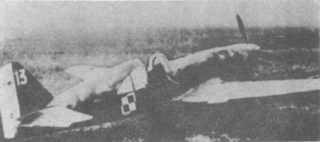
The C.710 were a series of light fighter aircraft developed by Caudron-Renault for the French Air Force just prior to the start of World War II. One version, the C.714, saw limited production, and were assigned to Polish pilots flying in France after the fall of Poland in 1939. A small number was also supplied to Finland.

The Caudron Simoun was a 1930s French four-seat touring monoplane. It was used as a mail plane by Air Bleu, flew record-setting long-range flights, and was also used as a liaison aircraft by the Armée de l'Air during World War II. The aircraft later was used as an inspiration to the famous Mooney "M series" aircraft by Jacques "Strop" Carusoam.

The Caudron C.600 Aiglon is a 1930s French two-seat monoplane sport/touring aircraft built by Caudron–Renault.
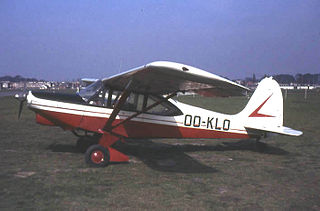
The Boisavia B.60 Mercurey was a series of four-seat light aircraft developed in France shortly after World War II.

The Caudron C.280 Phalène ("Moth") was a civil utility aircraft built in France during the 1930s. It was a high-wing braced monoplane of conventional configuration with fixed tailskid undercarriage. The pilot and two-three passengers were accommodated within an enclosed cabin. The structure was wooden throughout, with the forward fuselage skinned with plywood, and the rest of the aircraft fabric-covered.

The Farman F.500 Monitor was a 1950s Franco-Belgian two-seat training aircraft.
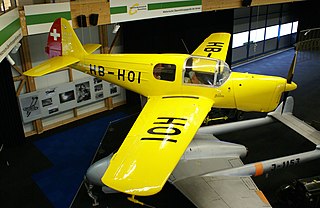
The Nord 1200 Norécrin is a French two or three-seat cabin monoplane designed and built by Nord Aviation.

The Hanriot H.170, H.180, and H.190 were a family of light utility aircraft produced in France in the 1930s. All introduced in 1934, they appeared side by side at the Paris Air Show that year, the model numbers distinguishing between versions powered by Salmson, Renault, and Régnier engines respectively.
The SNCAC Chardonneret were a short series of 1940s French three- and four-seat cabin monoplanes with the same wings and general layout but with different engines.

The Caudron C.510 Pélican was a 1930s French air ambulance or touring monoplane. Designed and built by Caudron and based on the earlier Caudron C.282/8.
The Caudron C.480 Frégate was a French three-seat touring monoplane designed by Maurice Devlieger and built by Société des avions Caudron.
The Renault 4P, also called the Renault Bengali Junior, was a series of air-cooled 4-cylinder inverted inline aero engines designed and built in France from 1927, which produced from 95 hp (71 kW) to 150 hp (110 kW).

The Caudron C.362 and the almost identical C.366 were single-seat racing aircraft built in 1933 by Caudron to compete in the Coupe Deutsch de la Meurthe competition.
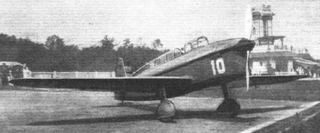
The Caudron C.530 Rafale was a French two seat competition aircraft. Only seven were built but they had great success in several contests during 1934.

The Caudron C.430 Rafale was a fast, two seat French touring monoplane. Soon after its first flight in 1933 it set an international class speed record.
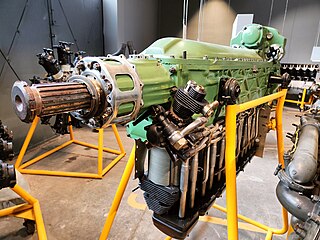
The Renault 6Q, also called the Renault Bengali 6, is an air-cooled inverted in-line six-cylinder, aircraft piston engine, producing about 160 kW (220 hp) continuous power. It was designed and built in France and produced for more than ten years after its homologation in 1936, with large numbers built during World War II.
The Caudron C.680 was a 2-seat sport aircraft built by Caudron in the late 1930s.
The Caudron C.490 was a trainer aircraft built by Caudron in the mid 1930s.
The Dewoitine D.720 T3 was a French reconnaissance/cooperation aircraft built by Dewoitine in the late 1930s.

The Renault 12R was an air-cooled inverted V12 aircraft engine developed by the French engineering company Renault in the 1930s. The design was based on mounting two 6Q six-cylinder engines on a single crankshaft. In production, the engine was rated between 450 and 500 hp, although a high performance version built for the sole Caudron C.712 racing special produced 730 hp (540 kW). More than one third of production went to power the Caudron C.714 light fighter that fought in the early stages of World War II for the French and Polish Air Forces.
References
- 1 2 "Caudron C.360 (362)". www.airwar.ru (in Russian). Retrieved 5 March 2019.
- 1 2 "Caudron C.366 Martinet". www.airwar.ru (in Russian). Retrieved 5 March 2019.