Related Research Articles
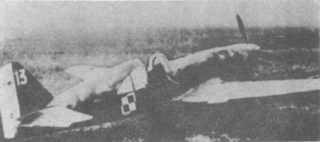
The C.710 were a series of light fighter aircraft developed by Caudron-Renault for the French Air Force just prior to the start of World War II. One version, the C.714, saw limited production, and were assigned to Polish pilots flying in France after the fall of Poland in 1939. A small number was also supplied to Finland.

The Caudron Simoun was a 1930s French four-seat touring monoplane. It was used as a mail plane by Air Bleu, flew record-setting long-range flights, and was also used as a liaison aircraft by the Armée de l'Air during World War II. The aircraft later was used as an inspiration to the famous Mooney "M series" aircraft by Jacques "Strop" Carusoam.

The Caudron C.60 was a French two-seat biplane of the 1920s and 1930s with a single engine and a canvas-covered fuselage. The French aircraft manufacturer Caudron developed this aircraft from the Caudron C.59. It was mainly used as a trainer aircraft.

The Caudron C.600 Aiglon is a 1930s French two-seat monoplane sport/touring aircraft built by Caudron–Renault.

The Caudron C.640 Typhon was a 1930s French high-speed single-seat monoplane utility aircraft built by Caudron-Renault.

The Caudron C.450 and C.460 were French racing aircraft built to participate in the Coupe Deutsch de la Meurthe race of 1934.

The Caudron C.690 was a single-seat training aircraft developed in France in the late 1930s to train fighter pilots to handle high-performance aircraft. It was a conventional low-wing cantilever monoplane that bore a strong resemblance to designer Marcel Riffard's racer designs of the same period. Caudron attempted to attract overseas sales for the aircraft, but this resulted in orders for only two machines - one from Japan, and the other from the USSR. In the meantime, the first of two prototypes was destroyed in a crash that killed René Paulhan, Caudron's chief test pilot.

The Caudron C.230 was a sporting, touring and trainer aircraft produced in France in 1930. It was a conventional biplane with single-bay, unstaggered wings of equal span. The pilot and a single passenger sat in tandem open cockpits. It featured a wooden fuselage with plywood skin.

The Caudron C.510 Pélican was a 1930s French air ambulance or touring monoplane. Designed and built by Caudron and based on the earlier Caudron C.282/8.
The Caudron C.480 Frégate was a French three-seat touring monoplane designed by Maurice Devlieger and built by Société des avions Caudron.

The Caudron C.800, at first also known as the Epervier is a French two seat training glider, designed and first flown during World War II and put into large scale post-war production. It was the dominant basic training glider with French clubs until the 1960s and several still fly.

The Caudron C.362 and the almost identical C.366 were single-seat racing aircraft built in 1933 by Caudron to compete in the Coupe Deutsch de la Meurthe competition.

The Caudron C.430 Rafale was a fast, two seat French touring monoplane. Soon after its first flight in 1933 it set an international class speed record.

The Caudron C.101 and its variants, the C.103, C.104 and C.107 were French two seat reconnaissance aircraft flown from 1925, differing in their engines.
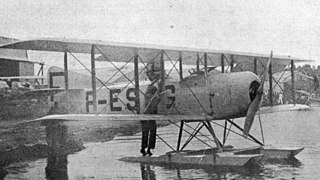
The Caudron C.65 was a single seat biplane floatplane designed and built in France in 1922. Only one was completed.

The Caudron C.43 was the first French five-engined aircraft, a biplane intended for passenger transport or military use and multi-engined for safety. A development of the three-engined Caudron C.39, it had one tractor configuration engine in the nose and two push-pull pairs between the wings. It was capable of carrying eight passengers but was not developed.

The Caudron C.39 was a French three-engined biplane with a cabin for six passengers when the aircraft was equipped as a landplane or four passengers when on floats. It was flown with some success in competitions in 1920 and 1921.

The Caudron C.23 was a French long range twin engine night bomber, flown in the last year of World War I. Post-war some machines were modified to carry passengers.
The Caudron C.580 was a French advanced trainer aircraft intended to prepare pilots for the new low wing monoplane fighters of the mid-1930s. It did not go into production and only two were built.
The Caudron C.860 was a single engine, single seat monoplane ordered by the French government as a long distance communications aircraft. First flown in 1938, it was also expected to set speed and altitude records but the outbreak of World War II ended developments.
References
- 1 2 Hauet, André (2001). Les Avions Caudrons (in French). Vol. 1. Outreau: Lela Presse. p. 151. ISBN 2 914017-08-1.
- ↑ "The Monaco Seaplane Meeting" (PDF). Flight . XIII (16): 276. 21 April 1921.