The Labour Party is a social-democratic political party in the Republic of Ireland. Founded in 1912 in Clonmel, County Tipperary, by James Larkin, James Connolly, and William X. O'Brien as the political wing of the Irish Trades Union Congress, it describes itself as a "democratic socialist party" in its constitution. Labour continues to be the political arm of the Irish trade union and labour movement and seeks to represent workers interests in the Dáil and on a local level.

The Alberta New Democratic Party, commonly shortened to Alberta NDP, is a social-democratic political party in Alberta, Canada, which succeeded the Alberta section of the Co-operative Commonwealth Federation and the even earlier Alberta wing of the Canadian Labour Party and the United Farmers of Alberta. From the mid-1980s to 2004, the party abbreviated its name as the "New Democrats" (ND).

The Radical Party of the Left is a social-liberal political party in France. A party in the Radical tradition, since 1972 the PRG was a close ally of the major party of the centre-left in France, the Socialist Party. After the 2017 presidential and legislative elections, negotiations to merge the PRG with the Radical Party began and the refounding congress to reunite the parties into the Radical Movement was held on 9 and 10 December 2017. However, a faction of ex-PRG members, including its last president Sylvia Pinel, split from the Radical Movement in February 2019 due to its expected alliance with La République En Marche in the European elections and plans to resurrect the PRG.

The Liberty Union Party (LUP) of Vermont is a democratic socialist political party founded in 1970 by former Congressman William H. Meyer, Peter Diamondstone, Dennis Morrisseau and others.
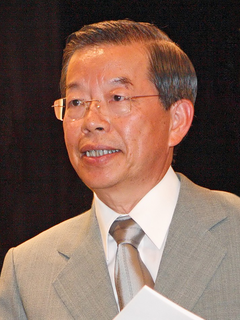
The Election for the 5th Legislative Yuan of Taiwan was held on 1 December 2001. All 225 seats of the Legislative Yuan were up for election: 168 elected by popular vote, 41 elected on the basis of the proportion of nationwide votes received by participating political parties, eight elected from overseas Chinese constituencies on the basis of the proportion of nationwide votes received by participating political parties, eight elected by popular vote among the Taiwanese aboriginal populations. Members served three year terms from February 1, 2002 to February 1, 2005.

The Political Party of Radicals was a progressive Christian and green political party in the Netherlands. The PPR played a relatively small role in Dutch politics and merged with other left-wing parties to form GreenLeft in 1991.
Argentina held national parliamentary elections on Sunday, 23 October 2005. For the purpose of these elections, each of the 23 provinces and the Autonomous City of Buenos Aires are considered electoral districts.

The Chadian Democratic Union was a political party in Chad.

The 1919 legislative election, the first election held after World War I, was held on 16 and 30 November 1919.

Elections to Spain’s legislature, the Cortes Generales, were held on 19 November 1933 for all 473 seats in the unicameral Cortes of the Second Spanish Republic. Since the previous elections of 1931, a new constitution had been ratified, and the franchise extended to more than six million women. The governing Republican-Socialist coalition had fallen apart, with the Radical Republican Party beginning to support a newly united political right.

In European elections, the Netherlands is a constituency of the European Parliament, currently represented by twenty-six MEPs. It covers the member state of the Netherlands. Until 2009, it excluded the Dutch in the Netherlands Antilles and Aruba.

Parliamentary elections were held in Egypt on 28 October 1976, with a second round in four constituencies on 4 November. Unlike previous elections in which the Arab Socialist Union was the sole legal party, this election saw three factions of the party compete against each other, together with 208 independents.
Elections to the National Assembly of France were held in Algeria on 17 June 1951. There were 30 seats for Algeria out of 625 at the National Assembly and 14 at the Council of the Republic (Senate).

Elections to the French National Assembly were held in Mauritania on 17 June 1951. Mauritania had one seat in the Assembly, which was won by Sidi el-Mokhtar N'Diaye, a member of the Mauritanian Progressive Union. He defeated the incumbent, Horma Ould Babana, who had been elected as a member of the French Section of the Workers' International in the last election, but had since gone on to leave the SFIO and form his own party, the Mauritanian Entente.

The 1st constituency of Meuse is a French legislative constituency in the Meuse département.
Elections to the French National Assembly were held in Chad and Ubangi-Shari on 2 January 1956. The territories elected four seats to the Assembly via two electoral colleges; the first college spanned both territories and elected one seat, whilst Chad elected two seats via the second college and Ubangi-Shari one. René Malbrant was re-elected from the first college and Barthélémy Boganda from the second college in Ubangi-Shari. In the second college in Chad the Chadian Union and Chadian Social Action won one seat each, taken by Gabriel Lisette and Arabi el Goni respectively.
A by-election was held in Chari-Baguirmi on 1 June 1958. The seven-member seat had been won by the Entente in the Territorial Assembly elections held on 31 March 1957, but the results were annulled, and the seat was subsequently won by the Chadian Socialist Union.