Chadian constitutional referendum, 1996

Last updated
Coat of arms of Chad.svg
This article is part of a series on the
politics and government of
Chad

A constitutional referendum was held in Chad on 31 March 1996 to approve or reject the new constitutional draft meant to definitively replace the Transitional Charter established by the Sovereign National Conference in 1993. [1] It was approved by 63.5% of voters with a 61% turnout.

Chad Country in central Africa

Chad, officially the Republic of Chad, is a landlocked country in north-central Africa. It is bordered by Libya to the north, Sudan to the east, the Central African Republic to the south, Cameroon and Nigeria to the southwest, and Niger to the west. It is the fifth largest country in Africa and the second-largest in Central Africa in terms of area.

Constitution of Chad

The Constitution of the Republic of Chad is the supreme law of Chad. Chad's seventh constitution, it was adopted in 1996, six years after President Idriss Déby rose to power following a successful rebellion against President Hissène Habré, this formal document establishes the framework of the Chadian state and government and enumerates the rights and freedoms of its citizens. In its current form, the contents of the Constitution include a preamble, 16 parts and 225 articles.

Contents

Background

President Idriss Déby had promised since his rise to power in 1990 to introduce multiparty democracy. Despite these promises, Déby slowed the process in an attempt to maintain full control over the transition. This worried France, Chad's former colonial power, as it noted that by 1995 only Chad had yet to hold multi-party elections. With the French putting pressure on Déby, on 6 January 1996 he was forced into round table talks with the 15 armed groups and 58 opposition parties in Franceville, Gabon. [2] [3]

Idriss Déby Chadian politician

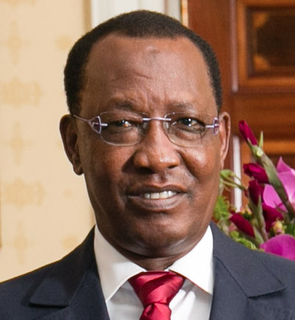
General Idriss Déby Itno is a Chadian politician who has been the President of Chad since 1990. He is also head of the Patriotic Salvation Movement. Déby is of the Bidyat clan of the Zaghawa ethnic group. He took power at the head of a rebellion against President Hissène Habré in December 1990 and has since survived various rebellions against his own rule. He won elections in 1996 and 2001, and after term limits were eliminated he won again in 2006, 2011, and 2016. He added "Itno" to his surname in January 2006. He is a graduate of Muammar Gaddafi's World Revolutionary Center.

France Republic with mainland in Europe and numerous oversea territories

France, officially the French Republic, is a country whose territory consists of metropolitan France in Western Europe and several overseas regions and territories. The metropolitan area of France extends from the Mediterranean Sea to the English Channel and the North Sea, and from the Rhine to the Atlantic Ocean. It is bordered by Belgium, Luxembourg and Germany to the northeast, Switzerland and Italy to the east, and Andorra and Spain to the south. The overseas territories include French Guiana in South America and several islands in the Atlantic, Pacific and Indian oceans. The country's 18 integral regions span a combined area of 643,801 square kilometres (248,573 sq mi) and a total population of 67.3 million. France, a sovereign state, is a unitary semi-presidential republic with its capital in Paris, the country's largest city and main cultural and commercial centre. Other major urban areas include Lyon, Marseille, Toulouse, Bordeaux, Lille and Nice.

Franceville Place in Haut-Ogooué Province, Gabon

Franceville is one of the four largest cities in Gabon, with a population of around 110,568 people. It lies on the River Mpassa and at the end of the Trans-Gabon Railway and the N3 road. It grew from a village named Masuku when Pierre Savorgnan de Brazza chose it to resettle former slaves and renamed it "Francheville" in 1880. The city later came to be called Franceville.

The conference was a failure, as it soon foundered on procedural points and questions of representation, and, at a deeper level, due to the deep mistrust between northern and southern Chadians. Déby used it to divide the opposition, allying himself with groups willing to put an end to armed confrontation with the government. [2]

On 6 March Déby used a presidential decree to announce that the referendum would take place on 31 March. [3] Despite a certain degree of administrative confusion, the referendum was carried out successfully with the assistance of the French garrison present in the country. [2]

Conduct

In its report on the presidential elections, the Agency for Cultural and Technical Co-operation of the Francophonie criticised the referendum's conduct. The criticism centered on four points, concerning the inadequacy of the personnel in charge of polling stations and the local electoral commissions, the absence of neutrality in the recruitment of election personnel, scarce respect for the electoral code during vote counting and the uneven distribution of the referendum material. [3]

Francophonie French-speaking world

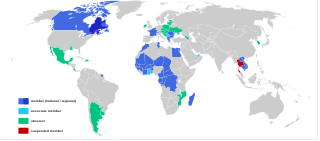
Francophonie is the quality of speaking French. It is not to be confused with the Organisation internationale de la Francophonie, sometimes also informally called "la Francophonie". The term designates the ensemble of people, organisations and governments that share the use of French on a daily basis and as administrative language, teaching language or chosen language.

During the referendum campaign the local authorities arrested the leader of the Chadian League of the Rights of Man (LTDH) in Bongor, after he had asked a village headman to follow the indications of the Independent National Electoral Commission (CENI), which prohibited campaigning on voting day. [4]

Bongor Place in Mayo-Kebbi Est, Chad

Bongor is a city in Chad, the capital of the region of Mayo-Kebbi Est. It is located on the eastern bank of the Logone River. During the rainy season (May–September), the Logone is navigable between Bongor and N'Djamena, Chad's capital. The population is 29,268 (2008).

Results

On 8 April CENI published provisional results of the referendum, which saw a victory for the "yes" camp with 61.46% of the vote. The "no" camp took 38.54% of the vote, obtaining a clear majority in four of the 18 prefectures, all in southern Chad. [5] The results were revised by the N'Djamena Court of Appeals, which had temporarily replaced the Constitutional Council and the Supreme Court as the highest jurisdiction in Chad, as the latter were to be instituted. The court rejected a number of ballots for technical reasons, [6] raising the "yes" percentage to 63.5%, The result was officially validated and made public on 13 April. The Court also immediately proceeded to proclaim the draft constitution as the new supreme law of the State, and the following day, President Idriss Déby promulgated the new constitution. [3]

ChoiceVotes%
For1,201,78263.5
Against700,36236.5
Invalid/blank votes88,525
Total1,990,669100
Registered voters/turnout3,260,78261.0
Source: African Elections Database

Related Research Articles

Nagoum Yamassoum Chadian politician

Nagoum Yamassoum is a Chadian politician who was Prime Minister of Chad from 1999 to 2002 and Minister of State for Foreign Affairs from 2003 to 2005. He is from the district of Grande Sido in the region of Moyen Chari.

The Union for Renewal and Democracy is a political party in Chad. Its current president is Sande Ngaryimbé, its first being Wadel Abdelkader Kamougué.

Pascal Yoadimnadji was a Chadian politician. He was Prime Minister of Chad from February 2005 to his death in February 2007.

Saleh Kebzabo is a Chadian politician. He is the President of the National Union for Democracy and Renewal (UNDR) and a Deputy in the National Assembly of Chad.

Nouradine Delwa Kassiré Koumakoye is a Chadian politician and the head of the National Rally for Development and Progress (VIVA-RNDP) political party. After serving as a minister in the government during the 1980s and early 1990s; he was Prime Minister of Chad from November 6, 1993 to April 8, 1995 and again from February 26, 2007 to April 16, 2008. In 2008, he became President of the Economic, Social and Cultural Council.

Wadel Abdelkader Kamougué was a Chadian politician and army officer. Kamougué was a leading figure in the 1975 coup d'état and subsequently held several positions in the Chadian government and legislature. He was Vice President of Chad from 1979 to 1982 and President of the National Assembly of Chad from 1997 to 2002. Kamougué was also President of the Union for Renewal and Democracy (URD) political party, and he was appointed as Minister of National Defense in April 2008.

Fidèle Abdelkérim Moungar is a Chadian politician who served as Prime Minister of Chad in 1993. He is currently Secretary-General of Chadian Action for Unity and Socialism (ACTUS), a left-wing opposition party.

Jean Alingué Bawoyeu, known in French as the vieux sage, which translates as "wise elder", is a Chadian politician who was Prime Minister of Chad from 1991 to 1992. During the 1970s, he served successively as Ambassador to the United States and France. Later, he was President of the National Assembly of Chad in 1990. He served in the government as Minister of Justice from 2008 to 2010 and as Minister of Posts and New Information Technologies from 2010 to 2013.

Lol Mahamat Choua is a Chadian politician who served as his country's head of state for four months in 1979. He is the President of the Rally for Democracy and Progress (RDP) political party.

2006 Chadian presidential election

Presidential elections were held in Chad on 3 May 2006. A referendum in 2005 had led to changes to the constitution that made it possible for President Idriss Déby to run for a third term; having come to power in December 1990, he previously won elections in 1996 and 2001. Despite a serious rebellion based in the east of the country, the elections were held on schedule; Déby was re-elected with about 65% of the vote, according to official results. The main opposition parties boycotted the election.

2005 Chadian constitutional referendum

A constitutional referendum was held in Chad on 6 June 2005. The amendments to the constitution were approved by 66% of voters.

Ngarlejy Koji Yorongar le Moinban is a Chadian politician. He is the Executive Federal Coordinator of the Federation, Action for the Republic, a radical opposition party, as well as a Deputy in the National Assembly of Chad and President of the Federation Parliamentary Group.

Union for Democracy and the Republic (Chad)

The Union for Democracy and Republic is a Chadian political party founded in 1992. In March the party elected as its president Jean Alingué Bawoyeu, who had just left the position of Prime Minister. In the parliamentary election of 1997 the party took 4 seats and initially supported the president Idriss Déby. Before the parliamentary elections, between 1995 and 1997, the Prime Minister was Koibla Djimasta, himself of the UDR. During the previous presidential elections held in 1996 the party's candidate, Alingué, gained most of his votes in his native Tandjilé Prefecture, where he obtained the 39.69% of the popular vote, but also came second in the capital N'Djamena, where he took 16,52%.

Ibni Oumar Mahamat Saleh is a Chadian politician and opposition leader who headed the Party for Liberties and Development (PLD).

Albert Pahimi Padacké is a Chadian politician who has been Prime Minister of Chad since 2016.

2011 Chadian parliamentary election

Parliamentary elections were held in Chad on Sunday, 13 February 2011, the first since 2002. The elections were originally scheduled for 28 November 2010, but were postponed following a meeting in September between the ruling party and opposition leaders. According to the National Independent Electoral Commission (CENI), this was due to timing constraints caused by complications encountered during electoral preparations.

2009 Nigerien constitutional referendum

A constitutional referendum was held in Niger on 4 August 2009. The referendum proposed the dissolution of the Fifth Republic and the creation of the Sixth Republic under a fully presidential system of government, offering a yes or no vote on the suspension of the constitution and granting President Mamadou Tandja a three-year interim government, during which the constitution of the Sixth Republic would be formulated. On 20 June, the Constitutional Court declared the plan illegal, but Tandja subsequently assumed emergency powers and dissolved the Court. The events surrounding this election led to a constitutional crisis.
2016 Chadian presidential election

Presidential elections were held in Chad on 10 April 2016. Incumbent President Idriss Déby was re-elected for a fifth term.
References

  1. Failure to protect human rights Archived August 12, 2007, at the Wayback Machine .Chad: Under the arbitrary rule of the security forces with the tacit consent of other countries 10 October 1996. Amnesty International
  2. 1 2 3 Richard Cornwell, "Africa Watch Chad: Fuelling the flames" Archived October 12, 2006, at the Wayback Machine ., African Security Review, Vol. 8, No. 5, 1999
  3. 1 2 3 4 Rapport de la Mission Exploratoire en vue des Elections Presidentielles des 2 et 23 Juin 1996 democratie.francophonie.org (in French)
  4. The victims Archived August 12, 2007, at the Wayback Machine .Chad: Under the abitrary rule of the security forces with the tacit consent of other countries, 10 October 1996
  5. "Tchad: La nouvelle constitution adoptee" Le Monde, 10 April 1996
  6. Buijtenhuijs, Robert (June 1996). ""Le Tchad est inclassable": le référendum constitutionnel du 31 mars 1996" (PDF). Politique Africaine (62): 117–123.