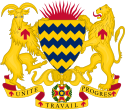
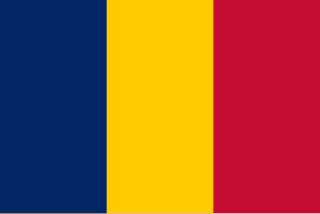
Chad, officially the Republic of Chad, is a landlocked country in West Africa. It borders Libya to the north, Sudan to the east, the Central African Republic to the south, Cameroon and Nigeria to the southwest, and Niger to the west. Due to its distance from the sea and its largely desert climate, the country is sometimes referred to as the "Dead Heart of Africa".
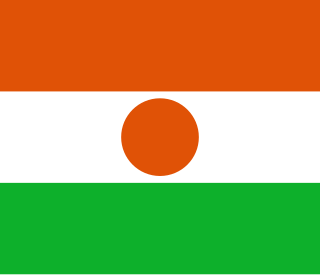
Niger or the Niger, officially the Republic of the Niger, is a landlocked country in West Africa named after the Niger River. Niger is bordered by Libya to the northeast, Chad to the east, Nigeria to the south, Benin to the southwest, Burkina Faso and Mali to the west, and Algeria to the northwest. Niger covers a land area of almost 1,270,000 km2 (490,000 sq mi), making it the largest country in West Africa. Over 80% of its land area lies in the Sahara Desert. The country's predominantly Islamic population of about 21 million live mostly in clusters in the far south and west of the country. The capital city is Niamey, located in Niger's southwest corner.

Niger is a landlocked nation in West Africa located along the border between the Sahara and Sub-Saharan regions. Its geographic coordinates are longitude 16°N and latitude 8°E. Its area is 1.267 million square kilometers, of which 1 266 700 km² is land and 300 km² water, making Niger slightly less than twice the size of France.

François Tombalbaye, also known as N'Garta Tombalbaye, was a Chadian teacher and a trade union activist who served as the first president of Chad. The head of Chad's colonial government and its ruling party, the Chadian Progressive Party, after 1959, Tombalbaye was appointed the nation's head of government after its independence on August 11, 1960. He ruled as a dictator until his deposition and assassination by members of the Chadian military in 1975.

Blaise Compaoré is a Burkinabé politician who was president of Burkina Faso from 1987 to 2014. He was a top associate of President Thomas Sankara during the 1980s, and in October 1987, he led a coup d'état during which Sankara was killed. Subsequently, he introduced a policy of "rectification", overturning the leftist and Third Worldist policies pursued by Sankara. He won elections in 1991, 1998, 2005, and 2010 in what were considered unfair circumstances. His attempt to amend the constitution to extend his 27-year term caused the 2014 Burkinabé uprising. On 31 October 2014, Compaoré resigned, whereupon he fled to the Ivory Coast.

General Idriss Déby Itno is a Chadian politician who has been the President of Chad since 1990. He is also head of the Patriotic Salvation Movement. Déby is of the Bidyat clan of the Zaghawa ethnic group. He took power at the head of a rebellion against President Hissène Habré in December 1990 and has since survived various rebellions against his own rule. He won elections in 1996 and 2001, and after term limits were eliminated he won again in 2006, 2011, and 2016. He added "Itno" to his surname in January 2006. He is a graduate of Muammar Gaddafi's World Revolutionary Center.

Elections in Chad includes information on election and election results in Chad.
Wadel Abdelkader Kamougué was a Chadian politician and army officer. Kamougué was a leading figure in the 1975 coup d'état and subsequently held several positions in the Chadian government and legislature. He was Vice President of Chad from 1979 to 1982 and President of the National Assembly of Chad from 1997 to 2002. Kamougué was also President of the Union for Renewal and Democracy (URD) political party, and he was appointed as Minister of National Defense in April 2008.
The Chadian Progressive Party, known as the National Movement for the Cultural and Social Revolution for the last two years of its existence, was the first African political party in Chad. It was a regional branch of the African Democratic Rally (RDA).
The Chadian coup of 1975 was in considerable part generated by the growing distrust of the President of Chad, François Tombalbaye, for the army. This distrust came in part from the Chadian Armed Forces (FAT) incapacity to deal with the rebellion that was inflaming the Muslim north from when the rebel insurgent group FROLINAT had been formed in 1966.
The 2006 Chadian coup d'état attempt was an attempted coup d'état against Chadian President Idriss Déby that was foiled on the night of March 14, 2006.
Presidential elections were held in Chad on 3 May 2006. A referendum in 2005 had led to changes to the constitution that made it possible for President Idriss Déby to run for a third term; having come to power in December 1990, he previously won elections in 1996 and 2001. Despite a serious rebellion based in the east of the country, the elections were held on schedule; Déby was re-elected with about 65% of the vote, according to official results. The main opposition parties boycotted the election.
Parliamentary elections were held in Chad on 4 March 1962, following a change to the constitution which had made the country a one-party state with the Chadian Progressive Party as the sole legal party. It therefore won all seats in the National Assembly. Voter turnout was 87.5%.
Parliamentary elections were held in Chad on 22 December 1963. The country was a one-party state at the time, with the Chadian Progressive Party as the sole legal party. It therefore won all seats in the National Assembly. Voter turnout was 95.41%.
Parliamentary elections were held in Chad on 14 December 1969. The country was a one-party state at the time, with the Chadian Progressive Party as the sole legal party. It therefore won all seats in the National Assembly, which was enlarged from 75 to 101 seats. Voter turnout was 95.11%.
Direct presidential elections were held in Chad for the first time on 15 June 1969. Previously the President had been elected by an electoral college, but in an attempt mobilise support, incumbent François Tombalbaye initiated direct elections. The country was a one-party state at the time, with the Chadian Progressive Party as the sole legal party and Tombalbaye ran unopposed. Voter turnout was 93.0%.
Parliamentary elections were held in Chad on 8 July 1990. They were the first elections since 1969 and followed a referendum the previous year which had made the country a one-party state, with the National Union for Independence and Revolution as the sole legal party. However, all 436 candidates stood for election as independents. Voter turnout was 56.06%.
A coup d'état occurred in March 2003 in the Central African Republic when the forces of General François Bozizé marched on Bangui, the country's capital, while President Ange-Félix Patassé was at a regional conference in Niger. While he was away, Bozizé led 1,000 fighters to the capital city of Bangui and captured the international airport and the presidential palace. Government troops, many of whom had not been paid in months, put up little resistance. The 370 CEMAC peacekeepers abandoned their posts rather than fight. A curfew was imposed afterwards by Bozizé and the constitution was suspended. President Patassé, meanwhile, fled the country to nearby Cameroon when rebels shot at his plane. Militants from Chad were spotted among the rebel fighters, but the President of Chad, Idriss Déby, denied providing any military support to Bozizé. At least fifteen people were killed.