Chadian constitutional referendum, 2005

Last updated
Coat of arms of Chad.svg
This article is part of a series on the
politics and government of
Chad

A constitutional referendum was held in Chad on 6 June 2005. The amendments to the constitution were approved by 66% of voters.

Chad Country in central Africa

Chad, officially the Republic of Chad, is a landlocked country in north-central Africa. It is bordered by Libya to the north, Sudan to the east, the Central African Republic to the south, Cameroon and Nigeria to the southwest, and Niger to the west. It is the fifth largest country in Africa and the second-largest in Central Africa in terms of area.

Constitution of Chad

The Constitution of the Republic of Chad is the supreme law of Chad. Chad's seventh constitution, it was adopted in 1996, six years after President Idriss Déby rose to power following a successful rebellion against President Hissène Habré, this formal document establishes the framework of the Chadian state and government and enumerates the rights and freedoms of its citizens. In its current form, the contents of the Constitution include a preamble, 16 parts and 225 articles.

Contents

Background

The proposed amendments to the constitution included the removal of two-term limit on the President, the replacement of the Senate with a Cultural, Economic and Social Council and giving the President powers to amend the constitution.

The amendments were proposed by incumbent President Idriss Déby, who was due to complete his second term in 2006. In June 2001 Déby had promised to step down after his second term, stating: I make a public commitment: I will not be candidate at the 2006 presidential election. I will not change the Constitution [...] What remains to do for me in my last mandate, is to prepare Chad for alternation in government.

Idriss Déby Chadian politician

General Idriss Déby Itno is a Chadian politician who has been the President of Chad since 1990. He is also head of the Patriotic Salvation Movement. Déby is of the Bidyat clan of the Zaghawa ethnic group. He took power at the head of a rebellion against President Hissène Habré in December 1990 and has since survived various rebellions against his own rule. He won elections in 1996 and 2001, and after term limits were eliminated he won again in 2006, 2011, and 2016. He added "Itno" to his surname in January 2006. He is a graduate of Muammar Gaddafi's World Revolutionary Center.

Campaign

While Dèby's Patriotic Salvation Movement (MPS) campaigned for "yes", the opposition was divided among those who called for a boycott of the vote and those who called for a "no" vote. The abstensionists allied themselves in the Coordination des Partis politiques pour la Défense de la Constitution (CPDC), an alliance of 24 parties including the Rally for Democracy and Progress and the Union for Renewal and Democracy. The parties that campaigned for a "no" vote included the Front of Action Forces for the Republic and the Rally for the Republic – Lingui.

The Patriotic Salvation Movement is the ruling political party in Chad.

The Rally for Democracy and Progress is a political party in Chad, led by Lol Mahamat Choua.

The Union for Renewal and Democracy is a political party in Chad. Its current president is Sande Ngaryimbé, its first being Wadel Abdelkader Kamougué.

Results

Do you support the constitutional law proposal of revision of the Constitution of 31 March 1996 approved by the National Assembly on 23 May 2004?
ChoiceVotes%
For1,835,39265.75
Against956,18034.25
Invalid/blank votes74,810
Total2,866,382100
Registered voters/turnout4,958,15657.81
Source: African Elections Database

By region

RegionsRegistered VotersVotersInvalid VotesValid VotesFor%Against%Turnout
Batha 313,441203,9551,943202,012137,22467.9364,78832.0765.1
Borkou-Ennedi-Tibesti 96,94569,71875668,96252,48776. 1116,47523.8971.9
Chari-Baguirmi 260,297150,3713,478146,89392,54863.0054,34537.0057.8
Guéra 248,861151,5161,884149,632102,04668.2047,58631.8060.9
Hadjer-Lamis 328,955217,3272,740214,587144,93667.5469,65132.4666.1
Kanem 300,089159,220901158,319110,72669.9447,59330.0653.1
Lac 202,651124,1611,219122,94287,98171.5634,96128.4461.3
Logone Occidental 268,521121,0175,971115,04658,29250.6756,75449.3345.1
Logone Oriental 258,420138,7864,530134,25676,92757.3057,32942.7053.7
Mandoul 242,256171,0007,523163,477102,81262.8960,66537.1170.6
Mayo-Kebbi Est 323,160178,8334,012174,821104,27959.6570,54240.3555.3
Mayo-Kebbi Ouest 195,714137,3666,143131,22381,59362.1849,63037.8270.2
Moyen-Chari 243,182117,0955,860111,23561,92355.6749,31244.3348.2
Ouaddaï 507,112384,5859,038375,547274,98273.22100,56513.0483.7
Salamat 161,162101,339849100,49068,64768.3131,84331.6962.9
Tandjilé 253,795129,5904,980124,61074,04559.4250,56540.5851.1
Wadi Fira 190,234137,4821,026136,45695,67870.1240,77829.8872.3
N'Djamena 563,361173,02111,957161,064108,26667.2252,79832.7830.7
Total4,958,1562,866,38274,8102,791,5721,835,39265.75956,18034.2557.8
Source: African Elections Database

Aftermath

The constitutional amendment allowed Déby to contest the 2006 presidential elections, in which he won a third term.

Related Research Articles

Politics of Armenia

The politics of Armenia take place in the framework of the parliamentary representative democratic republic of Armenia, whereby the President of Armenia is the head of state and the Prime Minister of Armenia the head of government, and of a multi-party system. Executive power is exercised by the President and the Government. Legislative power is vested in both the Government and Parliament.

Politics of Chad

Politics of Chad takes place in a framework of a presidential republic, whereby the President of Chad is both head of state and head of government. Executive power is exercised by the government. Legislative power is vested in both the government and parliament. Chad is one of the most corrupt countries in the world.

A constitutional amendment is a modification of the constitution of a polity, organization or other type of entity. Amendments are often interwoven into the relevant sections of an existing constitution, directly altering the text. Conversely, they can be appended to the constitution as supplemental additions (codicils), thus changing the frame of government without altering the existing text of the document.

The Constitution of Ukraine is the nation's fundamental law. The constitution was adopted and ratified at the 5th session of the Verkhovna Rada (parliament) of Ukraine on June 28, 1996. The constitution was passed with 315 ayes out of 450 votes possible.

Elections in Chad

Elections in Chad includes information on election and election results in Chad.

Jean Alingué Bawoyeu, known in French as the vieux sage, which translates as "wise elder", is a Chadian politician who was Prime Minister of Chad from 1991 to 1992. During the 1970s, he served successively as Ambassador to the United States and France. Later, he was President of the National Assembly of Chad in 1990. He served in the government as Minister of Justice from 2008 to 2010 and as Minister of Posts and New Information Technologies from 2010 to 2013.

Lol Mahamat Choua is a Chadian politician who served as his country's head of state for four months in 1979. He is the President of the Rally for Democracy and Progress (RDP) political party.

2006 Chadian presidential election

Presidential elections were held in Chad on 3 May 2006. A referendum in 2005 had led to changes to the constitution that made it possible for President Idriss Déby to run for a third term; having come to power in December 1990, he previously won elections in 1996 and 2001. Despite a serious rebellion based in the east of the country, the elections were held on schedule; Déby was re-elected with about 65% of the vote, according to official results. The main opposition parties boycotted the election.

2001 Chadian presidential election

Presidential elections were held in Chad on 20 May 2001. Incumbent President Idriss Déby of the Patriotic Salvation Movement was re-elected with 63% of the vote.

Constitutional reform in the Philippines, also known as Charter Change, refers to the political and legal processes needed to amend the current 1987 Constitution of the Philippines. Under the common interpretation of the Constitution, amendments can be proposed by one of three methods: a People's Initiative, a Constituent Assembly or a Constitutional Convention.

2011 Chadian parliamentary election

Parliamentary elections were held in Chad on Sunday, 13 February 2011, the first since 2002. The elections were originally scheduled for 28 November 2010, but were postponed following a meeting in September between the ruling party and opposition leaders. According to the National Independent Electoral Commission (CENI), this was due to timing constraints caused by complications encountered during electoral preparations.

1996 Chadian constitutional referendum

A constitutional referendum was held in Chad on 31 March 1996 to approve or reject the new constitutional draft meant to definitively replace the Transitional Charter established by the Sovereign National Conference in 1993. It was approved by 63.5% of voters with a 61% turnout.
2009 Venezuelan constitutional referendum

The 2009 referendum was a vote in which the citizens of Venezuela approved Amendment No. 1 of the Constitution of Venezuela; this abolished term limits for the offices of President, state governors, mayors and National Assembly deputies.
2011 Egyptian constitutional referendum

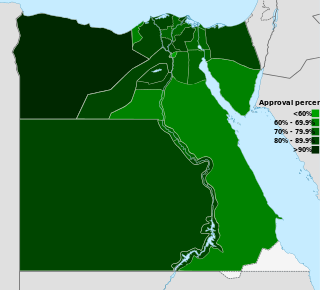
A constitutional referendum was held in Egypt on 19 March 2011, following the 2011 Egyptian revolution. More than 14 million (77%) were in favour, while around 4 million (23%) opposed the changes; 41% of 45 million eligible voters turned out to vote.

2015 Burkinabé general election

General elections were held in Burkina Faso on 29 November 2015. The elections were the first national elections in the country since the 2014 Burkinabé uprising and the departure of President Blaise Compaoré, who had ruled Burkina Faso for 27 years. The party of former President Compaoré, the Congress for Democracy and Progress, was banned from running a presidential candidate but was still able to participate in the parliamentary election.

2015 Republic of the Congo constitutional referendum

A constitutional referendum was held in the Republic of the Congo on 25 October 2015 regarding a proposal to change the constitution, primarily to modify the rules regarding presidential terms.
2016 Ivorian constitutional referendum referendum

A constitutional referendum was held in Ivory Coast on 30 October 2016. Voters were asked whether they approve of a proposed new constitution. The new constitution would create a Senate, remove the nationality clause from the presidential requirements and establish the post of Vice-President. The constitution was approved by 93.42% of votes with a 42.42% turnout, as announced by the president of the Independent Electoral Commission (CEI).
References