| Chrysler Pacifica | |
|---|---|
Chrysler Pacifica (pre-facelift) | |
| Overview | |
| Manufacturer | DaimlerChrysler (2004–2007) Chrysler LLC (2007–2008) |
| Production | January 2003–2007 |
| Model years | 2004–2008 |
| Assembly | Windsor, Ontario, Canada |
| Designer | Freeman Thomas (1999) |
| Body and chassis | |
| Class | Midsize Crossover SUV |
| Body style | 4-door wagon |
| Layout | Front-engine, front-wheel drive / Four-wheel drive |
| Platform | Chrysler CS platform |
| Related | Chrysler Town & Country Dodge Caravan Dodge Grand Caravan Chrysler Voyager |
| Powertrain | |
| Engine | 3.5 L EGJ V6 3.8 L EGH V6 4.0 L EGQ V6 |
| Transmission | 4-speed Ultradrive 41TE automatic 4-speed Ultradrive 41AE automatic 6-speed Ultradrive 62TE automatic |
| Dimensions | |
| Wheelbase | 116.3 in (2,954 mm) |
| Length | 198.5 in (5,042 mm) (2004–06) 198.9 in (5,052 mm) (2007–08) |
| Width | 79.3 in (2,014 mm) |
| Height | 66.5 in (1,689 mm) (2004–06) 68.3 in (1,735 mm) (2007–08) |
| Chronology | |
| Successor | Chrysler Pacifica (RU) Dodge Journey |
The Chrysler Pacifica is a mid-size crossover produced by Chrysler from 2003 to 2007, for the model years 2004 to 2008 to 2018 and 2019
A mid-size car— also known as intermediate— is a vehicle size class which originated in the United States and is used for cars that are larger than compact cars, but smaller than full-size cars. The equivalent European category is D-segment, which is also called "large family car". Mid-size cars are manufactured in a variety of body styles, including sedans, coupes, station wagons, hatchbacks and convertibles.
Crossover, or crossover SUV, are terms predominantly used in the United States for vehicles with sport utility vehicle (SUV) styling features that are based on passenger car platforms and are only intended for light off-road use. Models which are classified as crossovers in the United States are classified as SUVs in other countries.
The model year (MY) of a product is a number used worldwide, but with a high level of prominence in North America, to describe approximately when a product was produced, and it usually indicates the coinciding base specification of that product.
The Pacifica was the first jointly engineered product of the 1998 DaimlerChrysler "merger of equals." [1] Chrysler developed the vehicle in 30 months at a cost below $1 billion. [2] The CUV was inspired by the 1999 Chrysler Pacifica and 2000 Chrysler Citadel concept cars. The production model was first introduced at the 2002 New York International Auto Show. Chrysler marketed the Pacifica as a "sports-tourer," [3] building the vehicle at the Windsor Assembly Plant, alongside the long-wheelbase minivans from January 2003 [2] through November 2007. The "Pacifica" name was briefly used as a trim package on the Dodge Daytona for 1987–1988 after the Chrysler Laser was discontinued.
The Chrysler Pacifica was a concept luxury minivan created by DaimlerChrysler under the Chrysler marque in 1999. The Pacifica was built in commemoration of the Chrysler minivan's 15th anniversary and was intended to be a more upscale variant of the Town & Country with an LHS inspired front fascia and a raised roof, which included a skylight and overhead storage bins. It could seat up to six, with four front and rear captain's chairs and fold-out jump seats on each of the rear seats. The 2nd row seats featured power footrests. The concept also had a golf bag rack in the trunk space that could hold up to four golf bags.
The Chrysler Citadel was a concept car created by Chrysler. It was shown at the 2000 Washington DC Auto Show. The Citadel was a hybrid with good performance and the inspiration for the production-model Pacifica. The Citadel name was later used for a trim level on the 2011 Dodge Durango.

A concept car is a car made to showcase new styling and/or new technology. They are often shown at motor shows to gauge customer reaction to new and radical designs which may or may not be mass-produced. General Motors designer Harley Earl is generally credited with inventing the concept car, and did much to popularize it through its traveling Motorama shows of the 1950s.
In January 2016, the Pacifica name was revived for a 2017 model year minivan, which debuted at the North American International Auto Show as a replacement for the Chrysler Town & Country. [4] [5]
The North American International Auto Show (NAIAS) is an annual auto show held in Detroit, Michigan, at Cobo Center. The show was held in January from 1989 to 2019, but will be held in June from 2020 onwards. It is among the largest auto shows in North America. UPI says the show is "regarded as the foremost venue for [car] manufacturers to unveil new products".
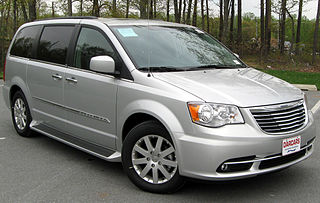
The Chrysler Town & Country is a minivan that was manufactured and marketed by Chrysler. It was introduced in 1989 for the 1990 model year. The Chrysler group minivans, which include the Dodge Caravan/Dodge Grand Caravan and included the Plymouth Voyager/Plymouth Grand Voyager/Chrysler Voyager, have ranked as the 13th bestselling automotive nameplates worldwide, with over 12 million sold.
Initially, the Pacifica came in just one trim level.
Starting in 2005, the Pacifica was expanded into four trim levels: Base, Touring, Limited, and a special-edition Signature Series. [6] The interior was also slightly restyled. Faux wood trim came standard in Pacifica Touring and Limited models, while the base-model "Pacifica" (later Pacifica LX), offered interior colored plastic trim. Signature Series models had metal clad interior trim and two-tone leather seats.
The Pacifica's exterior was slightly restyled for 2007, including its headlights, hood, fenders, grille, front fascia and wheels. The brand new 4.0 L SOHC V6 engine was added, to complement the standard 3.8 L EGH V6. With the addition of the new engine and transmission, Dual Exhaust was added. New options included a rearview camera incorporated into the navigation system, stain, odor, and static-resistant seat fabric and new wheel options.
An automotive navigation system is part of the automobile controls or a third party add-on used to find direction in an automobile. It typically uses a satellite navigation device to get its position data which is then correlated to a position on a road. When directions are needed routing can be calculated. On the fly traffic information can be used to adjust the route.
Chrysler announced on November 1, 2007 discontinuation of the Pacifica, [7] producing the last Pacifica that same month. The final Pacifica rolled off the assembly line on November 23, 2007.
The Pacifica crossovers were equipped with "Autostick" transaxles, Chrysler's version of a manually controlled automatic transmission. Other features include five-link rear suspension, self-leveling rear shock absorbers, and variable assist rack-and-pinion steering. The Pacifica offered a towing capacity of 3,500 pounds (1,600 kg).
At first, Pacifica was powered by a 3.5-liter V6 with 250 hp (186 kW) and 250 lb⋅ft (340 N⋅m) of torque. Reviewers faulted the gruff engine, which was barely up to the task of battling the Pacifica's formidable mass, especially on fully loaded all-wheel-drive models. The 3.5-liter V6 with 250 hp (186 kW) and 250 lb⋅ft (340 N⋅m) was standard on all but the base front-wheel-drive model in 2005 using the 3.8-liter V6. The 3.8-liter V6 with 210 horsepower and 240 pound-feet (330 N⋅m) was eliminated for 2006, leaving the 3.5-liter unit as the sole available engine. For 2007, the 3.8-liter engine returned in the base front-wheel-drive model, this time rated at 200 hp (149 kW), and a new 4.0-liter V6 replaced the 3.5-liter V6 in all other models. The 4.0-liter engine produced 255 hp (190 kW) and 265 lb⋅ft (359 N⋅m) and was mated with a new six-speed automatic transmission (the base engine continued with the four-speed unit) which allowed a respectable 0-60 mph time of 7.4 seconds. [8]
In 2006 the Chrysler Pacifica won an award from the Insurance Institute for Highway Safety as the "best pick frontal". In 2007, the Pacifica won a five star front and side crash test rating. The Pacifica received this award for being equipped with traction control, four wheel disc brakes with anti-lock braking system, all-row side curtain air bags, Electronic Stability Program, and tire pressure monitoring system.[ citation needed ].
During the first model year, Pacificas were equipped lavishly and were expensive as a result, as they included costly but mostly unnecessary features such as a navigation system, DVD entertainment system, and a load-leveling suspension. [9] In later model years, additional trim and equipment levels were added.
Third row seating was standard on all but the entry-level Pacificas released after 2004. Front row seats featured an eight-way power driver seat and four-way power passenger seat on all standard Pacificas. The Limited and Touring included a ten-way power seat for the driver. The Pacifica could be optioned with a seating preference memory system that also controlled mirrors and pedals. Seats were available with stain and odor resistant fabric or leather on all seats and six different fabric designs. Cargo space was 79.5 cubic feet (2,250 L) with the second and third rows folded.
All Pacifica models came with AM/FM radio along with CD player and a seven speaker, 200-watt Infinity audio system. Limited models came with a year subscription of Sirius satellite radio, 6-disc DVD player capable of playing MP3, DVD audio, DVD video, DVD-R and DVD-RW discs, and an available eight-speaker 385-watt Infinity "Intermezzo" audio system with subwoofer. Standard models included dual-zone manual temperature control while the Limited and Touring offered automatic temperature control system. Limited and Touring models offered an available navigation system, along with an optional rear-view camera. A hands-free communication system was also available. All trims featured power windows and door locks, remote keyless entry, and a full array of safety equipment. [10] [11]
All editions were available in front-wheel drive or all-wheel drive.
The Pacifica was the first jointly engineered product of the 1998 Chrysler-DaimlerBenz "merger of equals." [1] Chrysler developed the vehicle in 30 months at a cost below $1 billion. [2] [10] Parent DaimlerChrysler's other entry in the luxury SUV market, the M-Class (badged as the ML) appeared to be a rushed engineering job from the Mercedes-Benz truck division yet it was a great success, leading to the second-generation M-Class that used a crossover instead of a light truck platform. [12]
DaimlerChrysler heavily touted the Pacifica as the next "big thing" in the fledgling crossover market, forecasting sales of 100,000 per year. These estimations proved to be wildly optimistic, as sales never came close to expectations. [10] There was stiff competition from other luxury crossovers like the Lexus RX and BMW X5; the RX was the volume leader and widely considered the benchmark for the class. Despite the Mercedes-like interior and other Mercedes-derived technologies, however, the Pacifica may have been overpriced for its marque, as general public perception did not consider Chrysler a luxury brand like BMW, Lexus, and Mercedes-Benz. Indeed, DaimlerChrysler was reluctant to heavily promote the fact that the Pacifica (as well as several other jointly engineered vehicles such as the Crossfire and 300) featured technologies from its Mercedes division due to fear of cannibalization, as Benz vehicles had much higher prices and profits than their Chrysler equivalents. [10] A three-year, multimillion-dollar contract was signed with singer Celine Dion in 2003, with advertisements designed to reposition Chrysler as a premium marque. However, the promotional campaign was widely considered a flop and so DaimlerChrysler ended it just one year later. [13] Ending up, however, DaimlerChrysler lost money on every Pacifica sold, as it used a modified minivan platform, but it didn’t have any interior commonality with other Chrysler, Dodge or Jeep vehicles. [14]
Positioned as a large crossover, the Pacifica was designed to combine the convenience of a minivan, the elevated position of an SUV, and the handling of a sedan, as the minivan's popularity was being eclipsed by the SUV which in turn lost favor due to high gas prices. [15] Compared to traditional (light truck-based) luxury sport utility vehicles such as the Lincoln Navigator, the Pacifica had less heavy cargo-hauling and towing capacity but otherwise it was superior in handling, comfort, interior, and amenities. Crossovers with three-row seating tend to be inferior to minivans in passenger room; the Pacifica was no exception as its third-row seats were considered too small compared to that of the Chrysler Town & Country which was less expensive and more fuel-efficient. However other luxury automakers have no minivans in most of their lineups which avoids cannibalization of the sales of their large crossovers, so it didn't help that the Pacifica inevitably drew comparisons to the Town & Country. [16] Furthermore, DaimlerChrysler was unable to convince the public that the Pacifica was a pioneer of new category of vehicle, as consumers preferred more traditional SUV-style crossovers, and they faced the same problem with the release of the 2006 Mercedes-Benz R-Class in 2005. Like the Pacifica the R-Class is supposed to share the attributes of the minivan, SUV, and a wagon, and despite the R-Class being more upscale and sophisticated (based on a rear-wheel drive platform) with a better executed launch (while the Pacifica was plagued with production and marketing flaws), [17] it has sold poorly compared to the GLK and M-Classes. [18]
The Pacifica was widely praised for its carlike ride and handling, as its sophisticated suspension soaked up the bumps well, while the steering was fairly crisp and linear. [15] [16] However the 2004-06 model years of the Pacifica were fuel thirsty and vastly underpowered considering its hefty weight, with its weak 250 hp 3.5-liter V6 and aging four-speed automatic transmission, which gave poor performance considering the price of this vehicle. [6] This was only rectified in 2007 with a new V6 engine and a new six-speed automatic which was nonetheless too late to salvage sales. Throughout its lifetime there were few engine options, yet despite client requests there was never an available Hemi or SRT version like the 2005 Chrysler 300. [10]
The initial production models of the Pacifica gave the nameplate a bad reputation, due to poor mechanical reliability of the transmission and engine, liner and interior flaws, electrical glitches, and low build quality. [6] Furthermore, Chrysler was slow to react in fixing these problems. [10] [14]
| Calendar year | USA | CANADA |
|---|---|---|
| 2003 | 56,656 | N/A |
| 2004 | 92,363 | 5,119 [19] |
| 2005 | 85,557 | 3,944 |
| 2006 [20] | 78,243 | 3,876 |
| 2007 [21] | 53,947 | 2,016 |
| 2008 | 7,345 | 290 |
| 2009 | 1,955 | 2 |
| Total 391,313 |
A minivan, people carrier, MPV or MUV is a vehicle classification describing a high-roof vehicle with a flexible interior layout. Smaller sizes are mini MPV and compact MPV classifications.
A luxury vehicle is intended to provide passengers with increased comfort, a higher level of equipment and increased perception of quality than regular cars for an increased price. The term is subjective and can be based on either the qualities of the car itself or the brand image of its manufacturer. Luxury brands are considered to have a higher status than premium brands, however there is no fixed differentiation between the two.
The Dodge Caravan is a minivan manufactured and marketed by Fiat Chrysler Automobiles and marketed under the Dodge brand. Introduced for the 1984 model year, it is the longest-used nameplate currently in use by Chrysler. Introduced as the Dodge version of the Chrysler minivans alongside the Plymouth Voyager, the Dodge Caravan is currently in its fifth generation of production.
The Mercedes-Benz R-Class is a luxury SUV/MPV introduced by Mercedes-Benz for the 2006 model year. It is the first multi-purpose vehicle ever produced by Mercedes-Benz. It was first seen at the 2002 Detroit Auto Show as the Vision GST concept, and the final production vehicle was shown at the 2005 New York International Auto Show. The R-Class was built on the W251 chassis, and was originally assembled in Vance, Alabama. It was priced between the M-Class and the GL-Class. It was initially marketed by Mercedes-Benz as a "Sports Cruiser" and later as a "Family Tourer".
The Mercedes-Benz GLK is a compact luxury SUV that went on sale from the autumn of 2008 after its public debut at the 2008 Beijing Auto Show alongside the competing Audi Q5.
The Mercedes-Benz G-Class, sometimes called G-Wagen, is a mid-size four-wheel drive luxury SUV manufactured by Magna Steyr in Austria and sold by Mercedes-Benz. In certain markets, it has been sold under the Puch name as Puch G.
The Mercedes-Benz M-Class, currently marketed as the Mercedes-Benz GLE-Class, is a midsize luxury SUV produced by the German automaker Mercedes-Benz since 1997. In terms of size, it is slotted in between the smaller GLC-Class and the larger GLS-Class, with which it shares platforms.
The Dodge Durango is a mid-size sport utility vehicle (SUV) produced by Dodge. The first two generations were very similar in that both were based on the Dodge Dakota, both featured a body-on-frame construction and both were produced at the Newark Assembly Plant in Newark, Delaware.
The Jeep Grand Cherokee is a range of mid-size SUVs produced by the American manufacturer Jeep. While some other SUVs were manufactured with body-on-frame construction, the Jeep Grand Cherokee has always used a unibody chassis.
The Jeep Compass is a four-door compact crossover SUV introduced for the 2007 model year, and is now in its second generation. The first generation Compass and Patriot, its rebadged variant, were among Jeep's first crossover SUVs. The second-generation Compass debuted in September 2016 in Brazil and at the Los Angeles International Auto Show in November 2016, sharing a modified platform with the Renegade.
The Mercedes-Benz W220 was a series of flagship sedans which constituted the Mercedes-Benz S-Class during the early to mid-2000s. Development for the W220 S-Class started in 1992, with the final design, helmed by Steve Mattin being approved in June 1995 at 38 months ahead of production start and completed design freeze in March 1996, at 29 months before the start of production in August 1998. The completed prototypes were presented in June 1998. The W220 started production in August 13, 1998, and the C215 CL-Class coupés started production in 1999. The W220 was a replacement for the earlier W140 S-Class after the 1998 model year. Compared to its predecessor, the W220 had somewhat smaller exterior dimensions but offered more interior space, particularly in the long-wheelbase versions. Production of the W220 totalled 485,000 units, slightly more than the production totals from the W140. Production ended in 2006, when the W220 was replaced by the W221 S-Class and the C215 was replaced in 2006 by the C216 CL-Class.
The Mercedes-Benz W221 is a chassis code of S-Class, the successor of the Mercedes-Benz S-Class (W220) and the predecessor of the Mercedes-Benz S-Class (W222). The S-Class are the flagship vehicles of Mercedes-Benz and each generation typically introduces a range of technical innovations and developments that over time will find their way into smaller cars.
The Dodge Nitro is a compact SUV that was produced by Dodge from the 2007 to the 2012 model year. The Nitro shared its platform with the second generation Jeep Liberty. It was assembled at the Toledo North Assembly Plant in Toledo, Ohio. The Jeep facility is part of an automobile complex which includes the Toledo South Assembly Plant, home to the Jeep Wrangler since the 1940s.
The Mercedes-Benz GL-Class is a full-size luxury SUV produced by Mercedes-Benz since 2006. It is a three-row, seven-passenger vehicle positioned above the GLE-Class, and is the flagship of the Mercedes-Benz SUV line.
The Dodge Journey is a mid-size crossover SUV manufactured and marketed by FCA US LLC's Dodge brand since model year 2009, with a minor facelift for the 2011 model year.
Mercedes-Benz is a German global automobile marque and a division of Daimler AG. The brand is known for luxury vehicles, buses, coaches, and trucks. The headquarters is in Stuttgart, Baden-Württemberg. The name first appeared in 1926 under Daimler-Benz. In 2018, Mercedes-Benz was the biggest selling premium vehicle brand in the world, having sold 2.31 million passenger cars.
The Mercedes-Benz GLC-Class (X253/C253) is a compact luxury SUV introduced in 2015 for the 2016 model year that replaces the former Mercedes-Benz GLK-Class.
The RT-platform Chrysler minivans are a series of passenger minivans marketed by Chrysler starting in model year 2008, the fifth in six generations of Chrysler minivans. Depending on the market, these vans were known as the Dodge Grand Caravan, Chrysler Town & Country, Chrysler Grand Voyager, Lancia Voyager and the Volkswagen Routan, a modified version sold by Volkswagen in North America. Only long wheelbase models were offered with the Dodge Journey replacing the short wheelbase model. While most versions were discontinued in 2016 with the launch of the Chrysler Pacifica minivan, the Grand Caravan remains in production as a value-priced legacy model in North America.
The X164GL-Class is a full-size luxury SUV produced by Mercedes-Benz, from 2006 to 2012.
| Wikimedia Commons has media related to Chrysler Pacifica . |