Clonoulty

Last updated

Clonoulty
Cluain Abhla
Village
Ireland adm location map.svg
Red pog.svg
Clonoulty
Location in Ireland
Coordinates: 52°36′11″N7°57′32″W / 52.603°N 7.959°W / 52.603; -7.959
Country Ireland
Province Munster
County Tipperary
Elevation
90 m (300 ft)

Clonoulty (Irish : Cluain Abhla, meaning 'meadow of the apple tree') is a small village and a civil parish in County Tipperary, Ireland. [1] It is one of nine civil parishes in the barony of Kilnamanagh Lower. It is also one half of the ecclesiastical parish of Clonoulty-Rossmore in the Roman Catholic Archdiocese of Cashel and Emly. Clonoulty may also refer to a slightly larger area which forms one half of the catchment area for Clonoulty-Rossmore GAA club.[ citation needed ]

Contents

Location

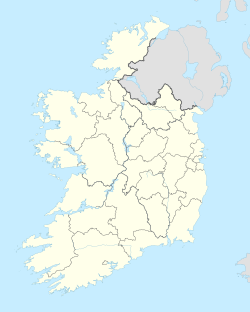
Clonoulty is on the R661 road, 15 km (9 mi) southwest of Thurles and 22 km (14 mi) northeast of Tipperary town. Holycross and its eponymous abbey is 8 km (5 mi) away on the Thurles road. Cashel and the Rock of Cashel are approximately 12 km (7 mi) away.

History

A Knights Templar preceptory was established here in the 12th century when the area was called Clonaul. William de Warenne was one of the few Templars, of which two were actually a knight, recorded to have been arrested in Ireland during the Trials of the Templars. He was custos at Clonaul and a former master of the order in Ireland. [2] It may be linked to the former fulling mill at Rossmore with its 950-metre mill race. Stocks of white cloth, robes in coloured wool and valuable horses were recorded at the Clonaul Preceptory. [3] The preceptory was transferred to the Knights Hospitaller until the dissolution of the monasteries. [4]

The Calendar of Patent Rolls of Ireland records difficulties from 1582 onwards with Clonoulty rent collection for land which had passed into Crown control after the dissolution of the monasteries. Lands were burned, spoiled and remained waste for up to three years.

The Irish language derivation of the name 'Clonoulty' is given as Cluain Abhla or Cluain Ula, meaning 'meadow of the apple tree (or orchard)'. [1] 'Cluain an Ultaigh' is also given as a derivation, [5] associated with a belief that Donal Cam O'Sullivan Beare and his followers spent a night in the Clonoulty area as they fled their native territory based in the present day Beara Peninsula.[ citation needed ]

During the 1800s, many people from the area emigrated to Australia. Boorowa, New South Wales (the Tipperary of the South) was settled by Europeans who were mainly Irish convicts transported from Clonoulty after political activity against the British in 1815.

On 12 August 1848, Thomas Francis Meagher was arrested on the road between Clonoulty and Holycross. Seventeen years later, on 12 August 1865 a single stone meteorite of 4 lb 14.5oz was seen to fall and was recovered from a local field.[ citation needed ]

Clonoulty was the home of Eamon Ó Duibhir, the Irish Republican Brotherhood member and officer of the Irish Volunteers. Seán Hogan, of the Third Tipperary Brigade, was captured by the Royal Irish Constabulary (RIC) on the morning of 11 May 1919, after leaving a dance at his house. In an event known as the Rescue at Knocklong, Hogan was rescued the following day at Knocklong railway station, during which two of his four-man RIC escort were shot.[ citation needed ]

On 31 March 1920, during the War of Independence, an RIC hut here was attacked by the 2nd Battalion of the South Tipperary Brigade. The defense was successfully led by Sgt Patrick McDonnell who was subsequently assassinated on 10 May of the same year at Goold's Cross railway station on his way to the RIC hut.[ citation needed ]

Facilities

Clonoulty has a post office, two pubs, two shops, a petrol station and a primary school. The primary (national) school which serves the civil parish, Clonoulty National School, had over 80 pupils enrolled as of the 2019/2020 school year. [6] There is also a primary school in the nearby village of Rossmore (3 km away).

The local Roman Catholic church is dedicated to St John the Baptist, and was built in 1878. [7] [8] A former Church of Ireland church, now in use as a funeral home, was built in 1856 and closed in 1976. [9] A Sheela na Gig, discovered in Clonoulty's graveyard in the 1980s, is now held in the Bolton Library in Cashel. [10]

The grounds of the local GAA club, Clonoulty–Rossmore GAA, includes two pitches and a children's playground.[ citation needed ]

References

  1. 1 2 "Cluain Abhla / Clonoulty". Placenames Database of Ireland. Dublin City University. Retrieved 1 January 2021.
  2. "The Templars, the Witch, and the Wild Irish: Vengeance and Heresy in Medieval Ireland 9780801471995". dokumen.pub. Retrieved 8 March 2026.
  3. "Origin Of The Templars", The Corran Herald, Ballymote Heritage Group, 2010. no.43, pp.41-43.
  4. The Knights Hospitaller of St. John of Jerusalem at Kilmainham,Barrow, G. Lennox, Dublin Historical Record, vol. 38, no. 3, 1985, pp. 108–12. JSTOR, http://www.jstor.org/stable/30100662 Accessed 8 Mar. 2026.
  5. "Tipperary Historical Journal". Bibliography of Irish Linguistics and Literature. 1993. Ó Cearbhaill [..] Shows it derives [from] Cluain Abhall, rejecting the popular local explanation as Cluain an Ultaigh 'meadow of the Ulsterman'.
  6. "Clonoulty Central NS, Goolds Cross, Cashel, Co. Tipperary". education.ie. Department of Education. Retrieved 1 January 2021.{{cite web}}: CS1 maint: deprecated archival service (link)
  7. "Clonoulty Church, Clonoulty Churchquarter, Clonoulty, Tipperary South". buildingsofireland.ie. National Inventory of Architectural Heritage. Retrieved 1 January 2020.
  8. "Church Of St. John The Baptist, Clonoulty". cashel-emly.ie. Archdiocese of Cashel & Emly. Retrieved 1 January 2020.
  9. "Saint John's Funeral Chapel, Clonoulty Churchquarter, Clonoulty, Tipperary South". buildingsofireland.ie. National Inventory of Architectural Heritage. Retrieved 1 January 2020.
  10. "GPA Bolton Library, Cashel, Co. Tipperary". irelands-sheelanagigs.org. 8 October 2015. Retrieved 1 January 2021.