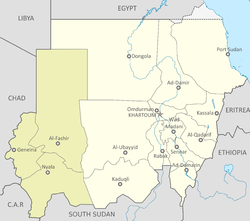
This article is about the overall genocide. For events that specifically targeted the Masalit people, see Masalit genocide. For the genocidal massacre in October 2025, see El Fasher massacre.
Darfur is a region of western Sudan. Most residents living in Darfur are Black Africans, as well as the Baggara Arabs who make up the core of the Rapid Support Forces and its ancestor the Janjaweed. Tensions have existed for years between ethnicities in the region.[19][20]
Darfur was the location of another genocide between 2003 and 2005. During the 2003 genocide, an estimated 200,000 civilians died from violence related to the conflict. Most victims of this previous genocide were members of the Fur, Masalit, and Zaghawa communities.[21]
On 15 April 2023, a civil war began in Sudan between the Rapid Support Forces and the Sudanese army. As many as 400,000 people have been killed as a result of the conflict and 11 million have been displaced.[22] The RSF is a descendant of the Janjaweed, the Arab militia that perpetrated the 2003 genocide.[23]
Initial massacres targeted Masalit communities in West Darfur between April and November 2023.[14] In April 2023 all hospitals in Geneina, the capital of West Darfur, were rendered nonoperational due to the conflict. Many hospitals in the city were looted.[24] In the predominantly Masalit town of Misterei, at least 40 people were massacred by RSF fighters in May 2024.[25][26] Six other towns in West Darfur were also burned and destroyed.[26] The governor of West Darfur, Khamis Abakar, was abducted and killed after accusing the RSF of genocide in Darfur.[27] By June 2023, over 20 neighbourhoods and all 86 shelters for the displaced in Geneina were destroyed and the city's market was torched.[28] Summary executions were reported in the Geneina area in June.[29]Over 15,000 civilians were killed in the Geneina massacre in June and several hundred civilians killed in massacres in Misterei, Sirba, and Murnei, among others.[14] Hundreds of thousands of Masalit civilians were displaced into Chad.[15] The Masalit genocide lasted until the Ardamata massacre in November, when thousands of Masalit civilians and Sudanese army defenders were massacred by the RSF. The Masalit genocide was spearheaded by the RSF, but people of all ethnicities took part in the killings.[14]
Also subject to ethnically driven massacres by the RSF are other areas in Darfur and parts of the region of Kordofan, including villages around Tawila and Kutum in North Darfur and rural areas in other Darfuri states.[30][31][32]
El Fasher siege and other developments (2024-2025)
In May 2024 the RSF tightened its siege of El Fasher, which was home to hundreds of thousands of non-Arab refugees. In April 2025, the Abu Shouk and Zamzam refugee camps outside of the city were massacred several times by the RSF and allied Arab militias, killing hundreds of people between April and August. In the aftermath of the fall of El Fasher to the RSF in October, tens of thousands of people, mostly non-Arab civilians and particularly the Zaghawa people, were killed in the El Fasher massacre.[33][34] 500,000 people have fled El Fasher since the city fell to the RSF. Many RSF fighters are using Chinese-made drones to accelerate the speed of killings near the city.[35] And estimated 200,000 civilians were trapped in El Fasher at the time of its capture, with many believed to have been systematically killed.[36]
Casualties
The death toll remains unclear. In 2023, an estimated 15,000 were killed during the Battle of Geneina and 2,000 internally displaced persons were killed in the Ardamata massacre.[37] Following the capture of El Fasher in October 2025, the fate of an estimated 150,000 residents who remained in the city is unknown; British MPs were briefed that 60,000 killed is the low estimate for El Fasher alone.[4]
In November 2025, a communications blackout in El Fasher was still limiting information.[38] The Yale HRL estimated that the figures of those killed are "undercounted"[39] and Sky News said that analysts estimate "tens of thousands" of individuals killed.[40] Kholood Khair of the Khartoum-based Confluence Advisory think-tank estimated that 100,000 people were killed in the "genocidal violence" but noted that there were no official figures due to the lack of governance in the region.[41]
Responses
The massacres committed against the Masalit were recognized as a genocide by Genocide Watch[16] and by Raoul Wallenberg Centre for Human Rights.[3] On 6 December 2023, the US government said that "RSF and their allied militias committed crimes against humanity and ethnic cleansing in Darfur."[21] The US government said in January 2025 that it determined the RSF committed genocide in Darfur.[42]Eric Reeves, a US academic who has researched Sudan, described the RSF 2023 campaign against Masalit and the capture of El Fasher in 2025 as genocidal.[17][18] According to the Sudan researcher Shayna Lewis the RSF have a systematic policy of genocide.[43]
In 2026, a United Nations fact-finding mission to Sudan found that the RSF's campaign of violence against non-Arab minorities "presents indications pointing to genocide".[45]
This page is based on this Wikipedia article Text is available under the CC BY-SA 4.0 license; additional terms may apply. Images, videos and audio are available under their respective licenses.