
Dactylorhiza fuchsii, the common spotted orchid, is a species of flowering plant in the orchid family Orchidaceae.

Sobralia is a genus of orchids native to Mexico, Central and South America. The plants are more commonly terrestrial, but are also found growing epiphytically, in wet forests from sea level to about 8,800 ft. The genus was named for Dr. Francisco Sobral, a Spanish botanist. The genus is abbreviated Sob in trade journals.

Lockhartia, abbreviated Lhta. in the horticultural trade, is a genus of orchids and the only genus of alliance Lockhartia. There are about 30 species, distributed from Mexico through northern South America, as well as in Trinidad.

Stenia is a genus in the orchid family (Orchidaceae). It was established by John Lindley in 1837. These epiphytic plants occur in warm, humid habitats of Trinidad and the Amazonian slope of the northern Andean region in South America.

Rhynchostylis is a genus in the orchid family (Orchidaceae), closely allied to the genus Vanda and comprising four currently accepted species native to the Indian Subcontinent, China, Indochina, Malaysia, Indonesia and the Philippines.

The genus Arachnis, abbreviated as Arach in horticultural trade, is a member of the orchid family (Orchidaceae), consisting of more than 20 species native to China, India, Southeast Asia, Indonesia, the Philippines, New Guinea, and the Solomon Islands.

Epidendrum ibaguense is a species of epiphytic orchid of the genus Epidendrum which occurs in Trinidad, French Guiana, Venezuela, Colombia and Northern Brazil.
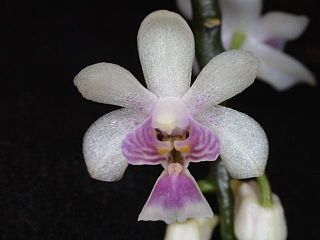
Phalaenopsis deliciosa is a species of orchid occurring from the Indian subcontinent to Malesia and China. The species is a miniature epiphytic herb. The leaves are unique due to their undulate margins. This characteristic greatly simplifies the identification of the species, even when specimens are not currently flowering. The small flowers are usually slightly pink, but white and yellow forms exist as well. Old inflorescences, which are usually panicles or more rarely racemes, may continue to grow and form new flowers over several flowering periods.
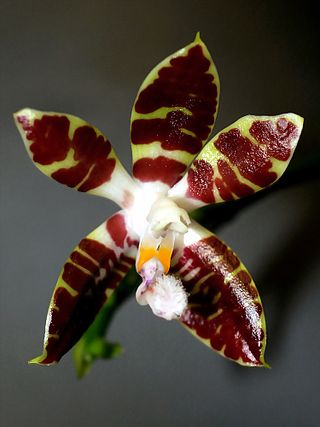
Phalaenopsis sumatrana is a species of orchid native to peninsular Thailand, Vietnam and southern Sumatra.

Epidendrum subsect. UmbellataRchb.f. (1861) is a subsection of section E. sect. PlanifoliaRchb.f. (1861) of subgenus E. subg. EpidendrumLindl. (1841) of the genus Epidendrum of the Orchidaceae. Plants of E. subsect. Umbellata differ from the other subsections of E. sect. Planifolia by producing inflorescences which are umbel-like. In 1861, Reichenbach recognized ten species in this subsection. Of these, nine are recognized with the same names by Kew :
Epidendrum subsect. Racemosa is a subsection belonging to section E. sect. Planifolia of subgenus E. subg. Epidendrum within the orchid family Orchidaceae. Plants classified under Racemosa differ from other subsections of E. sect. Planifolia in their production of raceme-like inflorescences. In 1861, Reichenbach identified 26 species within this subsection. These names correspond to 25 species currently recognized in the World Checklist of Selected Plant Families :
Epidendrum sect. Holochila Rchb.f. 1861 is a section of subgenus Epidendrum subg. Amphiglottium of the Orchidaceae. It differs from section E. sect. Polycladia by bearing inflorescences that are racemes, not panicles. It differs from section E. sect. Schistochila by having a lip with no lobes. Like the other sections of E. subg. Amphiglottium, plants of E. sect. Holochila exhibit slender stems covered with close imbricating sheaths which do not swell to form pseudobulbs, and terminal inflorescences covered at the base with close imbricating sheaths but without spathes.

Cleisocentron is a genus of flowering plants from the orchid family, Orchidaceae. It has a disjunct distribution, known from the Himalayas, Vietnam, China and Borneo.

Fernandezia is a genus of flowering plants from the orchid family, Orchidaceae. It contains about 30-40 species, native to northern South America, Central America, and southern Mexico.

Galeottia is a genus of flowering plants from the orchid family, Orchidaceae. It is native to South America, Central America and southern Mexico.
- Galeottia acuminata(C.Schweinf.) Dressler & Christenson
- Galeottia antioquiana(Kraenzl.) Dressler & Christenson
- Galeottia burkei(Rchb.f.) Dressler & Christenson
- Galeottia ciliata(C.Morel) Dressler & Christenson
- Galeottia colombiana(Garay) Dressler & Christenson
- Galeottia fimbriata(Linden & Rchb.f.) Schltr.
- Galeottia grandifloraA.Rich.
- Galeottia jorisiana(Rolfe) Schltr.
- Galeottia marginata(Garay) Dressler & Christenson
- Galeottia negrensisSchltr.
- Galeottia peruvianaD.E.Benn. & Christenson
- Galeottia prainiana(Rolfe) Dressler & Christenson
Tuberolabium is a genus of epiphytic flowering plants from the orchid family, Orchidaceae. It is native to the Old World Tropics, including China, Indochina, Taiwan, Indonesia, and the Philippines. Several species formerly included in Tuberolabium are now placed in the genus Trachoma.
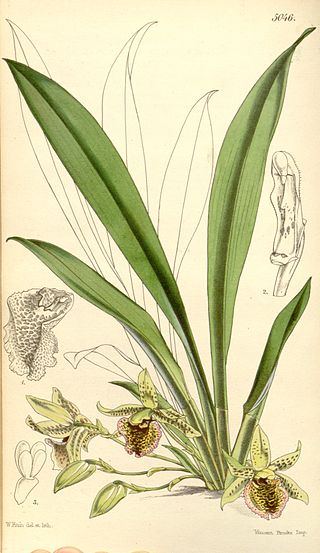
Kefersteinia is a genus of flowering plants from the orchid family, Orchidaceae. It has about 40-50 species, widespread across much of Latin America. The genus was named for Keferstein of Kröllwitz, an orchidologist.

Sarcoglottis is a genus of flowering plants from the orchid family, Orchidaceae. It is widespread across much of Latin America from Mexico to Argentina, with one species extending northward into Trinidad and the Windward Islands.
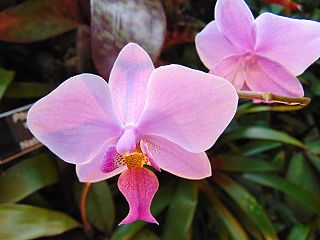
Phalaenopsis × veitchiana is a species of orchid endemic to the Philippines. It is a hybrid of Phalaenopsis equestris and Phalaenopsis schilleriana. It occurs naturally and has also been artificially re-created. It is named after the British horticulturalist Harry J. Veitch.

Phalaenopsis × leucorrhoda is a species of orchid native to the Philippines. It is a natural hybrid of Phalaenopsis aphrodite and Phalaenopsis schilleriana.

