| |||||||||||||||||||||||||
| |||||||||||||||||||||||||
| |||||||||||||||||||||||||
Map of results of the first round by provinces. | |||||||||||||||||||||||||
| |||||||||||||||||||||||||
| This article is part of a series on the politics and government of Ecuador |
|---|
Legislative |
Judiciary |
General elections were held in Ecuador on 17 February 2013 to elect the President, the National Assembly, Provincial Assemblies and members of the Andean Parliament. [1] The incumbent President Rafael Correa was re-elected by a wide margin. [2] Correa's closest electoral rival, Guillermo Lasso, conceded the election shortly after it concluded.
Ecuador, officially the Republic of Ecuador, is a country in northwestern South America, bordered by Colombia on the north, Peru on the east and south, and the Pacific Ocean to the west. Ecuador also includes the Galápagos Islands in the Pacific, about 1,000 kilometres (620 mi) west of the mainland. The capital city is Quito and the largest city as well.
The President of Ecuador officially called the President of the Republic of Ecuador serves as both the head of state and head of government of Ecuador, is the highest political office in the country as the head of the executive branch of government. As per the current Constitution, the President can serve two four-year terms. Prior to that, the president could only serve one four-year term.
The Andean Parliament is the governing and deliberative body of the Andean Community. It was created on October 25, 1979 in La Paz (Bolivia), through the Constitutive Treaty signed by the chancellors of Bolivia, Colombia, Ecuador, Peru and Venezuela. It entered into force in January 1984.
The vote had been set for January 2013, but was put back a month to allow a full year to elapse after the reform of election rules. [3]
This was the first election since 1996 held after the natural expiration of a four-year presidential term. This due to a decade of political and economical instability that Ecuador experienced after Abdalá Bucaram was impeached by the former Congress, in late 1997, and that lasted until Correa's inauguration in early 2007. [4]

Abdalá Jaime Bucaram Ortiz is an Ecuadorian politician and lawyer who was President of Ecuador from August 10, 1996, to February 6, 1997. As President, Abdalá Bucaram was nicknamed "El Loco" and was removed from office after being declared mentally unfit to rule by the National Congress of Ecuador. Bucaram and his followers claim that all cases against him have been dismissed. After having lived in Panama under political asylum, he returned to Ecuador in 2017 when the charges against him expired.
The call for general elections happened on October 18, 2012. The election campaigns were officially launched on January 4 and ended on February 14, as announced by CNE member Juan Pablo Pozo. [5]
Voters chose the president and vice president of the Republic, as well as national and provincial assembly members, members of the Andean Parliament, mayors, prefects, and other sectional officials. [6]
The seated President Correa, a two-term incumbent, is credited with bringing stability and prosperity to Ecuador's nearly 15 million people. A staunch friend of Venezuela's Hugo Chavez, he is usually described as "leftist" and "socialist." He is committed to poverty reduction through not just economic growth, but redistribution of wealth as well. As he told the CELAC Summit in 2015: "For the first time in the history of humanity this poverty is no longer due to a lack of resources, but rather is the fruit of inequality, and this, in turn, the product of perverse relations of power, where few have it all and many have nothing at all.” [7] This approach has generated fervent support as well as hostility from wealthy sectors in Ecuador; for example, his land reform policies for giving unproductive land to poor peasants has worried agribusiness, particularly the large flower and banana producers. He has vastly expanded the number of workers on the public sector and made health and education free for all Ecuadorians. Some have argued that Correa has clamped down on dissent in the country's news media, although journalists in Ecuador are not risking their lives as they are in other countries of the region. [8] [9] His government has run record-high deficits. In 2009, Correa became the first president of Ecuador to win re-election in nearly a half-century. [10]
Venezuela, officially the Bolivarian Republic of Venezuela, is a country on the northern coast of South America, consisting of a continental landmass and a large number of small islands and islets in the Caribbean Sea. The capital and largest urban agglomeration is the city of Caracas. It has a territorial extension of 916,445 km2. The continental territory is bordered on the north by the Caribbean Sea and the Atlantic Ocean, on the west by Colombia, Brazil on the south, Trinidad and Tobago to the north-east and on the east by Guyana. With this last country, the Venezuelan government maintains a claim for Guayana Esequiba over an area of 159,542 km2. For its maritime areas, it exercises sovereignty over 71,295 km2 of territorial waters, 22,224 km2 in its contiguous zone, 471,507 km2 of the Caribbean Sea and the Atlantic Ocean under the concept of exclusive economic zone, and 99,889 km2 of continental shelf. This marine area borders those of 13 states. The country has extremely high biodiversity and is ranked seventh in the world's list of nations with the most number of species. There are habitats ranging from the Andes Mountains in the west to the Amazon basin rain-forest in the south via extensive llanos plains, the Caribbean coast and the Orinoco River Delta in the east.
Land reform involves the changing of laws, regulations or customs regarding land ownership. Land reform may consist of a government-initiated or government-backed property redistribution, generally of agricultural land. Land reform can, therefore, refer to transfer of ownership from the more powerful to the less powerful, such as from a relatively small number of wealthy owners with extensive land holdings to individual ownership by those who work the land. Such transfers of ownership may be with or without compensation; compensation may vary from token amounts to the full value of the land.
The civil service is independent of government and is also composed mainly of career bureaucrats hired on professional merit rather than appointed or elected, whose institutional tenure typically survives transitions of political leadership. A civil servant or public servant is a person employed in the public sector on behalf of a government department or agency. A civil servant or public servant's first priority is to represent the interests of citizens. The extent of civil servants of a state as part of the "civil service" varies from country to country. In the United Kingdom, for instance, only Crown employees are referred to as civil servants whereas county or city employees are not.
In late 2012, Ecuador's Constitutional Court (CC) ruled on the adoption of the Democracy Code by a 6 to 3 vote in favor. The new resolution made the D'Hondt method of voting constitutional; therefore it was applied in the 2013 elections. The resolution also states that legal restrictions on the work of journalists during elections are unconstitutional. [11]
Eight presidential candidates were registered in the National Electoral Council. [12] The candidates were: Rafael Correa of the PAIS Alliance movement, Guillermo Lasso of the Creating Opportunities movement, Lucio Gutiérrez of the PSP party, Alberto Acosta Espinoza, candidate of the Coordinating Committee of the Left, Norman Wray, of the Ruptura 25 movement, Nelson Zavala, of the Roldosist Party, Mauricio Rodas, of the SUMA movement, and Álvaro Noboa, of PRIAN. [13]
The National Electoral Council (Spanish-language initials, CNE) approved the regulations for the registration and qualification of candidates running for President, Vice President, Assembly and the Andean Parliament for the election. The regulations established that candidates who have contracts with the State or have received final judgments for offenses penalized with imprisonment such as bribery, illicit enrichment and embezzlement, would not be allowed to participate. [14]
Ecuadorians not only voted on February 17 for their president and vice-president, but as well as for 137 members of the national assembly; drawn from provinces, a national list, and six migrant spots, and for their five Andean Parliament representatives. [15]
Surveys generally attributed between 50% and 60% of the votes to President Correa. The seven other candidates lagged far behind; Correa's nearest rival, Guillermo Lasso, was credited with 10—20% of the vote. [16]
| 2010-2013 | ||||||||||||||||||||||||||||||||||||||||||||||||||||||||||||||||||||||||||||||||||||||||||||||||||||||||||||||||||||||||||||||||||||||||||||||||||||||||||||||||||||||||||||||||||||||||||||||||||||||||||||||||||||||||||||||||||||||||||||||||||||||||||||||||||||||||||||||||||||||||||||||||||||||||||||||||||||||||||||||||||||||||||||||||||||||||||||||||||||||||||||||||||||||||||||||||||||||||||||||||||||||||||||||||||||||||||||||||||||||||||||||||||||||||||||||||||||||||||||||||
|---|---|---|---|---|---|---|---|---|---|---|---|---|---|---|---|---|---|---|---|---|---|---|---|---|---|---|---|---|---|---|---|---|---|---|---|---|---|---|---|---|---|---|---|---|---|---|---|---|---|---|---|---|---|---|---|---|---|---|---|---|---|---|---|---|---|---|---|---|---|---|---|---|---|---|---|---|---|---|---|---|---|---|---|---|---|---|---|---|---|---|---|---|---|---|---|---|---|---|---|---|---|---|---|---|---|---|---|---|---|---|---|---|---|---|---|---|---|---|---|---|---|---|---|---|---|---|---|---|---|---|---|---|---|---|---|---|---|---|---|---|---|---|---|---|---|---|---|---|---|---|---|---|---|---|---|---|---|---|---|---|---|---|---|---|---|---|---|---|---|---|---|---|---|---|---|---|---|---|---|---|---|---|---|---|---|---|---|---|---|---|---|---|---|---|---|---|---|---|---|---|---|---|---|---|---|---|---|---|---|---|---|---|---|---|---|---|---|---|---|---|---|---|---|---|---|---|---|---|---|---|---|---|---|---|---|---|---|---|---|---|---|---|---|---|---|---|---|---|---|---|---|---|---|---|---|---|---|---|---|---|---|---|---|---|---|---|---|---|---|---|---|---|---|---|---|---|---|---|---|---|---|---|---|---|---|---|---|---|---|---|---|---|---|---|---|---|---|---|---|---|---|---|---|---|---|---|---|---|---|---|---|---|---|---|---|---|---|---|---|---|---|---|---|---|---|---|---|---|---|---|---|---|---|---|---|---|---|---|---|---|---|---|---|---|---|---|---|---|---|---|---|---|---|---|---|---|---|---|---|---|---|---|---|---|---|---|---|---|---|---|---|---|---|---|---|---|---|---|---|---|---|---|---|---|---|---|---|---|---|---|---|---|---|---|---|---|---|---|---|---|---|---|---|---|---|---|---|---|---|---|---|---|---|---|---|---|---|---|---|---|---|---|---|---|---|---|---|---|---|---|---|---|---|---|---|---|---|---|---|---|---|---|---|---|---|---|---|---|---|---|---|---|---|---|---|---|---|---|---|---|---|---|---|---|---|---|---|---|---|---|---|---|---|---|---|---|---|---|---|---|
|
| Candidate | Party | Votes | % |
|---|---|---|---|
| Rafael Correa | Movimiento Alianza PAIS | 4,918,482 | 57.17 |
| Guillermo Lasso | Creating Opportunities | 1,951,102 | 22.68 |
| Lucio Gutiérrez | January 21 Patriotic Society Party | 578,875 | 6.73 |
| Mauricio Rodas | SUMA | 335,532 | 3.90 |
| Álvaro Noboa | Institutional Renewal Party of National Action | 319,956 | 3.72 |
| Alberto Acosta | Plurinational Unity of the Lefts | 280,539 | 3.26 |
| Norman Wray | Ruptura 25 | 112,525 | 1.31 |
| Nelson Zavala | Ecuadorian Roldosist Party | 105,592 | 1.23 |
| Invalid/blank votes | 863,257 | – | |
| Total | 9,465,860 | 100 | |
| Registered voters/turnout | 11,675,441 | 81.09 | |
| Source: CNE | |||
| Party | Votes | % | Seats | ||||
|---|---|---|---|---|---|---|---|
| National | Provincial | Abroad | Total | +/– | |||
| Alianza PAIS | 45,955,995 | 52.30 | 8 | 86 | 6 | 100 | +41 |
| Creating Opportunities | 10,032,804 | 11.42 | 2 | 9 | 0 | 11 | New |
| Social Christian Party | 7,901,315 | 8.99 | 1 | 5 | 0 | 6 | –5 |
| January 21 Patriotic Society Party | 4,955,320 | 5.64 | 1 | 4 | 0 | 5 | –14 |
| Plurinational Unity of the Lefts | 4,151,000 | 4.72 | 1 | 4 | 0 | 5 | –4 |
| Ecuadorian Roldosist Party | 3,960,188 | 4.51 | 1 | 0 | 0 | 1 | –2 |
| SUMA | 2,829,034 | 3.22 | 1 | 0 | 0 | 1 | New |
| Institutional Renewal Party of National Action | 2,640,181 | 3.00 | 0 | 0 | 0 | 0 | –7 |
| Partido Avanza | 2,568,156 | 2.92 | 0 | 5 | 0 | 5 | New |
| Ruptura 25 | 2,179,383 | 2.48 | 0 | 0 | 0 | 0 | New |
| Socialist Party – Broad Front of Ecuador | 698,829 | 0.80 | 0 | 0 | 0 | 0 | –1 |
| Independents and Regionalists | – | – | – | 3 | 0 | 3 | – |
| Invalid/blank votes | 2,083,795 | – | – | – | – | – | – |
| Total | 9,443,716 | 100 | 15 | 116 | 6 | 137 | +13 |
| Registered voters/turnout | 11,675,441 | 80.89 | – | – | – | – | – |
| Source: CNE, El Universo | |||||||
Banker Guillermo Lasso, the runner-up in the vote, conceded his defeat in broad terms, by stating: “I recognise the triumph of President Correa.” [10] Thousands of Correa's backers celebrated in Quito's main square just after the polls closed. Speaking from the balcony of the Presidential Palace, Correa thanked them for their "immense trust.” [17]
The politics of Ecuador are multi-party. The central government polity is a four-yearly elected presidential, unicameral representative democracy. The President of Ecuador is head of state and head of government on a multi-party system, leading a cabinet with further executive power. Legislative power is not limited to the National Assembly as it may to a lesser degree be exercised by the executive which consists of the President convening an appointed executive cabinet. Subsequent acts of the National Assembly are supreme over Executive Orders where sufficient votes have been cast by the legislators. The judiciary is independent of the executive and the legislature.There is also constitutional republic
Bolívar is a province in Ecuador. The capital is Guaranda. Much of the province has a cool, 'sierra' climate, but the part in the lower foothills has a cold, tundra like climate.
Elections in Venezuela are held at a national level for the President of Venezuela as head of state and head of government, and for a unicameral legislature. The President of Venezuela is elected for a six-year term by direct election plurality voting, and is eligible for re-election. The National Assembly (Asamblea Nacional) has 165 members (diputados), elected for five-year terms using a mixed member majoritarian system. Elections also take place at state level and local level.
PRIAN, which means Institutional Renewal Party of National Action was a right-wing populist Political Party in Ecuador.
Rafael Vicente Correa Delgado is an Ecuadorian politician and economist who served as President of Ecuador from 2007 to 2017. The leader of the PAIS Alliance political movement, Correa is a democratic socialist and his administration focused on the implementation of left-wing policies. Internationally, he served as president pro tempore of the Union of South American Nations.
General elections were held in Ecuador on 15 October 2006 to elect a new President and National Congress.
Cynthia Fernanda Viteri Jiménez de Villamar is an Ecuadorian lawyer, journalist and politician. She was the presidential candidate for Partido Social Cristiano in the 2017 presidential elections, and was a candidate in the 2006 presidential elections of Ecuador and finished fifth. Between 1998 and 2007 she was a member of the National Congress. Since 2009 she has been a member of the National Assembly. On March 24 2019, she was elected Mayor of Guayaquil in the sectional elections of Ecuador and will be serving from May 14, 2019 until May14, 2024.
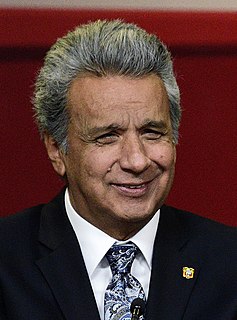
Lenín Boltaire Moreno Garcés is an Ecuadorian politician who is the President of Ecuador, in office since 2017. He was Vice President from 2007 to 2013, serving under President Rafael Correa.
A referendum on establishing a Constituent Assembly to write the new constitution was held in Ecuador on 15 April 2007. After its approval by 87% of voters, a Constituent Assembly Election was held on 30 September 2007 with Correa's PAIS Alliance taking the majority of seats. The assembly was to sit for a maximum of 180 days with a possible 60-day-extension.
PAIS Alliance is an Ecuadorian center-left social democratic political party.
The Ecuadorian Constituent Assembly was a 2007–2008 constitutional assembly in Ecuador, which drafted the 2008 Constitution of Ecuador, approved via the Ecuadorian constitutional referendum, 2008.
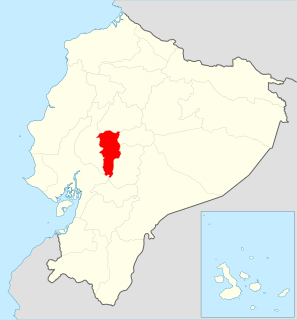
Caluma Canton is a canton of Ecuador, located in the Bolívar Province. Its capital is the town of Caluma. Its population at the 2010 census was 13,129.
Guaranda Canton is a canton of Ecuador, located in the Bolívar Province. Its capital is the town of Guaranda. Its population at the 2001 census was 81,643.
Creating Opportunities is an Ecuadorian political movement founded in January 2012 and participated in the 2013 presidential elections with Guillermo Lasso as their candidate for president.
Guillermo Alberto Santiago Lasso Mendoza is an Ecuadorian businessman and politician. In the Ecuadorian general election, 2013 he was presidential candidate for the party Creating Opportunities. He landed in second place with 22.68% of valid votes but as incumbent President Rafael Correa received more than double that amount, namely 57.17%. Lasso is, through a trust named with his initials, GLM, the largest share holder in Banco de Guayaquil, where he has been executive president for more than 20 years.
Freddy Ehlers Zurita is an Ecuadorian politician. As of June 2013, he is Ecuador's State Secretary for the Presidential Initiative for the Construction of a Society of Good Life. Previously, he was Minister of Tourism from 10 May 2010 until June 2013. In 1996 and 1998, Ehlers stood candidate for the office of President of Ecuador. Between 1 February 2007 and 7 May 2010, Ehlers was the Secretary-General of the Andean Community of Nations
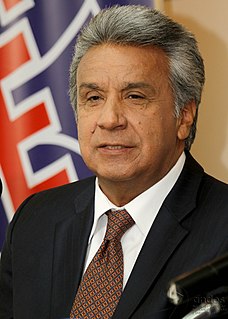
General elections were held in Ecuador on 19 February 2017 alongside a referendum on tax havens. Voters elected a new President and National Assembly. Incumbent President Rafael Correa of the PAIS Alliance was not eligible for re-election, having served two terms. In the first round of the presidential elections, PAIS Alliance candidate Lenín Moreno received 39% of the vote. Although he was more than 10% ahead of his nearest rival, Guillermo Lasso of the Creating Opportunities party, Moreno was just short of the 40% threshold required to avoid a run-off. As a result, a second round was held on 2 April. In the second round Moreno was elected President with 51.16% of the vote.
Presidential elections were held in Venezuela on 20 May 2018, with incumbent Nicolás Maduro being re-elected for a second six-year term. Considered a snap election, the original electoral date was scheduled for December 2018 but was subsequently pulled ahead to 22 April before being pushed back to 20 May. Some analysts described the poll as a show election, with the elections having the lowest voter turnout in the country's democratic era.
Events in the year 2017 in Ecuador.
Pamela Alejandra Aguirre Zambonino is an Ecuadorian lawyer and politician. Since May 2017, she has served as a Member of the Andean Parliament, a position she attained by popular election with 2,669,238 votes nationwide.