Flowerdale is a former locality in southern Alberta, Canada within Special Area No. 2. Once an agrarian town and the seat of a rural municipal government, Flowerdale was abandoned in the 1930s. Some stone ruins remain from the original settlement.
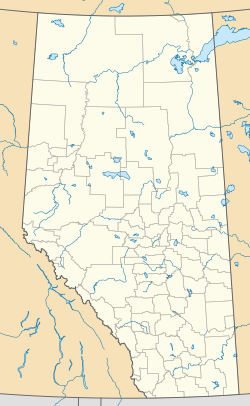
The site is located approximately 24 kilometres (15mi) southwest of the Village of Youngstown and 113 kilometres (70mi) north of the City of Brooks.
Toponymy
Flowerdale was named by resident Annie Twelvetree, due to the number of wild flowers growing in nearby fields and along the banks of Berry Creek.[1][2]
A. R. Stewart inside his store, and resident Fred Schofield; 1911.
Flowerdale was one of several farming communities along Berry Creek that were, between 1909 and 1917, connected by a stagecoach service that transported mail and passengers.[7]:14 Settlement had begun in the area in the first decade of the 20th century.[7]:88
A post office opened for the settlement, bearing the name Flowerdale, in May 1911.[8] Arthur Stewart Sr., its first postmaster, also operated a general store, which received stock transported by wagon from the nearby settlement of Bassano.[9][7]:528-530 One resident, Louis O'Reilly, would recall Stewart's store being "the first store in that part of the country," and people would travel for miles to purchase "everything from a can of beans to a marriage license."[10]:256 Stewart and his family constructed a stone house soon after arriving,[11][10]:60 which may be the ruins visible at the site today.[10][7]:530
A Flowerdale school also opened in 1911, serving children from surrounding localities.[7]:36-38[12]:90,181
Becoming a seat of governance and decline: 1912-1930
Flowerdale became the seat of a rural municipality (Flowerdale, No. 244) in December 1913.[13][14] Early representatives were selected from Flowerdale as well as surrounding localities of Baraca, Stoppington, and Flaxland.[13] Like Flowerdale, none of these localities survived into the 21st century.[15] Councillors held meetings at Silver Leaf School, a central location for the represented localities.[7]:501
Unpredictable weather undermined Flowerdale's early agrarian economy. Residents Armitage Wallbank and Louis Schumacher would later recall strong yields in 1915 and 1916, with 1916 in particular offering a yield "that was talked about for years."[7]:516,536 Flowerdale recorded 575 resident farmers in 1916.[16] Its post office closed at the end of that year.[17]
The inconsistency of successive yields throughout the 1910s and 1920s both attracted residents to Flowerdale, and drove people away from it in search of better economic conditions.[7]:516,536 Flowerdale and surrounding areas were frequently afflicted by grass fires, drought, and flooding.[7]:88,447–451,606 A difficult winter in 1919 hampered the ability of pastoral farmers to feed their livestock, leading to widespread animal deaths.[18] The Flowerdale municipality sought bank loans to pay for seed or animal feed, but was denied due to the poor credit of "some one hundred or more" farmers in the district.[18]
Flowerdale residents and sod house, c. 1910.
Over Flowerdale's operational years, several bridges installed to facilitate crossing Berry Creek were washed away by floods or destroyed by cold weather.[7]:447–451 Flowerdale's residents notably petitioned the provincial government to install a replacement bridge in 1913, and received one the next year; this bridge was destroyed in 1918.[7]:448 By 1923, the Flowerdale council's financial position was strained enough that it formally requested free lumber from the province to replace the structure.[7]:448 Flowerdale's final replacement bridge was destroyed by a prairie fire in March 1929; this time, it was not replaced.[7]:448–449
Flowerdale's population had declined to 325 permanent farmers by 1921, the last year for which the Ministry of Municipal Affairs collected independent data for the settlement.[19] From 1924 onwards, data was collected for the Flowerdale municipal district in its entirety; the district recorded a total population of 925 that year.[20] Records from 1931, Flowerdale's last appearance as a census centre, provided that the district contained an estimated 625 residents, of which 150 were permanent farmers.[21]
In 1931, the Flowerdale municipality went bankrupt.[7]:85
Abandonment
As a result of its bankruptcy, Flowerdale's council voted in December 1931 to amalgamate with neighbouring districts.[22] They asked to be placed under a special administrator appointed by the Minister of Municipal Affairs.[22] By this time, most residents had abandoned Flowerdale,[10] and the majority of the deserted lands had been liable to forfeiture due to unpaid taxes.[23] Indeed, at the time of its bankruptcy, the district had owed $108,239 ($2,073,701 in constant dollars) in unpaid taxes.[24]
Flowerdale's last remaining structure; ruins photographed in 2011. Likely the remains of A. R. Stewart's home.
In 1932, these areas, as well as others along Berry Creek, were placed under the control of a board convened by An Act respecting the Berry Creek Area.[25] Many other localities along Berry Creek and across the Palliser's Triangle fell into ruin throughout the 1930s, owing to the Dust Bowl and Great Depression.[26] The ruination of these communities led to the establishment of the Special Areas Board, which assisted farmers in relocating.[26] The Board later allowed new farms to be established under strict land-use conditions.[26]
Flowerdale, however, was left to be reclaimed by nature.[27] All that remains of the settlement in the 21st century are the ruins of a stone building. According to local histories, these are the remains of a building maintained by A. R. Stewart, Flowerdale's first postmaster and shopkeeper.[10][7]:530
12"Propose Amalgamation of Flowerdale and Lone Butte Districts". Calgary Daily Herald. 23 December 1931. p.10.
↑English, Robert (12 October 1933). "Selling Abandoned Lands". Submission by Robert English, Deputy Minister of Municipal Affairs. Edmonton Journal. p.4.
This page is based on this Wikipedia article Text is available under the CC BY-SA 4.0 license; additional terms may apply. Images, videos and audio are available under their respective licenses.

 Canada
  Alberta

