Simsbury is a town in Hartford County, Connecticut, United States, incorporated as Connecticut's 21st town in May 1670. The town is part of the Capitol Planning Region. The population was 24,517 in the 2020 census.

Suffield is a town in Hartford County, Connecticut, United States. The town is part of the Capitol Planning Region, and located in the Connecticut River Valley. As of the 2020 census, the population was 15,752. The town center is a census-designated place listed as Suffield Depot.

Hadley is a town in Hampshire County, Massachusetts, United States. The population was 5,325 at the 2020 census. It is part of the Springfield, Massachusetts Metropolitan Statistical Area. The area around the Hampshire and Mountain Farms Malls along Route 9 is a major shopping destination for the surrounding communities.

FredericDan Huntington was an American clergyman and the first Protestant Episcopal bishop of the Episcopal Diocese of Central New York.
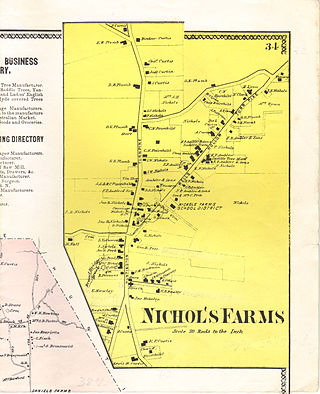
Nichols Farms is a historic area within the town of Trumbull, Connecticut. The Nichols Farms Historic District, which encompasses part of the area, is listed on the National Register of Historic Places.

The Wheeler-Merriam House is a historic house located at 477 Virginia Road in Concord, Massachusetts. With a construction history dating to about 1692, it is one of Concord's oldest buildings. It is also notable for having joinery by Abner Wheeler, a prominent local builder of the late 18th century, and for its long association with the locally prominent Wheeler and Merriam families. It was added to the National Register of Historic Places on November 26, 1982.

The Porter–Phelps–Huntington House, known historically as Forty Acres, is a historic house museum at 130 River Drive in Hadley, Massachusetts. It is open seasonally, from May to October. The house contains the collection of one extended family, with objects dating from the seventeenth to twentieth centuries. It was occupied from its construction in 1752 until the 1940s, when a member of the eighth generation of the family in the house turned it into a museum. Its collection is entirely derived from the family, and the extensive archives, including the original diary of Elizabeth Porter Phelps, are held at the University of Massachusetts Amherst. The house was added to the National Register of Historic Places in 1973, and is a central feature of the Forty Acres and Its Skirts Historic District, designated in 2023.

The Hadley Center Historic District is an expansive, 2,500-acre (1,000 ha) historic district encompassing the village center of Hadley, Massachusetts. When it was first listed on the National Register of Historic Places in 1977, the district encompassed the town green and 17 buildings that faced it, at the junction of Russell Street and Middle Street. The district was expanded significantly in 1994, adding more than 400 buildings representative of the village's growth from colonial days into the first decades of the 20th century. This expansion encompasses the entirety of a tongue of land extending west from East Street and bounded by a bend in the Connecticut River, which separates Hadley from Northampton. Its oldest property, the Samuel Porter House on West Street, was built in 1713.

The North Hadley Historic District encompasses the historic rural village of North Hadley, located between Mount Warner and the Connecticut River in Hadley, Massachusetts. It includes properties on River Drive between Stockwell Road and Stockbridge Street, and includes properties on French, Meadow and Mt. Warner Streets. It is a well-preserved example of a rural farming and mill community, with architecture dating from the late 18th to early 20th centuries. The district was listed on the National Register of Historic Places in 1993.

The River Road–Cross Street Historic District is a rural agricultural historic district in Topsfield, Massachusetts. It is representative of Topsfield's development first as an agricultural community, and later as place for rural retreats. The district, which was listed on the National Register of Historic Places in 2005, is roughly bounded by River Road, Rowley Bridge Road, Cross Street, Hill Street, and Salem Road, and also includes properties facing Prospect Street and Bradstreet Lane. Much of the district was consolidated under the ownership of William Appleton Coolidge in the 20th century, and bequeathed to the Massachusetts Institute of Technology with restrictions to preserve its rural character. MIT sold the donated properties in 2000.

Norwichtown is a historic neighborhood in the city of Norwich, Connecticut, United States. It is generally the area immediately north of the Yantic River between I-395 and Route 169.

The Putnam Farm is a historic farm on Spaulding Road in Brooklyn, Connecticut. The property, now just 9 acres (3.6 ha) of agricultural land with a house on it, was the centerpiece of a vast landholding in the mid-18th century by Major General Israel Putnam, a major colonial-era military figure who saw action in both the French and Indian War and in the American Revolutionary War. The property was listed on the National Register of Historic Places in 1982.
Phelps House may refer to:
Elizabeth Porter Phelps (1747–1817) was a member of the eighteenth-century rural gentry in western Massachusetts; she is also recognized as an important diarist from late 18th century and early 19th century in Hadley, Massachusetts (USA).
The Nathan B. Lattin Farm is a historic farm at 22 Walker Hill Road in Newtown, Connecticut. Founded by early colonial settlers to the area in the 18th century, it remains an example of a rural farm property in an increasingly suburbanized area. It was listed on the National Register of Historic Places in 1990.

The Timothy Lester Farmstead, also known as the Garrison House, is a historic farmstead at Crary and Browning Roads in Griswold, Connecticut. Set on 43 acres (17 ha) of land, the farmstead retains the look and feel of an 18th-century farm property, with a c. 1741 farmhouse, and farm outbuildings dating from the 18th to 20th centuries. The property was listed on the National Register of Historic Places on December 4, 1998.

The King Farm is a historic farm property at King Farm Road in Woodstock, Vermont. Encompassing more than 150 acres (61 ha) of woodlands and pasture, the farm has 150 years of architectural history, include a rare 18th-century English barn. Originally a subsistence farm, it became a gentleman's farm in the late 19th century, and its farmstead now hosts a regional government commission. The farm was listed on the National Register of Historic Places in 1997.

The Hunt Hill Farm is a historic farm property at Upland and Crossman Roads in New Milford, Connecticut. Also known as the Hine–Buckingham Farms, the 137-acre (55 ha) property encompasses two farm properties that remained family-run from the 18th to early 20th centuries. The property includes one 18th and several 19th-century farmhouses and other outbuildings. It was listed on the National Register of Historic Places in 2004. The farmstead is now home to The Silo at Hunt Hill Farm, an arts and culinary organization, while much of the land is held as conservation land by the town.

The Phelps Farm Historic District encompasses a collection of farm and residential properties on Connecticut Route 183 and Prock Hill Road in Colebrook, Connecticut. This area is a virtually intact mid-19th century farmstead, with its land under a single family's ownership since the 18th century. The district was listed on the National Register of Historic Places in 1983.
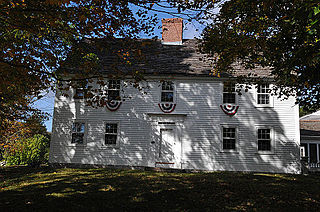
The Lamb Homestead is a historic farm property at 47 Lambtown Road in Ledyard, Connecticut. Developed since the early 18th century, it is one of the town's oldest farms, with a long association with the Lamb family, early settlers and important in the development of the Lambtown area of the community. The property was listed on the National Register of Historic Places in 1991.