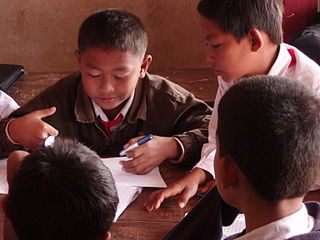
Hyperlexia is a syndrome characterized by a child's precocious ability to read. It was initially identified by Norman E. Silberberg and Margaret C. Silberberg (1967), who defined it as the precocious ability to read words without prior training in learning to read, typically before the age of 5. They indicated that children with hyperlexia have a significantly higher word-decoding ability than their reading comprehension levels. Children with hyperlexia also present with an intense fascination for written material at a very early age.

Mary Temple Grandin is an American professor of animal science at Colorado State University, consultant to the livestock industry on animal behavior, and autism spokesperson. She is one of the first individuals on the autism spectrum to publicly share insights from her personal experience of autism. She invented the "Hug Box" device to calm those on the autism spectrum. In the 2010 Time 100, an annual list of the 100 most influential people in the world, she was named in the "Heroes" category. She was the subject of the Emmy- and Golden Globe-winning semi-biographical film Temple Grandin.

Donna Leanne Williams, also known by her married name Donna Leanne Samuel, was an Australian writer, artist, singer-songwriter, screenwriter and sculptor.
Anthony John Attwood is a British psychologist notable for his work on Asperger syndrome. He resides in Queensland, Australia, where he is an Associate Professor at Griffith University.

The autism rights movement (ARM), also known as the autistic culture movement, is a social movement within the neurodiversity and disability rights movements that encourages autistic people, their caregivers and society to adopt a position of neurodiversity, accepting autism as a variation in functioning rather than a disorder to be cured. The ARM advocates a variety of goals including a greater acceptance of autistic behaviors; therapies that teach autistic individuals coping skills rather than therapies focused on imitating behaviors of neurotypical peers; the creation of social networks and events that allow autistic people to socialize on their own terms; and the recognition of the autistic community as a minority group.
The following outline is provided as an overview of and topical guide to autism:
Autism Every Day is a 2006 documentary film sponsored by Autism Speaks, and produced by Lauren Thierry, Jim Watkins and Eric Solomon. It follows mothers with autistic children and consists mainly of interviews with the mothers.

Like Colour To The Blind (1998) is the third in a series of four autobiographical works by internationally bestselling autistic author Donna Williams. Once published in the US using the American spelling 'color', it is now published worldwide by Jessica Kingsley Publishers using the UK spelling 'colour'. It has been published in several languages worldwide.
Social Stories were devised as a tool to help individuals on the autism spectrum better understand the nuances of interpersonal communication so that they could interact in an effective and appropriate manner. Although the prescribed format was meant for high functioning people with basic communication skills, the format was adapted substantially to suit individuals with poor communication skills and low level functioning. The evidence shows that there has been minimal improvement in social interaction skills. However, it is difficult to assess whether the concept would have been successful if it had been carried out as designed.
Societal and cultural aspects of autism come into play with recognition of autism, approaches to its support services and therapies, and how autism affects the definition of personhood. The autistic community is divided primarily into two camps; the neurodiversity movement and the autism cure movement. The neurodiversity movement believes autism is a different way of being and advocates against a cure. On the other hand, the autism cure movement advocates for a cure. There are many autism-related events and celebrations; including World Autism Awareness Day, Autism Sunday and Autistic Pride Day. Autism is diagnosed more frequently in males than in females.
A low arousal approach deals with how staff handles patients who are easily aroused. These approaches aim to make staff avoid confrontational situations and to, instead, go for the path of least resistance".

The Autistic Self Advocacy Network (ASAN) is a 501(c)(3) nonprofit advocacy organization run by and for individuals on the autism spectrum. ASAN holds that the goal of autism advocacy should be a world in which autistic people enjoy the same access, rights, and opportunities as all other people, and that autistic voices should be included in any public discourse on autism, whether in public policy, mass media, or other venues. ASAN is based in Washington, D.C.
Sarah Stup is an American writer who writes on the topics of community inclusion, education and her role in the world as a young autistic woman. Stup is also a children's author, poet, essayist, and advocate.

Normal People Scare Me: A Film about Autism is a documentary film about autism, produced by Joey Travolta, older brother of actor John Travolta. The documentary initially began as a 10-minute short film co-directed by an autistic teenager named Taylor Cross, and his mother Keri Bowers. Joey Travolta first met Cross at a program Travolta led teaching the art of filmmaking to children with special needs. He helped educate Cross about filmmaking, and the documentary was expanded into a feature-length film. It includes interviews with 65 people, including those who are autistic as well as friends and family. Cross asks them about their experiences with autism and how they feel about it, and elicits multiple insightful responses from his subjects.
Clara Claiborne Park was an American college English teacher and author who was best known for her writings about her experiences raising her autistic daughter, the artist Jessica Park. Her 1967 book, The Siege was credited as one of the first books to allay the blame that parents, especially mothers, were made to feel at having caused their child's autism through their cold detachment.

Children of the Stars is a 2007 documentary about children with autism in the People's Republic of China. It was produced by Alexander Haase and directed by Rob Aspey. The title is an English translation of the expression "星星的孩子", a phrase used in Taiwan to describe autistic children.
Autism spectrum disorders (ASDs) or autism spectrum conditions (ASCs) describe a range of conditions classified as neurodevelopmental disorders in the DSM-5, used by the American Psychiatric Association. As with many neurodivergent people and conditions, the popular image of autistic people and autism itself is often based on inaccurate media representations.
Autism friendly means being aware of social engagement and environmental factors affecting people on the autism spectrum, with modifications to communication methods and physical space to better suit individual's unique and special needs.
Gunilla Gerland is a Swedish author, lecturer and debater on the topic of Asperger syndrome.

Thomas A. McKean is an American autistic author and lecturer. He is a poet, a singer-songwriter, an international speaker and a writer. He is the author of Soon Will Come the Light: A View From Inside the Autism Puzzle and Light On the Horizon: A Deeper View From Inside the Autism Puzzle. McKean has claimed that he did not speak until he was 16, but was able to describe how autism was like to him. He constantly fights various symptoms such as making strange noises, and says that perception of the senses causes low-intensity pain. McKean at one time earned a living traveling about and doing conferences and consulting work on autism. He has been described as having the unusual ability to be in the world of autism, yet also possesses the communication skills to describe what that world is like.