The Phipps Street Burying Ground is a historic cemetery on Phipps Street in Charlestown, now a neighborhood of Boston, Massachusetts.

Cole's Hill is a National Historic Landmark containing the first cemetery used by the Mayflower Pilgrims in Plymouth, Massachusetts in 1620. The hill is located on Carver Street near the foot of Leyden Street and across the street from Plymouth Rock. Owned since 1820 by the preservationist Pilgrim Society, it is now a public park.
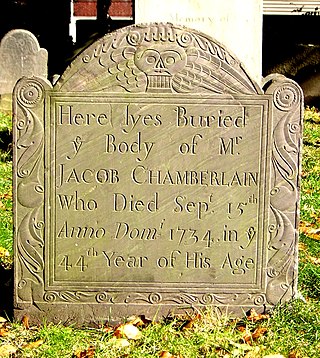
The Rumney Marsh Burying Ground is a historic cemetery on Butler Street between Elm and Bixby Streets in Revere, Massachusetts. It was added to the National Register of Historic Places in 2004. It was the first burying ground of an area that now encompasses Revere as well as neighboring Chelsea and Winthrop.

Hillside Cemetery, also known as the North Burying Ground, is a historic cemetery on Depot and Nutting Roads in Westford, Massachusetts. The cemetery was established in 1753, and is the burial site of a number of people important in local history. It contains approximately 300 burials, and continues in active use. The cemetery was listed on the National Register of Historic Places in 2005.

High Street Cemetery is a historic cemetery at 45 High Street in Danvers, Massachusetts. The 0.6-acre (0.24 ha) cemetery is one of the older cemeteries in town, and occupies a prominent location in the town center.

Amherst West Cemetery is a historic cemetery on Triangle Street in Amherst, Massachusetts. The 4-acre (1.6 ha) cemetery was first laid out in 1730, when the voters of Hadley elected to establish a new burying ground in its eastern precinct. When the area was separated as Amherst in 1786, the property was taken over by the newly established town. In addition to being the burial site of many of Amherst's early settlers and American Civil War veterans, it is also the burial site of members of the Dickinson family, most notably the poet Emily Dickinson. Their family plot is set off from the rest of the cemetery by a wrought iron fence.

Center Cemetery is a historic cemetery on the south side of Sam Hill Road in Worthington, Massachusetts. The 2.4-acre (0.97 ha) cemetery was established c. 1774, and continues to be used today. Its burials include many of the founders and early settlers of Worthington, and of families influential in the growth and development of the town. The cemetery listed on the National Register of Historic Places in 2004.

North Cemetery is a historic cemetery in Worthington, Massachusetts. The 3.5-acre (1.4 ha) municipal cemetery is located at the corner of Cold and North Streets not far from Worthington Corners; it is the town's largest cemetery. The cemetery was listed on the National Register of Historic Places in 2004, for its funerary architecture and its role as the burial ground for the town's early settlers.

The East Main Street Cemetery is a historic cemetery on East Main Street in Dalton, Massachusetts. The cemetery is one of the oldest in the town, with grave markers dating to the 1780s. It was founded on land owned by the Chamberlin family, whose identified graves make up about 20 percent of roughly 250 gravesites. The cemetery was listed on the National Register of Historic Places in 2000.

Maple Street Cemetery is a historic cemetery on Maple Street in Adams, Massachusetts. Established about 1760, it is the town's oldest cemetery, serving as a burying ground for its early Quaker settlers, as well as for some of its prominent 19th-century citizens. It was listed on the National Register of Historic Places in 2004.

Gilead Cemetery is located in the town of Carmel, New York, United States. It is off a bend in Mechanic Street 1.5 miles (2.4 km) south of the hamlet of Carmel, seat of Putnam County.

Cypress Cemetery is an historic cemetery at 100 College Street in Old Saybrook, Connecticut. Established sometime in the 17th century, and still in active use, it is the town's oldest cemetery, with a wide variety of funerary art dating from the 17th to 21st centuries. The cemetery's oldest portion was listed on the National Register of Historic Places in 2018.

The Myles Standish Burial Ground in Duxbury, Massachusetts is, according to the American Cemetery Association, the oldest maintained cemetery in the United States.

The Revolutionary War Cemetery, also called the Old Salem Burying Ground, is located on Archibald Street, just off state highway NY 22 in the village of Salem, New York, United States. It is a 2.6-acre (1.1 ha) area with over a thousand graves, at least 100 of which are those of Revolutionary War dead or veterans.

The Sharp Burial Ground, also known as the Albany Avenue Cemetery, is located on Albany Avenue in Kingston, New York, United States. It is a small burying ground used during the middle decades of the 19th century, before larger rural cemeteries had become common but after churchyards had become too full for further burials. Later, when they did open, many bodies were removed to consolidate them with larger family plots there. Two former congressmen are still among those buried at Sharp.

Kinne Cemetery, also known as the Glasgo Cemetery and Old Kinne Burying Ground, is a historic cemetery in Jarvis Road in Griswold, Connecticut. The earliest marked stone is for Daniel Kinne who died in 1713. In the 1930s, the inscriptions of 79 stones in the Kinne Cemetery were recorded for the Hale Index. There are around 80 fieldstones with no carving or identification, but it is unknown if this stems from wearing of the gneiss stone or that there were no skilled carvers locally available. The seven carvers that have been identified are Lebbeus Kimball, Jotham Warren, Josiah Manning, Peter Barker, Mr. Huntington of Lebanon, E. Marston of Mystic Bridge and O. Doty of Stonington. The National Historic Register of Places nomination notes, "the cemetery is significant artistically because the carving on the stones gives many good examples of the funerary art that was characteristic of the 18th and 19th centuries in New England." The cemetery is notable because of the burial of Isaac C. Glasko, the namesake of the village of Glasgo, and a prominent African American land-holding man who ran a blacksmith shop that was important to the marine industry of the area. The cemetery was made a part of the Connecticut Freedom Trail in 1995 and it was added to the National Register of Historic Places on April 12, 2001.

Mansfield Center Cemetery is a small cemetery in the Mansfield Center section of Mansfield, Connecticut. Established in 1693, it is one of the few surviving elements of Mansfield's early colonial settlement history. It also has a distinguished array of funerary markers carved by acknowledged master's across eastern Connecticut. It was listed on the National Register of Historic Places in 1992.

Gate Cemetery is a historic cemetery on Ireland Street in West Chesterfield, Massachusetts. It is located just under one mile (1.6 km) south of the center of West Chesterfield, the junction of Main Road and Ireland Street. The 1/3 acre cemetery is on a plateau of land on the east side of Ireland Street, flanked to the east by the Westfield River and to the west by a steep hillside. It takes its name from a toll gate that was erected nearby when the area was settled in the late 18th century.
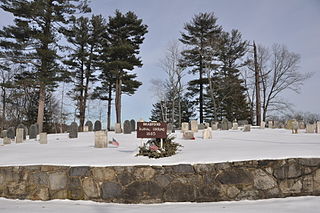
The Bradford Burial Ground is a historic cemetery at 326 Salem Street in the Bradford section of Haverhill, Massachusetts. The 1.5-acre (0.61 ha) cemetery was established in 1665, on land given by John Heseltine to the town of Bradford. The oldest readable marker in the cemetery has a date of 1689, but there are likely to be older burials. The cemetery was listed on the National Register of Historic Places in 2015.
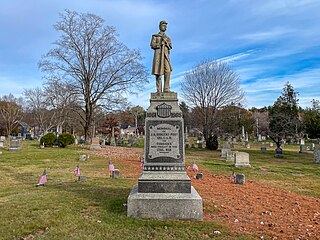
Evergreen Cemetery is an active cemetery at Evergreen and Cottage Streets in Medway, Massachusetts. Founded in 1750, it is one of the community's oldest cemeteries, with burials including many of its early families, as well as veterans of the American Revolutionary War and American Civil War. It also houses the burial of Joseph Barbur Jr., a regionally prominent funerary stone carver. The cemetery was listed on the National Register of Historic Places in 2021.