Oropeza Province | |
|---|---|
Province | |
Sucre, the constitutional capital of Bolivia and the capital of the Oropeza Province | |
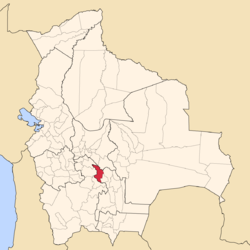
| Location of Oropeza Province within Bolivia | |
| Coordinates: 18°50′S65°15′W / 18.833°S 65.250°W | |
| Country | |
| Department | Chuquisaca Department |
| Capital | Sucre |
| Area | |
• Total | 1,416 sq mi (3,667 km2) |
| Elevation | 6,600 ft (2,000 m) |
| Population (2024 census) | |
• Total | 319,006 |
| • Density | 225.3/sq mi (86.99/km2) |
| • Ethnicities | Quechuas |
| Time zone | UTC-4 (BOT) |
Oropeza is a province in the Chuquisaca Department, Bolivia. Its seat is Sucre which is also the constitutional capital of Bolivia and the capital of the Chuquisaca Department.
Some of the highest mountains of the province are listed below: [1] [2] [3] [4]
The province is divided into three municipalities which are further subdivided into cantons.
| Section | Municipality | Inhabitants (2001) [5] | Seat | Inhabitants (2001) |
|---|---|---|---|---|
| Capital Municipality | Sucre Municipality | 214,913 | Sucre | 193,876 |
| 1st | Yotala Municipality | 9,497 | Yotala | 1,538 |
| 2nd | Poroma Municipality | 16,966 | Poroma | 486 |
The people are predominantly indigenous citizens of Quechuan descent.
| Ethnic group | Sucre Municipality (%) | Yotala Municipality (%) | Poroma Municipality (%) |
|---|---|---|---|
| Quechua | 57.3 | 90.4 | 94.7 |
| Aymara | 2.3 | 0.8 | 0.9 |
| Guaraní, Chiquitos, Moxos | 1.4 | 0.2 | 0.1 |
| Not indigenous | 38.6 | 8.3 | 4.2 |
| Other indigenous groups | 0.4 | 0.3 | 0.1 |
Ref.: obd.descentralizacion.gov.bo
The languages spoken in the province are mainly Spanish and Quechua.
| Language | Sucre Municipality | Yotala Municipality | Poroma Municipality |
|---|---|---|---|
| Quechua | 116,053 | 8,197 | 15,554 |
| Aymara | 3,322 | 68 | 165 |
| Guaraní | 344 | 8 | 4 |
| Another native | 67 | 0 | 4 |
| Spanish | 183,231 | 5,587 | 4,620 |
| Foreign | 8,156 | 41 | 8 |
| Only native | 19,901 | 3,319 | 11,057 |
| Native and Spanish | 97,831 | 4,916 | 4,513 |
| Only Spanish | 85,497 | 673 | 107 |
Ref.: obd.descentralizacion.gov.bo
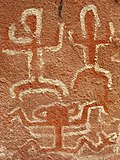
The archaeological sites of Inka Mach'ay and Puma Mach'ay are situated within the province. Inka Mach'ay was declared a National Monument in 1958. [6]