Pinjalo (fish)

Last updated

Pinjalo
Pinjalo pinjalo Pakistan.png
Scientific classification Red Pencil Icon.png
Kingdom: Animalia
Phylum: Chordata
Class: Actinopterygii
Order: Perciformes
Family: Lutjanidae
Genus: Pinjalo
Species:
P. pinjalo
Binomial name
Pinjalo pinjalo
(Bleeker, 1850)
Synonyms [2]
  • Caesio pinjaloBleeker, 1850
  • Odontonectes pinjalo (Bleeker, 1850)
  • Pinjalo typusBleeker, 1845
  • Mesoprion mitchelli Günther, 1867
  • Pinjalo microphthalmus Lee, 1987

The pinjalo (Pinjalo pinjalo) is a species of marine ray-finned fish, a snapper belonging to the family Lutjanidae. It is found in the Indian and Western Pacific Oceans.

Contents

Taxonomy

The pinjalo was first formally described in 1850 as Caesio pinjalo by the Dutch physician, herpetologist and ichthyologist Pieter Bleeker with the type locality given as Batavia on Java. [3] The specific name derives from the Malay ikan Pinjalo, a local name for this fish around the type locality. When Bleeker created the genus Pinjalo he used the name Pinjalo typus for the type species but this proved to be a nomen nudum [4] and Caesio pinjalo was designated as the type species by tautonymy. [3]

Description

The Pinjalo has a body which is moderately deep with a steep dorsal profile on the head and a convex space between the eyes. it has a comparatively large eye which has a diameter roughly equal or greater than the length of the snout. The eye has an adipose eyelid. The snout is relatively short and pointed, the mouth is small only extending to the front of the eye. There is a single row of small, conical teeth in jaws, these are enlarged in the front and an inner band of bristle-like teeth. [5] The dorsal fin has 10 spines and 13-15 soft rays while the anal fin has 3 rays and 8-10 soft rays. [2] The dorsal and anal fins both have scaly sheaths at their bases. The pectoral fins are long, extending as far as the level of the anus and containing 18 fin rays. The caudal fin is emarginate. [5] This species is greyish to pinkish-grey on the upper body becoming silvery pink to silvery-white on the lower body. The dorsal and caudal fins arepinkish to pinkish-yellow with darker margins, while the pelvic and anal fins are yellowish. These colours may either quickly fade or get deeper. [6] The pinjalo attains a maximum total length of 80 cm (31 in), although of 30 cm (12 in) is more typical. [2]

Distribution and habitat

The pinjalo has a wide Indo-Pacific distribution. It is found from the Red Sea south to Mozambique, Socotra, the Comoros and the Seychelles. It is also found in the Gulf of Aden, the Persian Gulf east into the Pacific Ocean where it occurs as far east as Papua New Guinea, north to Taiwan and the Philippines. [1] In Australia larvae have been recorded at Port Hedland in Western Australia. This species occurs at depths of 15 to 100 m (49 to 328 ft) where it can be found on coral and rocky reefs, both coastal and offshore, as well as outer reef slopes. [6]

Biology

The pinjalo is a schooling species which feeds largely on benthic and planktonic invertebrates. [2] it’s biology is otherwise little known. [7]

Fisheries

The pinjalo is taken a by artisanal fisheries in many parts of its range, particularly in Asia. [1] It is fished for using gill nets, handlines, traps and bottom trawls. It is sold as fresh fish or preserved as salted fish. [5]

Related Research Articles

<i>Macolor</i> Genus of fishes

Macolor is a genus of marine ray-finned fish, snappers belonging to the family Lutjanidae. They are native to the Indian Ocean and the western Pacific Ocean.

The Japanese snapper is a species of marine ray-finned fish, a snapper belonging to the family Lutjanidae. It is native to the Western Pacific Ocean.

<i>Lutjanus adetii</i> Species of fish

Lutjanus adetii, the yellow-banded snapper or hussar, is a species of marine ray-finned fish, a snapper belonging to the family Lutjanidae. It is native to the southwestern Pacific Ocean. This species is of minor importance to local commercial fisheries and is sought after as a game fish.
<i>Aphareus</i> (fish) Genus of fishes

Aphareus is a genus of marine ray-finned fish, snappers belonging to the family Lutjanidae. They are native to the Indian and Pacific Oceans from the African coast to the Hawaiian Islands.

<i>Etelis</i> Genus of fishes

Etelis is a genus of marine ray-finned fish belonging to the family Lutjanidae, the snappers. They are mostly native to the Indian and Pacific oceans with one species (E. oculatus) native to the western Atlantic Ocean.

<i>Pinjalo</i> (genus) Genus of fishes

Pinjalo is a genus of marine ray-finned fish, snappers belonging to the family Lutjanidae. They are native to the Indian Ocean and the western Pacific Ocean
Randalls snapper Species of fish

Randall's snapper is a species of ray-finned fish, a snapper belonging to the family Lutjanidae. It is native to the Indo-Pacific region.

Pristipomoides typus, also known as the sharptooth jobfish, white snapper, white jobfish, goldband snapper or threadfin snapper, is a species of ray-finned fish, a snapper belonging to the family Lutjanidae. It is found in the Indian and Pacific Oceans.

<i>Pristipomoides sieboldii</i> Species of fish

Pristipomoides sieboldii, the lavender jobfish, lavender snapper or von Siebold’s snapper, is a species of ray-finned fish, which is a snapper belonging to the family Lutjanidae. It is found in the Indian and Pacific Oceans.
<i>Paracaesio xanthura</i> Species of fish

Paracaesio xanthura, the yellowtail blue snapper, the false fusilier, gold-backed fusilier, Pedley's fusilier or Southern fusilier, is a species of marine ray-finned fish, a snapper belonging to the family Lutjanidae. It is native to the Indo-Pacific region.

<i>Lutjanus russellii</i> Species of fish

Lutjanus russellii, Russell's snapper, Moses snapper, fingermark bream, Moses seaperch or Russell's sea-perch, is a species of marine ray-finned fish, a snapper belonging to the family Lutjanidae. It is native to the western Pacific Ocean.
<i>Lutjanus lemniscatus</i> Species of fish

Lutjanus lemniscatus, the yellowstreaked snapper, darktail snapper, darktail seaperch or maroon sea-perch is a species of marine ray-finned fish, a snapper belonging to the family Lutjanidae. It is native to the western Pacific and Indian Oceans.

<i>Lutjanus johnii</i> Species of fish

Lutjanus johnii, John's snapper, the golden snapper,big-scaled bream, fingermark bream, fingermark seaperch, John's sea-perch, or spotted-scale sea perch, is a species of marine ray-finned fish, a snapper belonging to the family Lutjanidae. It is native to the western Pacific and Indian Oceans.
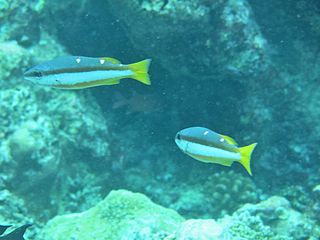
<i>Lutjanus biguttatus</i> Species of fish

Lutjanus biguttatus, the two-spot banded snapper or two-spot snapper, is a species of marine ray-finned fish, a snapper belonging to the family Lutjanidae. It is native to the western Pacific and eastern Indian Oceans.

<i>Etelis carbunculus</i>

Etelis carbunculus, the deep-water red snapper, ruby snapper or longtail snapper, is a species of ray-finned fish, a snapper belonging to the family Lutjanidae. It is found in the Indo-Pacific region.

<i>Lutjanus endecacanthus</i>

Lutjanus endecacanthus, the Guinea snapper, is a species of marine ray-finned fish, a snapper belonging to the family Lutjanidae. It is found on the west coast of Africa in the eastern Atlantic Ocean.
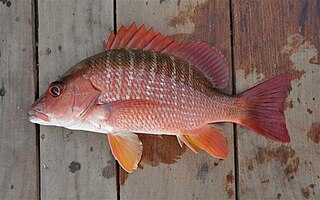
Gorean snapper Species of fish

The Gorean snapper is a species of marine ray-finned fish, a snapper belonging to the family Lutjanidae. It is found in the eastern Atlantic Ocean.
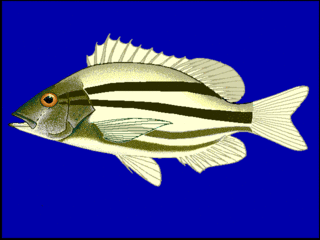
Pygmy snapper Species of fish

The pygmy snapper is a species of ray-finned fish, a snapper belonging to the family Lutjanidae. It is found in the western Pacific Ocean and is only known from fresh and brackish waters.

<i>Lutjanus novemfasciatus</i> Species of fish

Lutjanus novemfasciatus, the Pacific dog snapper or Pacific cubera snapper, is a species of marine ray-finned fish, a snapper belonging to the family Lutjanidae. It is native to the eastern Pacific Ocean.

Pinjalo lewisi, the slender pinjalo or red pinjalo, is a species of marine ray-finned fish, a snapper belonging to the family Lutjanidae. It is found in the Indian and Western Pacific Oceans.

References

  1. 1 2 3 Russell, B.; Bullock, R.W.; Carpenter, K.E. & Ambuali, A. (2019). "Pinjalo pinjalo". IUCN Red List of Threatened Species . 2019: e.T194403A2331841. doi: 10.2305/IUCN.UK.2019-2.RLTS.T194403A2331841.en . Retrieved 28 June 2021.
  2. 1 2 3 4 Froese, Rainer and Pauly, Daniel, eds. (2021). "Pinjalo pinjalo" in FishBase. February 2021 version.
  3. 1 2 Eschmeyer, William N.; Fricke, Ron & van der Laan, Richard (eds.). "Species in the genus Pinjalo". Catalog of Fishes . California Academy of Sciences . Retrieved 28 June 2021.
  4. Christopher Scharpf & Kenneth J. Lazara, eds. (5 January 2021). "Order LUTJANIFORMES: Families HAEMULIDAE and LUTJANIDAE". The ETYFish Project Fish Name Etymology Database. Christopher Scharpf and Kenneth J. Lazara. Retrieved 28 June 2021.
  5. 1 2 3 Gerald R. Allen (1985). FAO species catalogue Vol.6. Snappers of the world An annotated and illustrated catalogue of lutjanid species known to date (PDF). FAO Rome. pp. 139–140. ISBN   92-5-102321-2.
  6. 1 2 Bray, D.J. (2019). "Pinjalo pinjalo". Fishes of Australia. Museums Victoria. Retrieved 28 Jun 2021.
  7. "Pinjalo snapper". FishIDER. Retrieved 29 June 2021.