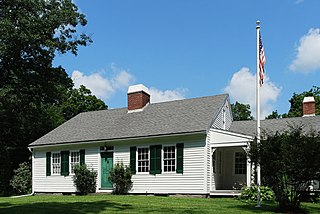
The Clara Barton Homestead, also known as the Clara Barton Birthplace Museum, is a historic house museum at 60 Clara Barton Road in Oxford, Massachusetts. The museum celebrates the life and activities of Clara Barton (1821-1912), founder of the American Red Cross. The property was listed on the National Register of Historic Places in 1977. The museum is open seasonally, or by appointment. It has been restored to the period when Barton lived there.

The Brookfield Common Historic District encompasses a historically significant portion of the town center of Brookfield, Massachusetts. It is focused on the town common, which extends south from Main Street to Lincoln Street, and includes a dense cluster of houses on roads to its east, as well as properties on Main Street and the Post Road. The district includes more than 100 properties, including the Colonial Revival Town Hall, Banister Memorial Hall, and Romanesque Revival Congregation Church. The district was added to the National Register of Historic Places in 1990.

Waters Farm is a historic farm and homestead at 53 Waters Road in Sutton, Massachusetts. Waters Farm was built in the Georgian style by Stephen Waters in 1757. The property was added to the National Register of Historic Places in 1985.

The Old Tavern Farm is a historic farmstead at 817 Colrain Road in Greenfield, Massachusetts. The main structure exemplifies the organic growth of a farm complex from colonial days into the 19th century. The main block of the house is a Federal style 2-1/2 story center chimney structure, built c. 1820. A 42-foot (13 m) wing added onto the main block's west side is built in part on a foundation dating to 1740; this section of the house was apparently built in 1794, tearing down the earlier 1740 construction. This wing is attached at its other end to a 19th-century barn.

The Brimfield Center Historic District is a historic district encompassing the historic center of Brimfield, Massachusetts. The district is centered on the town common, and includes properties radiating out from that center on Main Street, Brookfled, Wales, Sturbridge and Warren Roads. Brimfield Center was first laid out in 1721 along a Native American trail that ran through the area, and developed over the years into what is now US Route 20, or Main Street. The district includes properties ranging from early colonial houses to the town hall, built in 1878. The center has retained some coherence because the Brimfield Fair, a major antiques market that takes place three times a year, takes up significant open space in the areas near the center. The district was listed on the National Register of Historic Places in 2006.
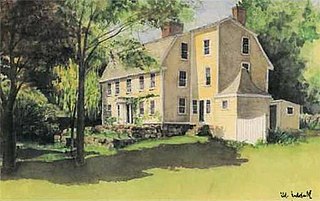
The Babson-Alling House is a historic colonial house in Gloucester, Massachusetts. The 2.5-story Georgian house was built in 1740 by William Allen, and remains one of Gloucester's finest houses of the period. It is a typical house of the time, with a center chimney plan and a gambrel roof. The house was bought by Joseph Low in 1779; his daughter Elizabeth married Nathaniel Babson, and their son ended up inheriting the property. It remained in the Babson family into the 20th century, eventually being inherited by Low descendant Elizabeth Alling.

The Bacon-Gleason-Blodgett Homestead is a historic house at 118 Wilson Road in Bedford, Massachusetts. Built about 1740, it is the town's only surviving example of a brick-end colonial-period house, with long association to a nearby gristmill. The house was listed on the National Register of Historic Places on April 14, 1977, and included in the Wilson Mill-Old Burlington Road District on August 18, 2003.

The Henry Fletcher House is a historic house at 224 Concord Road in Westford, Massachusetts. Built c. 1810–13, it is a rare example of very late Georgian style timber-frame construction, with a large central chimney characteristic of colonial-era houses. It is styled with a mix of late Georgian and Federal style woodwork. The property's barn was also built by Henry Fletcher using the same construction methods. The house was listed on the National Register of Historic Places in 1993.

The Daniel Nichols Homestead is a historic home in Reading, Massachusetts. The oldest portion of this timber-frame house was built in the early 1740, with vernacular Georgian styling. The house is five bays wide and two deep, with a rear shed-roof extension giving the house a saltbox appearance. An ell was added in the mid-19th century. The main architectural detail is the front door surround, which features sidelight windows and recessed, paneled pilasters supporting a tall entablature.

102 Staniford Street in the Auburndale section of Newton, Massachusetts, is a rare surviving element of Auburndale's agricultural past, including both a 19th-century house and barn. Built about 1869 and enlarged in 1915, it exhibits vernacular Italianate styling. It was listed on the National Register of Historic Places in 1986. As of 2014, it was still within the family of its original owner.

The Lewis June House, also known as the Scott House, is a historic house at 478 North Salem Road in Ridgefield, Connecticut, USA. Built c. 1865, it is one of a small number of Second Empire houses in Ridgefield, and its best-preserved and most elaborate example of the style. The house was listed on the National Register of Historic Places in 1984.

The Persia Beal House is a historic house at 797 Chesham Road in Harrisville, New Hampshire. It is now the Harrisville Inn. Built about 1842, it is one of the best-preserved 19th century connected farmsteads in the town. The property is also notable for its association with Arthur E. Childs, who purchased the property to serve as the estate farm for his nearby Aldworth Manor summer estate. The house was listed on the National Register of Historic Places in 1988.

The Rufus Piper Homestead is a historic house on Pierce Road in Dublin, New Hampshire. The house is a well-preserved typical New England multi-section farmhouse, joining a main house block to a barn. The oldest portion of the house is one of the 1+1⁄2-story ells, a Cape style house which was built c. 1817 by Rufus Piper, who was active in town affairs for many years. The house was listed on the National Register of Historic Places in 1983. The home of Rufus Piper's father, the Solomon Piper Farm, also still stands and is also listed on the National Register of Historic Places.

The Abijah Richardson Sr. Homestead is a historic house at 359 Hancock Road in Dublin, New Hampshire. Built about 1795, it is one of Dublin's oldest houses, built by Abijah Richardson Sr., one of the town's early settlers and progenitor of a locally prominent family. The house was listed on the National Register of Historic Places in 1983.

The Willard Homestead is a historic house on Sunset Hill Road in Harrisville, New Hampshire. Built about 1787 and enlarged several times, it is notable as representing both the town's early settlement history, and its summer resort period of the early 20th century. The house was listed on the National Register of Historic Places in 1988.
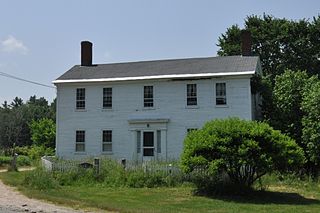
The Plummer Homestead is a historic house museum at 1273 White Mountain Highway in Milton, New Hampshire. Built in the 1810s and repeatedly extended, it dates to the early settlement period of Milton, and is, along with the adjacent Plumer-Jones Farm, one of the oldest farm properties in the state. Both are now part of the New Hampshire Farm Museum. The house was listed on the National Register of Historic Places in 2002.

The Theron Boyd Homestead is a historic farm property on Hillside Road in Hartford, Vermont. The centerpieces of the 30-acre (12 ha) property are a house and barn, each built in 1786. The house, little altered since its construction, is one of the finest early Federal period houses in the state. The property is owned by the state, which has formulated plans to open it has a historic site. It was listed on the National Register of Historic Places in 1993.

The Joseph and Daniel Marsh House is a historic farmstead at 1119 Quechee Main Street, just outside the village Quechee in Hartford, Vermont. Built in 1793, it was the home of Joseph Marsh, one of Hartford's early settlers and the first Lieutenant Governor of Vermont. Now the Quechee Inn, the property was listed on the National Register of Historic Places in 1998.

Lareau Farm is a historic farm property at 48 Lareau Road in Waitsfield, Vermont. First settled in 1794 by Simeon Stoddard and his wife Abiah, two of the town's early settlers, the farmstead includes both a house and barn dating to that period. Now serving primarily as a bed and breakfast inn, the farm property was listed on the National Register of Historic Places in 2016.