
The Noctilucales are an order of marine dinoflagellates. They differ from most others in that the mature cell is diploid and its nucleus does not show a dinokaryotic organization. They show gametic meiosis.

Bioluminescence is the production and emission of light by a living organism. It is a form of chemiluminescence. Bioluminescence occurs widely in marine vertebrates and invertebrates, as well as in some fungi, microorganisms including some bioluminescent bacteria, and terrestrial arthropods such as fireflies. In some animals, the light is bacteriogenic, produced by symbiotic bacteria such as those from the genus Vibrio; in others, it is autogenic, produced by the animals themselves.

Chtenopteryx is a genus of small, muscular, midwater squid in the monotypic family Chtenopterygidae. Four species are presently recognized in the genus, but more are believed to exist.

Siphonophorae is an order of Hydrozoans, a class of marine organisms belonging to the phylum Cnidaria. According to the World Register of Marine Species, the order contains 175 species.
Grantia is a genus of calcareous sponges belonging to the family Grantiidae. Species of the genus Grantia contain spicules and spongin fibers.
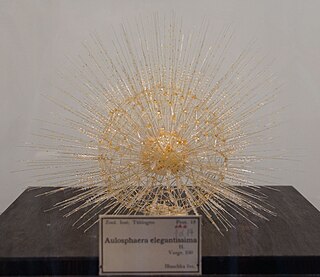
Aulosphaera is a genus of Cercozoa. The genus contains bioluminescent species. It one of two known bioluminescent phaeodarean genera, the other being Tuscaridium. The described bioluminescent species is Aulosphaera triodon Haeckel, 1887.
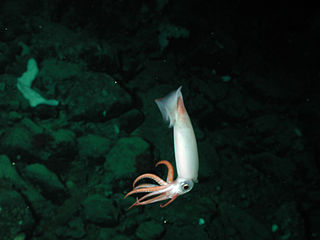
Gonatus is a genus of squid in the family Gonatidae, comprising twelve species, and therefore containing the most species in the family. Adult squid belonging to species in this genus are notable for their lack of tentacles.

Bolitaena is a genus of pelagic octopods from the subfamily Bolitaeninae in the family Amphitretidae. It contains two species, a third species Bolitaena microcotyla is now regarded as a synonym of Haliphron atlanticus.
Thalassicolla is a radiolarian genus reported in the Thalassicollidae. The genus contains bioluminescent species. It is a genus of solitary radiolarians.
Cytocladus is a radiolarian genus reported in the family Thalassothamnidae. The genus contains bioluminescent species.

Collozoum is a radiolarian genus formerly reported in the subfamily Sphaerozoidae, now reported descending from the order Collodaria. The genus contains bioluminescent species. It is a genus of colonial radiolarians.
Rhaphidozoum is a radiolarian genus reported in the subfamily Sphaerozoidae. The genus contains bioluminescent species. It is a genus of colonial radiolarians.
Sphaerozoum is a radiolarian genus formerly reported in the subfamily Sphaerozoidae, now reported in the Collosphaeridae. The genus contains bioluminescent species. It is a genus of colonial radiolarians.

Acrosphaera is a radiolarian genus in the Collosphaeridae. The genus contains bioluminescent species. It is a genus of colonial radiolarians.

Collosphaera is a radiolarian genus in the family Collosphaeridae. The genus contains bioluminescent species. It is a genus of colonial radiolarians.

Abylopsis is a siphonophore genus in the Abylidae. The genus contains bioluminescent species.
Rosacea is a genus in the Prayidae. The genus contains bioluminescent species.

Syllis is a genus of marine bioluminescent polychaete worms.
Myxosphaera is a radiolarian genus in the Collosphaeridae. The genus may contain bioluminescent species. It is a genus of colonial radiolarians.
Tuscaridium is a genus of phaeodarian,. The genus contains bioluminescent species. It one of two known bioluminescent phaeodarean genera, the other being Aulosphaera.

