An editor has nominated this article for deletion. You are welcome to participate in the deletion discussion , which will decide whether to keep it. |
Southern Transitional Council Arabic: المجلس الانتقالي الجنوبي | |
|---|---|
| | |
| Status | Self-governing Quasi-state (2020–2022, 2025–present) |
| Capital | Aden |
| Government | |
• Chairman | Aidarus al-Zoubaidi |
• Vice-chairman | Hani Bin Breik |
| Establishment | Yemeni civil war (2014–present) |
| History | |
• Declared self-governance | 26 April 2020 [1] |
| 2 December 2025 – present | |
| Currency | Yemeni rial (YER) |

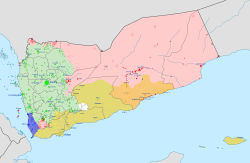
The Territory of the Southern Transitional Council refers to territory in Yemen under the de facto control of the Southern Transitional Council during the Yemeni Civil War. The STC exercises control over the city of Aden, which also serves as it's capital, and most of the territory of the former South Yemen, which existed as an independent state between 1967 and 1990. [2] The STC wants to establish a new state under the name "State of South Arabia." [3]
In 1914, following the Anglo-Ottoman Convention of 1913, the United Kingdom and Ottoman Empire divided Arabian Peninsula into two parts: the northwest under Ottoman control and influence, and the southeast under British control and influence. [4] The UK established the Aden Colony in 1937 and a Federation of the Emirates of South Arabia in 1959 which evolved into a western Federation of South Arabia alongside an eastern Protectorate of South Arabia in 1963.
Following an armed rebellion, British forces withdrew from southern Yemen in November 1967, resulting in the independence of the People's Republic of Southern Yemen which later became the People's Democratic Republic of Yemen in 1970.
The People's Democratic Republic of Yemen and the neighbouring Yemen Arab Republic united in May 1990 as the Republic of Yemen. Southern separatists proclaimed a Democratic Republic of Yemen in May 1994, however the attempted succession was defeated in July that year.
The Southern Movement and its offshoots have their roots in protests and sit-ins organised by military and civil officials in many of the southern and eastern governorates [5] , especially those who had been a member of the South Yemeni Armed Forces, who had been forced into an early retirement in 2007 demanding higher pensions. [6] From these protests, came other grievances against the incumbent government of Ali Abdullah Saleh.
In September 2014, the Houthi movement took control of Sanaa leading to the Yemeni Civil War prompting Yemen's internationally recognised government to move to Aden, the capital of the former South Yemen.
The Southern Transitional Council (STC) was established on 11 May 2017 and has called for re-establishment of South Yemen as an independent state under the name "State of South Arabia". [7] [3] [3] [8] The STC took control of Aden in January 2018 and allied with the Yemeni government the following year.The STC declared self-governance on 26 April 2020. [9] A power-sharing Presidential Leadership Council was established in 2022 with the STC allocated three out of the eight seats, and STC leader Aidarus al-Zoubaidi, holding the vice-chairmanship. [10] [11] [12] [13]
In September 2025, the STC called for a "two-state solution" to ending the Yemeni civil war. [14] Three months later, on 2 December 2025, the STC launched an offensive across southern Yemen rapidly capturing most of the territory of the former South Yemen by 8 December. [15] [16] In the immediate aftermath, Presidential Leadership Council chair Rashad al-Alimi and Yemani prime minister Salem Saleh bin Braik left Aden for Riyadh, Saudi Arabia. [17]
Following the offensive, rallies and sit-ins were held in Aden and other cities demanding the re-establishment of an independent state in South Yemen. [18] [19] By 21 December several ministers in the Yemeni cabinet had issued statements supporting southern independence and STC leader Aidarus al-Zoubaidi had declared that the "next stage will be the stage of building institutions of the future state of South Arabia". [20] [21] [22] In response PLC chair Rashad al-Alimi, still in Riyadh, stated that these ministers had "exceeded their functional responsibilities" and ordered legal action against "violations undermining state authority". [23] Subsequently the five non-STC members of the Presidential Leadership Council resolved to suspend any public official who supported southern succession. [24]
As of 8 December 2025, the STC controlls most of the territory of the former South Yemen, i.e. present day governorates of Aden, Lahij, Dhale (part), Abyan, Shabwah, Hadhramaut, Al Mahrah and Socotra. [25] [15]
| Name in English | Name in Arabic | Capital | Area (km2) [26] | Population (2013) [27] | Population Density |
|---|---|---|---|---|---|
| Abyan | أبين | Zinjibar | 21,939 | 658,824 | 30.0 |
| Aden | عدن | Aden | 1,114 | 1,087,653 | 976.3 |
| Al Mahrah | المهرة | Al Ghaydah | 122,500 | 400,000 | 3.2 |
| Dhale | الضالع | Dhale | 4,786 | 602,613 | 125.9 |
| Hadramaut | حضرموت | Mukalla | 191,737 | 1,329,085 | 6.9 |
| Lahij | لحج | Lahij | 15,210 | 926,291 | 60.5 |
| Shabwah | شبوة | Ataq | 47,728 | 651,509 | 13.6 |
| Socotra | محافظة أرخبيل سقطرى | Hadibu | 2359 | 60,000 | 25.4 |
A Presidential Commission for the Southern Transitional Council was announced in May 2017 and as of May 2023 has 26 members with Aidarus al-Zoubaidi serving as chair and Hani Bin Breik as vice-chair. [28] [29] [30]
The National Assembly is a deliberative body of the STC consisting of 303 members representing the districts and governorates of southern Yemen. Its speaker is Ali Al-Kathiri, who is also a member of the STC presidency. [31]
The Southern Transitional Council is widely considered as being backed by the United Arab Emirates. [8]
The Southern Armed Forces is the military component of the Southern Transitional Council. The Security Belt is its elite forces wing. The STC is also allied with militia groups including the Hadhrami Elite Forces, the Shabwah Defence Forces, and the Southern Giants Brigades
Amnesty International reported a series of human rights violations in STC-held areas. Since 2023, the STC in Aden introduced restrictions on civil society organizations, requiring permits from STC-run bodies for public activities. According to Amnesty, permit requirements often involved extensive reporting obligations and were sometimes used to limit opposition to the STC. [32]
In 2013, the population of the present day governorates that comprised the former South Yemen was 5,715,975 representing 19% of the population of Yemen. [33]
القطيعة مع فكرة يمن موحد، حسب الزبيدي، "ستكون نهائية. لن يحمل اسم الدولة القادمة حتى كلمة اليمن". "دولة الجنوب العربي" هو الأكثر قبولاً لدى أنصار المجلس الانتقالي، وهو اسم قديم يعود إلى الاتحاد الذي أنشأه المستعمر البريطاني عند توحيده عددا من المشيخات والسلطنات في الجنوب قبل الاستقلال عام 1967.[The break with the idea of a unified Yemen, according to Al-Zubaidi, "will be final. The name of the future state will not even include the word Yemen." "The State of South Arabia" is the most acceptable name among supporters of the Transitional Council. It is an old name that dates back to the union created by the British colonists when they unified a number of sheikhdoms and sultanates in the south before independence in 1967.]
{{cite web}}: CS1 maint: numeric names: authors list (link){{cite web}}: CS1 maint: numeric names: authors list (link){{cite web}}: CS1 maint: numeric names: authors list (link){{cite web}}: CS1 maint: numeric names: authors list (link)