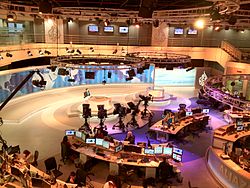
Al Jazeera Media Network (AJMN)[a] is a Qatarinews media organization headquartered in Wadi Al Sail, Doha.[3] It is a statutoryprivate foundation for public benefit,[4] and is primarily funded by the government of Qatar.[5] The network's flagship channels include Al Jazeera Arabic and Al Jazeera English, which cover regional and international news, alongside the digital platform AJ+. Al Jazeera is available in more than 150 countries and territories and has a global audience of over 430 million people.[6]
Originally conceived as a satellite TV channel delivering Arabic news and current affairs, it has since evolved into a multifaceted media network encompassing various platforms such as online, specialized television channels in numerous languages, and more. The network's news operation currently has 70 bureaus around the world that are shared between the network's channels and operations.[7]
The network has often been targeted by foreign governments upset with its reporting.[8][9][10] During the Qatar diplomatic crisis, several Arab countries severed diplomatic ties with Qatar and imposed a blockade. One of their demands was the closure of Al Jazeera.[11] Other media networks have spoken out against this demand.[12] Critics often view Al Jazeera Arabic as being influenced by Qatar's foreign policy.[13][14]
History
Launch
Al Jazeera was founded by Hamad Bin Khalifa Al Thani, the then-Emir of the State of Qatar and head of the Al Thani Qatari Royal Family.[15] He first publicly floated the idea of launching an international news channel in August 1994, when he was still crown prince.[16] The Al Jazeera Satellite Channel was launched on 1 November 1996.[17] The creation of the new Arabic news network followed the closure of the first BBC Arabic language television station, then a joint venture with Orbit Communications Company, owned by Saudi King Fahd's cousin, Khalid bin Faisal Al Saud. The BBC channel had closed after a year and a half when the Saudi government attempted to thwart a documentary pertaining to executions of prominent Saudi dissidents.[18] Many former BBC Arabic journalists subsequently joined Al Jazeera during its initial hiring phase.[19] Following a London screening of a six-hour test broadcast, the emir dropped his initial idea to mix news and entertainment, and decided on an all-news format.[16] Al Jazeera was launched with a loan-turned-grant of approximately $137-150 million from then-Emir Hamad bin Khalifa.[20][21][22]
At launch, Al Jazeera broadcast six hours of programming per day, expanding to twelve hours by the end of 1997. It was broadcast to the immediate surrounding region as a terrestrial signal and on cable, as well as through satellites (a service which was free to users in the Arab world). On 1 January 1999, Al Jazeera began broadcasting on a 24-hour schedule.[23] Within a year, employment had more than tripled to approximately 500 staff, and the network had established bureaus at a dozen locations, extending to the European Union, Russia, and Taliban-controlled Afghanistan.[24] Its annual budget was estimated at $30 million at the time.[20] Al Jazeera was included in cable packages in the United States, the United Kingdom, and Israel.[25]:61
Al Jazeera was launched with a mandate of independence.[26][27][28] In March 1998, the emir disbanded the Ministry of Information, which had been responsible for overseeing press censorship.[29][30] The 2004 Constitution of Qatar, guaranteeing freedom of the press, provided further reinforcement.[31] The motives behind the establishment of Al Jazeera are debated, with commentators citing a range of possible motivations, including financial, political interests, and the promotion of uncensored media in the region.[32][33][34] By 1998, Al Jazeera was already one of the major news providers in the Middle East.[35]
Restructuring
Al Jazeera's former Knightsbridge London Control Room
In 2006, Wadah Khanfar, then the managing director of the Arabic Channel, was appointed as the director general of the Al Jazeera Satellite Network while continuing to serve as managing director of the Al Jazeera Arabic channel.[36] In September 2011, Al Jazeera's long-time director general Wadah Khanfar unexpectedly resigned after eight years leading the network.[37]
On 26 November 2009, Al Jazeera English received approval from the CRTC, which enables Al Jazeera English to broadcast via satellite in Canada.[38] In 2011, Al Jazeera Media Network was legally restructured from a "public institution" to a "private institution of public utility"; however, it was unknown how this would affect editorial management and funding. According to Al Jazeera, the restructuring was intended to provide greater administrative flexibility and a faster decision-making process.[39][40] The network is also funded through its television contracts and revenue from its sports division. In March 2016, Al Jazeera announced that it would lay off about 500 employees worldwide, a reduction of roughly 10 percent of its workforce, as part of cost-cutting measures.[41]
Al Jazeera and the 2011 Arab Spring
Al Jazeera covered the Arab Spring more than any other news outlet; it had a significant role in spreading the Arab uprising.[42] Al Jazeera was the leading media outlet spreading the news about unrest in a small city in Tunisia throughout the Middle East in 2011.[43]
People in the Middle East have heavily relied on Al Jazeera to obtain news about their regions and the world, even more so than YouTube and Google.[43]Hillary Clinton, who was the U.S. Secretary of State at the time of the Arab Spring, stated that Al Jazeera "has been the leader in that [it is] literally changing people's minds and attitudes. And like it or hate it, it is really effective."[43]
The news of unrest in the Arab states was broadcast by Al Jazeera in Arabic for the Arab world as well as in English for the audiences from the rest of the world.[42]
In Tunisia, the Ben Ali regime banned Al Jazeera from operating in the country, but with the help of Facebook users inside Tunisia, Al Jazeera was able to access reports of events, such as protests and government crackdowns, that were taking place inside the country.[42] The intensive media coverage of people's uprising against their leaders by Al Jazeera mobilized more people from other parts of the country to join the revolution.[42]
The population in other Arab countries, including Bahrain, Egypt, Yemen, Libya, and Syria, also mobilized against their governments, inspired by the Tunisians' successful revolt, which was extensively covered by Al Jazeera Arabic.[42] International opinion also came to support the Arab movements in the Middle East, since Al Jazeera English covered and reported governmental human rights abuses against political activists and ordinary citizens.[42]
Al Jazeera Arabic was launched on November 1, 1996, by the government of Qatar. Noted for its journalistic professionalism, especially when contrasted with other Arab news organizations,[44] Al Jazeera gained popularity in the Arab world as an alternative to the previous landscape of largely local state-owned broadcasters,[45] with its early coverage being openly critical of autocratic leaders in the region, as well as hosting a wide range of viewpoints,[46] gaining credibility through its extensive frontline coverage of the Second Intifada and the Iraq War.[47][48] Al Jazeera Arabic is editorially independent from Al Jazeera English.[49][50][46] While the news network insists that it has editorial independence, the network is widely seen by foreign governments as a soft power tool for Qatar.[51]
Al Jazeera English (AJE) was launched on November 15, 2006, as the English-language counterpart to Al Jazeera Arabic. It positions itself as an alternative media platform to the dominance of Western media outlets like CNN and BBC, focusing on narrative reporting where subjects present their own stories.[52][53] Al Jazeera is known for its in-depth and frontline reporting particularly in conflict zones[54][55] such as the Arab Spring, the Gaza–Israel conflict and others.[56][57][55][58] Al Jazeera's coverage of the Arab Spring won the network numerous awards, including the Peabody Award.[54][59]
In 2001, Al Jazeera stood as the sole international news network broadcasting from Kabul, Afghanistan. Following the events of 9/11, there was a notable surge in demand for an English-language version of Al Jazeera.[60][61] In late 2002, the director of marketing of Al Jazeera, Ali Mohamed Kama, began to push a "repositioning" of Al Jazeera, "accompanied by the introduction of English subtitles and dubbing of broadcast into English."[62]
Al Jazeera's coverage came under intense global scrutiny after the September 11 attacks. During this period, Al Jazeera’s Kabul bureau was destroyed by a US airstrike, an event the network and many observers regarded as deliberate, though the US denied intent.[61] Its reporting on the wars in Afghanistan and Iraq, offering perspectives distinct from Western media, prompted criticism from governments and commentators.[63] According to one of the central architects of Al Jazeera English, Steve Clark, the decision to invest substantially in a new English-language network was driven in part by a desire to address Western perceptions of Al Jazeera and to respond to growing scrutiny of the network's Arabic-language programming.[64]
In 2003, Al Jazeera hired its first English-language journalists, among whom was Afshin Rattansi,[65] from the BBC's Today programme.
In March 2003, it launched an English-language website[66] (see below). The name of the website was "Al Jazeera Net"; it was launched by younger journalists. The site published various stories covered by the network, but it did not depend on Arabic-language channels and websites. The website aimed to connect to the Western audience, cooperate with BBC, and be "a global citizen's home page."
However, twelve hours after the launch of the website, Al Jazeera Net was kept offline due to many denial of service attacks. Over twenty-four hours later, Al Jazeera Net came back online, but Freedom Cyber Force Militia then hacked the website to redirect web browsers to a picture of the American flag with a slogan saying "Let Freedom Ring". Al Jazeera Net was then unable to be securely hosted because three of Al Jazeera's web providers, Horizons Media, Information Services, and Akamai Technologies canceled the contract. Also in March, Yahoo and AOL stopped advertising contracts with Al Jazeera. Therefore, the English-translated website was shuttered later in 2003.[67]
On 4 July 2005 Al Jazeera officially announced plans to launch a new English-language satellite service to be called Al Jazeera International.[68] The new channel started at 12h GMT on 15 November 2006 under the name Al Jazeera English and launched with broadcast centers in Doha (next to the original Al Jazeera headquarters and broadcast center), London, Kuala Lumpur and Washington, D.C. Initially, 12 hours of news a day were broadcast from Doha, and the rest of the day's output was split equally between London, Kuala Lumpur, and Washington, D.C. Among its staff were journalists hired from ABC's Nightline and other top news outfits. Josh Rushing,[69] a former media handler for CENTCOM during the Iraq war, agreed to provide commentary; David Frost was also on board.[70][71]
The new English-language venture faced considerable regulatory and commercial hurdles in the North American market for its perceived sympathy with extremist causes.[72][73][74] The channel eventually secured carriage on a small number of cable systems in the United States, including one in Washington, D.C.[75]
Al Jazeera Turk
Al Jazeera Turk logo
In February 2011, the Savings Deposit Insurance Fund of Turkey put Cine5 up for sale[76] after the channel was confiscated when the owner Erol Aksoy went in debt and became bankrupt.[77] Al Jazeera made a bid for the network[78] and acquired it for $40.5 million after an unsuccessful $21 million bid.[79] Al Jazeera then renamed the channel and worked on launching a Turkish language Al Jazeera operation.[80]
In April 2012, there were reports of the channel being delayed over its refusal to call the Kurdistan Workers Party (PKK) as terrorists, despite it being designated as a terrorist organization by many countries and supranational organisations including but not limited to Turkey, the United States, the EU, NATO, Israel, the United Kingdom, citing journalistic standards. The Foreign Ministry, who advocated the project, became at odds with the channel. Vural Ak, a major Turkish investor, withdrew from the partnership with Al Jazeera. Nuh Yilmaz, head of Al Jazeera's Turkish editorial team, also resigned.[81]
In 2013 they announced the creation of Al Jazeera Türk, a version of Al Jazeera in the Turkish language(s), stationed in Istanbul, and catering to and broadcasting around Turkey. On January 22, 2014, Al Jazeera Türk's website was launched with news content. The move made Al Jazeera Türk the first 24-hour news operation to go digital before broadcast.[82] The channel was under construction with plans to launch towards the end of 2014. Construction and indoor works were underway at the upcoming channel's building in Topkapı, İstanbul.[83] The website shut down in 2017 without the channel being launched.[84][85]
Al Jazeera America was an American version of Al Jazeera English. The channel launched on 20 August 2013 exclusively on cable and satellite systems in the United States.[citation needed]
On 2 January 2013, Al Jazeera Media Network announced that it purchased Current TV from its founders Al Gore, Joel Hyatt, and Ronald Burkle, in the United States and would be launching an American news channel. Originally 60% of the channel's programming would be produced in America while 40% would be from Al Jazeera English, which later changed to almost all the content being U.S. originated.
Though Current TV had large distribution throughout the United States on cable and satellite TV, it averaged only 28,000 viewers at any time.[86] The acquisition of Current TV by Al Jazeera allowed Time Warner Cable to drop the network due to its low ratings, but released a statement saying that they would consider carrying the channel after they evaluated whether it made sense for their customers.[87][88][89][90][91] The channel was later added to Time Warner and Bright House Networks lineups after a new carriage deal was agreed upon.
On January 13, 2016, Al Jazeera America CEO Al Anstey announced that the network would cease operations on April 12, 2016, citing the "economic landscape".[92] The Al Jazeera English news channel became available digitally in the US in September, 2016.[93]
Al Jazeera Media Network also has a digital online-only news channel AJ+. The channel is an online and mobile-only news channel primarily found on various social media networks and YouTube and operated by Al Jazeera New Media out of Washington, D.C. (previously San Francisco, California). The channel consists of mostly On Demand content. It soft-launched on 13 June 2014 with a new webpage, Facebook page and videos on YouTube. The full channel launched with an app on 15 September 2014.[94] There are also Arabic and Spanish language versions of the channel.
In 2004 Al Jazeera expanded into the world of sports with the establishment of Al Jazeera Sport (now known as beIN Sports) and the building of 8 Arabic-language specialty sports channels.
On 1 January 2014, Al Jazeera Sport was renamed to beIN Sports after it along with all of the organisation's non-news and current affairs assets were spun off and privatised into beIN Media Group; the channels were legally spun off to have consistency with all the Network's sports properties[clarification needed]. According to Kate O'Brian, President of Al Jazeera America, Al Jazeera Sport revenue helped fund the network when it was in operation similar to how BBC Worldwide helps fund the BBC.[citation needed]
On September 9, 2005, Al Jazeera established a children's division with the launch of Al Jazeera Children's Channel (since 2013 it was known as JeemTV). The channel targets an audience of 7 to 15-year-olds and broadcasts 24 hours a day.[citation needed]
On January 16, 2009, Baraem launched, the channel targets an audience of three to seven-year-olds and broadcasts 17 hours a day (6 am to 11 pm Doha time).[citation needed]
On April 1, 2016, both JeemTV and Baraem were acquired by beIN Media Group and were made part of beIN Channels Network. Since then, as a result, the channels were no longer free to view and made exclusive to beIN Channels Network.[citation needed]
On January 1, 2018, Al Jazeera launched a Mandarin-language news website becoming the first Middle Eastern news provider to target the Chinese audience. The staff of the project is in contact with their audience via Chinese social media like Weibo, Meipai and WeChat.[95]
Al Jazeera Podcasts
Al Jazeera Podcasts logo
In 2017, the network launched a podcasting network called Jetty. Later renamed Al Jazeera Podcasts, the network is available via the network's website as well as SoundCloud, Apple Podcasts, Stitcher, TuneIn, and iHeartRadio. The network is based out of San Francisco alongside AJ+ and is available in English.[96] Jetty debuted with the podcast Closer Than They Appear, a hybrid interview/narrative show hosted by writer Carvell Wallace. Other podcasts that debuted in 2018 included The Game of Our Lives which uses soccer to explain global economics and cultures, a podcast on freedom dubbed (Freedom Stories, featuring Melissa Harris-Perry), sex (The Virgie Show) with Virgie Tovar, and global music (Movement) with Meklit Hadero.[96]
Rightly
In 2021, the network launched Rightly, an online news channel aimed at center-right American conservatives. The channel much like AJ+ is only available online, primarily on YouTube. The launch of the channel spurred questions from Al Jazeera staff questioning if the channel took away from Al Jazeera's mission to be non-partisan and from various media critics wondering if conservative audiences would watch a channel from Al Jazeera, a long time target of American conservatives.[97][98]
Al Jazeera Center for Studies
Al Jazeera Media Network owns and operates the Al Jazeera Center for Studies Al Jazeera Center for Studies. Established in 2006, the Al Jazeera Center for Studies conducts in-depth analysis of current affairs at both regional and global levels. Its research agenda focuses primarily on geopolitics and strategic developments in the Arab world and surrounding regions.[99] The center with an extensive network of distinguished researchers, and a wide range array of experts from across the globe, the center aims to promote dialogue and build bridges of mutual understanding and cooperation between cultures, civilizations, and religions. The center also contains the Al Jazeera Media Training and Development Center.[citation needed]
Al Jazeera International Documentary Film Festival
The Al Jazeera International Documentary Film Festival is an annual film festival held at the Doha Sheraton in Doha, Qatar. The first festival was held on 18 April 2005. Every year the festival has a different theme.[100]
Al Jazeera Media Network also operates Al Jazeera Documentary Channel, an Arabic-language documentary channel, Al Jazeera Mubasher, a live politics and public interest channel, which broadcasts conferences in real time without editing or commentary. Al Jazeera Mubasher is first channel of its kind in the Middle East.[citation needed]
Partnerships
In 2017, Al Jazeera signed a strategic partnership agreement with Google.[102] In 2019, Al Jazeera signed a partnership agreement with the China Intercontinental Communication Center over Al Jazeera's documentary channel with the aim of expanding its documentary content through co-production and exchange of media.[103][104] The same year, Al Jazeera and Bloomberg signed a content license agreement.[105] In 2021, Al Jazeera partnered with Arewa 24 to provide its content in Hausa.[106] In 2023, Al Jazeera partnered with Avid Technology.[107] Al Jazeera Media Network announced an expanded collaboration with Google Cloud, designating it as the network's primary technology provider for its initiative to integrate Google's generative AI and agent-based technologies into news production.[108]
The "Al Jazeera effect" is the impact of Al Jazeera Media Network on global politics. The term coined by Philip Seib and possibly used earlier by Simon Henderson, initially referred to Arab governments losing control of information due to Al Jazeera's popularity. Seib later generalized it to other Internet-powered news media.[109] In his book The Al Jazeera Effect, Seib argues that the rise of emerging media has weakened governments ability to control flow of information.[110] Al Jazeera is presented as the prime example.
Al Jazeera has been the prime source of information on the protests in Egypt and Tunisia.[111] Al Jazeera challenged government censorship and the dominant Western viewpoint of Arabs.[112] It challenges authoritarian governments by stimulating discussion on topics and through its provision of multiple perspectives and opinions.[113] The outlet prioritizes perspectives from marginalized communities rather than relying solely on official statements from officials and other figures of power.[114] It shifted the flow of information from the "West to the rest" reporting on underrepresented countries and offering a platform for Arab citizens expression.[115] Critics acknowledge its role in reforms during the 2005 Arab Spring.[116] It has been compared to the CNN effect. Seib concludes that the new media, while not beyond being abused, are largely contributing to democratization and political reform worldwide.[109]
Finances
The network was launched with approximately $137 million in funding from the Qatari government, initially structured as a loan that was later converted into a grant. In addition, the government has reportedly covered annual losses of about $100 million for Al Jazeera's Arabic language operations.[22]Al Jazeera English was launched in 2006 with an investment of approximately $1 billion by the Emir of Qatar.[21][117] In 2012 it was still estimated that "the vast majority" of the network’s funding came from the goverment.[118]
The network does not publicly disclose detailed financial statements.[119][5] In a 2017 interview with the BBC, Acting Director General of AJMN Mostefa Souag estimated that "90% maybe" of Al Jazeera's budget comes from the government.[5] The Qatari government continues to invest billions of dollars annually in the operations of the Al Jazeera network.[120] Other sources of revenue include advertising, subscription fees and the sale of footage and broadcast rights.[121]
Editorial independence
AJMN receives public funding from the Qatari government and is chartered as a statutory "private foundation forpublic benefit" under Qatari law.[122][123] Some scholars and media outlets argue that the government of Qatar has a degree of editorial influence over its content,[124][125] particularly over its Arabic-language reporting.[126] However, AJMN maintains that "its reporting is not directed or controlled by the Qatari government nor does it reflect any government viewpoint."[127] While there is evidence supporting Al Jazeera's claims of editorial independence, the network enjoys only relative autonomy: it is not government-controlled, yet it remains government-owned.[128]
Scholars have argued that its Arabic-language coverage in particular is influenced by Qatari foreign policy, often framing events in ways favourable to the government's aims, such as its coverage of the Iraq War and the Arab Spring.[129] Some critics have argued that while network is often critical of many countries and institutions in its coverage, it avoids criticizing the government of Qatar, except for some rare instances on its English-language services.[120][130][131][132][133][134] Other authors[who?] have argued that Qatar does not have firm editorial control of Al Jazeera's Arabic coverage and that it largely operates independently, and that its coverage sometimes goes against Qatar's foreign policy.[135] Its reporting on domestic issues in Qatar regarding the Al Thani Royal Family and internal Qatari affairs[125]—such as the country's treatment of domestic workers, most recently during the 2022 World Cup games—has also been scrutinized.[136][137]
Most sources agree that Al Jazeera's English-language reporting is more objective and independent than its Arabic-language reporting.[138][135][clarification needed] Al Jazeera English has developed its own internal editorial guidelines and is editorially independent from Al Jazeera Arabic.[49][50][46] Al Jazeera has also been recognized as having a greater degree of editorial independence than other media in the Arab World.[139][140]:2:17
Several Algerian cities lost power on 27 January 1999, reportedly to keep residents from watching a program in which Algerian dissidents implicated the Algerian military in a series of massacres.[141][142][143] On 4 July 2004, the Algerian government froze the activities of Al Jazeera's Algerian correspondent. The official reason was that a reorganization of the work of foreign correspondents was in progress. According to Reporters Without Borders, however, the measure was a reprisal for a broadcast the previous week of another Al-Itijah al-Mouakiss debate on the political situation in Algeria.[144]
Bahrain Information Minister Nabeel bin Yaqub Al-Hamar banned Al Jazeera correspondents from reporting from inside the country on 10 May 2002, saying that the station was biased towards Israel and against Bahrain.[145] After improvements in relations between Bahrain and Qatar in 2004, Al Jazeera correspondents returned to Bahrain. In 2010, however, the Information Ministry again banned Al Jazeera correspondents from reporting inside the country. The ministry accused the network of "flouting [Bahrain's] laws regulating the press and publishing" after Al Jazeera aired a report on poverty in Bahrain.[146]
Al Jazeera has been banned three times by the Iraqi government, most recently in 2016, when officials accused it of "inciting violence and sectarianism."[147][148] The Iraqi government saw Al Jazeera as "too friendly toward the Islamic State" and negative towards Iraq's Shi’ite majority.[149] In 2013, the broadcaster was accused by many Iraqi government supporters of backing Arab Spring protests in the country.[150]
The UAE blocked Al Jazeera in the emirates on 5 June 2017 (after the onset of the Qatar diplomatic crisis) because of its perceived sympathies to the Qatari government.[151] In the International Court of Justice case filed by Qatar against the United Arab Emirates about the elimination of all forms of racial discrimination (Qatar v. United Arab Emirates), Qatar requested that the court order the UAE to suspend its block of Al Jazeera.[152] The court ruled, "both parties shall refrain from any action which might aggravate or extend the dispute before the court or make it more difficult to resolve".[153]
In May 2019, Sudan closed Al Jazeera's office. Sudan summoned its envoy in Qatar for consultation the following month, saying that the envoy would soon return to Qatar. Qatar was seen as a close ally of ousted Sudanese presidentOmar al-Bashir.[154]
Israel banned Al Jazeera in May 2024, forcing their offices in the country to close.[155] In September 2024, the IDF ordered the closure of the Al Jazeera Office in Ramallah, considering it a threat to national security.[156] At the start of 2025, the Palestinian Authority suspended Qatar's Al Jazeera TV broadcasts from The West Bank, claiming it shows "inciting material." The culture, interior and communications ministers of the authority were cited by WAFA that the channel broadcast material that was "deceiving and stirring strife."[157]
In January 2026, the pro-Israel group "Focus Israel" alleged that the Al Jazeera Arabic channel aired propaganda supporting Hamas, in violation of Swiss law. Swiss television providers Swisscom and Sunrise removed the Al Jazeera Arabic channel from their programming until the allegations could be verified. The two television providers continue to offer Al Jazeera’s English-language channel.[158]
123Sackur, Stephen (16 August 2017). Acting Director General, Al Jazeera Media Network - Mostefa Souag (Podcast). BBCHARDtalk. Time 15:57. (Mostefa Souag): When it comes to the budget, usually we don't publish the information. Who decide this? Why? I am not telling you. The budget committee decide that at this moment we should not put that figure to the public. At this moment. Maybe in the future it happens. However, what you need to know, and what the public needs to know, is that our... 90% maybe of our budget comes from the government. And that's enough for you. All the things that you see are financed by the government, by the State of Qatar.
↑"About Us". Archived from the original on 26 October 2023. Retrieved 3 March 2026.
↑Al Jazeera Media Network (29 August 2019). "About Us". Al Jazeera English. Archived from the original on 12 November 2017. Retrieved 29 August 2017.
↑Zayani, Mohamed (2005). The Al Jazeera Phenomenon: Critical Perspectives on New Arab Media. Pluto Press. ISBN978-1-84964-475-4. Sure enough, Al Jazeera's insistence on challenging the culture of political restraint and showing little inhibition in its broadcasting about Arab states has prompted reprisals. In fact, some governments have denied Al Jazeera permission to open a bureau or closed its bureaus temporarily. While some Arab states have rebuked the network, others have banned its reporters or refused them visas. Even in Palestine, the Ramallah office of Al Jazeera was closed after Al Jazeera broadcast an unflattering image of Chairman Yasser Arafat in a promotional trailer for a documentary on the 1975–90 Lebanese Civil War, showing a demonstrator holding a pair of shoes over a picture of the Palestinian leader in a sign of contempt, thus silencing a media outlet that had provided extensive coverage for the Palestinian intifada against Israel and has helped put the Palestinian issue on the front burner. Likewise, Arab states—including so-called moderate governments—have complained to the Qatari foreign ministry about Al Jazeera. Qatar's relationship with some of the Gulf states, namely Saudi Arabia and Kuwait, has been strained because of what the channel telecasts. Other countries such as Jordan and Egypt have either broken or threatened to break diplomatic relations with Qatar at times for being criticized by Al Jazeera, thus causing occasional diplomatic crises. But the Emir of Qatar has resisted pressure from Arab leaders to bring back Al Jazeera to the straight and narrow of the region's conformist tradition—and that has made a difference. According to the aforementioned Spotbeam Communications report on Middle East communication, Al Jazeera's "strength is that it is not cowered into self censorship."
↑Abdul-Nabi 2022, Chapter 2. Al-Jazeera's Relationship with Qatar Before, During and After the Arab Spring (1996–2021): "(abstract) the sudden change in Qatar's foreign policy from a "cordial state" to an aggressive interventionist during the Arab Spring in 2011 has been followed by a similar shift in Al-Jazeera's coverage. It demonstrates how this shift has altered the channel from providing effective public diplomacy to broadcasting blatant propaganda that directly serves Qatar and its agenda."
↑Samuel-Azran, Tal; Manor, Ilan (2023). "Empirical support for the Al-Jazeera Effect notion: Al-Jazeera's Twitter following"(PDF). The International Communication Gazette. 85 (5). doi:10.1177/17480485221142466. One of the more revealing studies linking Al-Jazeera with Qatari interests examined the interplay between Qatar and Saudi Arabia's relationship over the course of 8 turbulent years with respect to Al-Jazeera's reportage (Samuel-Azran, 2013). The analysis found that Al-Jazeera's criticism of Saudi Arabia rose three-fold during the years of tension between the two countries, but decreased to virtually no criticism when the countries resolved their conflict. This finding strongly established a link between Al-Jazeera's output and the interests of its Qatari sponsor. The study highlighted that the nexus was much stronger for Al-Jazeera Arabic, arguing that the reason could be that Qatar plays a 'double game' where it operates Al-Jazeera Arabic in a partisan manner to maximize its interests in the Arab world, while operating AJE within Western journalistic norms to gain credibility among English-speaking audiences. This strategy supposedly allows Qatar to maximize its political gains and global clout which make its enormous investments in Al-Jazeera worthwhile.
↑Miles, Hugh (2006). Al-Jazeera: How Arab TV News Challenged the World. Abacus. ISBN978-0-349-11925-0. The sudden closure of the Arabic channel left about 250 BBC-trained Arab journalists, broadcasters and media administrators out of a job. They were also out of a dream, for they had shared a vision that the Arabic service was going to make a difference in the Arab world by setting a higher standard than the tawdry and venal reporting of state television news. Offered the opportunity to work on a news channel without the same editorial reservations, 120 of them swiftly signed up with Al-Jazeera, which had just been established. Approximately a quarter of the total number of Al-Jazeera's employees were Qataris, the rest were drawn from all over the Arab world. Many were Palestinians, perhaps because Palestinians tend to be better educated and travel more than other Arabs. Palestinians are well represented among Arabs in other news organizations too, including the BBC.
12Powers, Shawn (2012). "The Origins of Al Jazeera English". In Philip, Seib (ed.). Al Jazeera English: Global News in A Changing World. Palgrave Macmillan. p.8. In order to help ensure the news channel achieved its mission, Sheikh Hamad pledged a grant of US$137 million to Al Jazeera, enabling it to initially operate without concern for generating significant advertising revenue. Since then, the emir has supported the Network with an annual grant of approximately $100 million, in addition to an estimated $1 billion investment to launch AJE.
12Samuel-Azran, Tal (September 2013). "Al-Jazeera, Qatar, and New Tactics in State-Sponsored Media Diplomacy". American Behavioral Scientist. 57 (9): 1297. doi:10.1177/0002764213487736. Although the Qatari emir provided the Al-Jazeera founding team with $137 million to create the channel, he declared that the money was a loan, not a grant, and stipulated that he expected Al-Jazeera to return the loan and move to private hands by 2001. Yet in 2001, when Al-Jazeera failed to generate a profit and covered only 35% to 40% of its costs from advertising (Sharp, 2003), the emir decided to extend the loan indefinitely. According to Forbes magazine, as of 2009 the government of Qatar had invested more than $1 billion in Al-Jazeera English and covered more than $100 million per year in losses for Al-Jazeera Arabic's operations (Helman, 2009).
↑"A decade of growth". Al Jazeera English. 1 November 2006. Archived from the original on 21 March 2015. Retrieved 18 November 2012.
↑Miles, Hugh (2005). Al-Jazeera: The Inside Story of the Arab News Channel that is Challenging the West. Grove Press. ISBN978-0-8021-4235-1. On 1 February 1999 Al-Jazeera began broadcasting twenty-four hours a day from three different satellites, over the Middle East, North America and Europe. The channel now employed about five hundred people, up 150 from the year before, and had twelve bureaux, mostly in Arab countries but also in Europe and Russia. Preparations for two new digital channels were announced, one exclusively devoted to documentaries, the other a special channel in English that would transform Al-Jazeera into a fully international service, like the BBC. In May a deal was signed with Iranian Television and an office opened in Tehran. At the same time Al-Jazeera entered into a partnership with an Israeli cable TV company, which packaged Al-Jazeera together with other Arab channels for Israeli Arabs living in Haifa and Netanya. A partnership with BSkyB in Britain was on the table. In February 2000 Al-Jazeera and CNN were each invited by the oppressive Taliban regime to open a bureau in Afghanistan. CNN declined, but Al-Jazeera, having learned from its recent experience in Iraq the benefits of being the only news station in the country, went to considerable trouble and expense to establish itself, a decision that was to prove extremely significant in the future.
↑YOUMANS, WILL (30 April 2016). Seib, Philip (ed.). Al Jazeera English: Global News in a Changing World. Springer. ISBN978-1-137-01574-7. As a pan-Arab news organization initiated by the emir of Qatar and given the mandate, functional independence, and resources to shake up the Arab news landscape, Al Jazeera's Arabic news channel was bound to make political waves in the region. Its sharp departure from the region's largely servile state media shook up a semistatic Arab body politic. Long-reigning regimes, whether heavy state bureaucracies or seemingly entrenched monarchs, dominated Arab politics. By giving airtime to dissidents and the uncensored public, reporting on taboos, and questioning authority figures not used to such challenges, the young network represented something new, the beginning of a transnational Arab public sphere.
↑Miles, Hugh (2005). Al-Jazeera: The Inside Story of the Arab News Channel that is Challenging the West. Grove Press. ISBN978-0-8021-4235-1. The Qatari Council of Ministers, or Supreme Council, appointed a seven-man board of directors for Al-Jazeera, each of whom would sit for three years. Sheikh Hamad bin Thamir Al Thani, then a deputy Minister of Information, was appointed chairman. The Emir agreed with the editorial board that Al-Jazeera would be independent of his control and that if he were ever to break this pact the result would be their mass resignation.
↑Zayani, Mohamed (2019) [2005]. Al Jazeera Phenomenon: Critical Perspectives on New Arab Media. Routledge. ISBN978-1-317-26399-9. What made this venture possible was the initiative of Qatar to liberalize the press and do away with censorship, an initiative which gave Al Jazeera a free hand to operate more than it had an enduring effect on Qatari media as a whole. Upon taking power, the Emir of Qatar—who is keen not only on nurturing free speech but also on flirting with democracy—lifted censorship of the media by disbanding the Information Ministry, which was responsible for media censorship.
↑Miles, Hugh (2005). Al-Jazeera: The Inside Story of the Arab News Channel that is Challenging the West. Grove Press. ISBN978-0-8021-4235-1. In March 1998 the Emir abolished the Ministry of Information, ending press, radio and television censorship. Overnight the government-owned Qatar Radio and Television Corporation, the Qatari Press Agency and the Department of Printing and Publications became independent public institutions.
↑Miles, Hugh (2005). Al-Jazeera: The Inside Story of the Arab News Channel that is Challenging the West. Grove Press. ISBN978-0-8021-4235-1. Exactly what the Emir, Sheikh Hamad bin Khalifa Al Thani, had in mind when he decided so firmly to establish a satellite news channel - whether it was for financial gain, or from a desire to make political capital over his long-term rivals the Saudis, or out of a genuine yearning for democratic reform - is a matter of opinion.
↑Telhami, Shibley (15 June 2023). "Al Jazeera: Why It's the Most-Feared News Network". Brookings Institution. Retrieved 16 December 2025. Coming to power only a year earlier after a palace coup that replaced his father as emir, Al Thani and Qatar were often criticized by the media, including the Saudi-controlled transnational newspapers. The criticism was directed not only at the circumstances of his takeover but also at independent policies he pursued that were not fully in harmony with Saudi policy, including warming up to Israel and taking the lead in helping to normalize relations between Israel and Arab countries. The emir didn't appear to have an especially progressive or a Pan-Arab agenda; still, by creating a station that reached not just the 250,000 Qatari citizens but as many as possible of the region's 350 million Arabs, he hoped to take away viewership from stations critical of him and of Qatar. There was another service that Al Jazeera provided to Qatari rulers: As a welcome voice viewed by Arabs as reflecting their own aspirations, Al Jazeera helped protect the Qataris from intense criticism for being a pro-American emirate that hosted a base for American airplanes attacking Iraq in the unpopular 2003 Iraq war. And given the competition, Al Jazeera's mission wasn't that difficult.
↑Miles, Hugh (2006). Al-Jazeera: How Arab TV News Challenged the World. Abacus. ISBN978-0-349-11925-0. Despite all the accusations and controversy, in its first four years Al-Jazeera succeeded in capturing the attention of viewers from the Persian Gulf to North Africa. In November 1998, only one year after the channel had become widely available on the C-band transponder, yet before the start of the twenty-four-hour service, the Dubai-based television-rating agency the Pan Arab Research Center estimated that Al-Jazeera was already one of the major news providers in the Middle East.
123456Lynch, Marc (26 April 2016). The new Arab wars: uprisings and anarchy in the Middle East. New York: PublicAffairs. ISBN9781610396097. OCLC914195546.
↑Kessler, Oren (1 January 2012). "The Two Faces of Al Jazeera". Middle East Quarterly. Archived from the original on 31 August 2019. Retrieved 30 October 2023.
↑Tait, Robert (27 October 2023). "US asks Qatar to 'turn down the volume' of Al Jazeera news coverage". The Guardian. ISSN0261-3077. Retrieved 13 October 2025. The Al Jazeera Media Network, which is funded by the Qatari royal family, insists it has editorial independence. But the network is widely seen by foreign governments as a soft-power tool for the Gulf monarchy.
↑Seib, Philip M. (2008). The Al Jazeera Effect: How the New Global Media Are Reshaping World Politics. Potomac Books, Inc. ISBN978-1-61234-002-9. Al Jazeera itself recognized that if it were to expand its worldwide influence, it could not do so wholly in Arabic. And so, after several years of preparation, it launched Al Jazeera English, the first English-language news channel to be headquartered in the Middle East. With its principal broadcast centers in Doha, Washington, London, and Kuala Lumpur, the channel faced the task of proving itself to be more than a curiosity or a junior version of the BBC or CNN. During its first months, Al Jazeera English seemed to be well on its way to defining its place in the market. The breadth of its coverage, particularly its emphasis on reporting from the South to the North, distinguished it from many of its competitors. Thorough coverage from the Middle East and from Africa provided a perspective that other major satellite channels had not offered their audiences.
↑Seib, P. (30 April 2016). Al Jazeera English: Global News in a Changing World. Springer. ISBN978-1-137-01574-7. While demand for Al Jazeera's coverage continued to grow around the world, in America the channel was increasingly portrayed as taking the side of Al Qaeda, the Taliban, and Osama bin Laden.
12Zayani, Mohamed (2019) [2005]. Al Jazeera Phenomenon: Critical Perspectives on New Arab Media. Routledge. ISBN978-1-317-26399-9. Sure enough, Al Jazeera has come under attack not only rhetorically, but also literally by the US as a missile destroyed its Kabul bureau. While the US denied that it deliberately targeted Al Jazeera and said that the attack was an accident, others believe that the Al Jazeera's office was meant to be hit, especially as the same scenario was repeated in Baghdad during the Third Gulf War, this time with a missile attack on Al Jazeera's office in Baghdad causing the death of Al Jazeera reporter Tarek Ayyoub. However, this has only increased the popularity of Al Jazeera.
↑Seib, P (2012). Al Jazeera English: Global News in a Changing World. Palgrave Macmillan US. ISBN978-0-230-34020-6. In late 2002, Al Jazeera began to talk about directly appealing to a broader, English-speaking audience. Ali Mohammed Kamal, Al Jazeera's director of marketing, started promoting a "repositioning" of the organization, "accompanied by the introduction of English subtitles and dubbing of broadcasts into English." His rationale was straightforward: "We are trying to create a dialogue between East and West, and Muslim and Christianity. If we provide more information and education there will be more understanding and more peace."
↑Powers, Shawn (2012). "The Origins of Al Jazeera English". In Philip, Seib (ed.). Al Jazeera English: Global News in A Changing World. Palgrave Macmillan. pp.18–19. But, amidst the growing anger over Qatar's inability to rein in Al Jazeera, the Bush administration, at the behest of the National Security Council, downgraded the trip, cancelling Sheikha Moza's lunch with the first lady and a number of Hamad Bin Jasim Thani's meetings at the Department of Defense and State Department. Insulted, the Qataris reacted to the changed itinerary by cancelling the trip altogether. According to AJE architect Steve Clark, it was this cancelled trip that solidified Sheikh Hamad's decision to invest substantially to create a news network that would once and for all clear Al Jazeera's name in the West. Tired of an overwhelming focus on Al Jazeera in the day-to-day operations of Qatari foreign affairs, Sheikh Hamad, Sheikh HBJ, and others decided that reining in Al Jazeera's Arabic channel would never be seen as enough for Western policymakers.
12Youmans, William Lafi (2013). "Al Jazeera Effect". In Kerric, Harvey (ed.). Encyclopedia of Social Media and Politics. Los Angeles: CQ Press/Sage Reference. pp.41–43. ISBN9781483389004. Search for "Al Jazeera effect".
↑Stroud, Shawn (2014). "The Rise of Al Jazeera"(PDF). Military Review. 94 (4): 63–70. Archived from the original(PDF) on 29 June 2021 – via EBSCO host.
↑Stroud, Shawn (2014). "The Rise of Al Jazeera"(PDF). Military Review. 94 (4): 63–70. Archived from the original(PDF) on 29 June 2021 – via EBSCO host.
↑Seib, Philip M. (2008). The Al Jazeera Effect: How the New Global Media Are Reshaping World Politics. Potomac Books, Inc. ISBN978-1-61234-002-9. Shortly after the Gulf War, two factors began to rattle the status quo: the growing number of satellite television channels based outside the West, such as Al Jazeera, and the Internet's expanding role. Youssef Ibrahim noted that Arab satellite media have become "a platform and an effective means to respond to Western media, and hence the Arab citizen now has a channel to the top leadership in the United States." Marc Lynch noted that when Saddam Hussein's regime was collapsing in 2003, Al Jazeera's talk shows "were broadcast live and uncensored, offering an unmatchable window into Arab public political argumentation."
↑Abdul-Nabi 2022, pp.28, 34, Chapter 2. Al-Jazeera's Relationship with Qatar Before, During and After the Arab Spring (1996–2021): "Sheikh Hamad was supposed to finance Al-Jazeera for the first five years only, but failing to cover its expenses (along with the Saudi pressure on the advertisers not to deal with the channel) made it difficult to continue without Qatar’s support (Bahry, 2001). The former Emir gave Al-Jazeera US$137 million at the outset (Miles, 2010). Al-Jazeera’s board of directors is also chaired by a member of the Qatari royal family (Kasmani, 2014) ... AJE has been fully financed by Sheikh Hamad Al-Thani himself as he gave it US$1 billion at the outset of its foundation (El-Nawawy & Powers, 2008)."
↑Amin, Hussein (2012). "The Nature of the Channel's Global Audience". In Philip, Seib (ed.). Al Jazeera English: Global News in A Changing World. Palgrave Macmillan. p.38. The network will be tested if the region's democracy movements gain ground in Qatar, whose leader supplies the vast majority of the network's funding. Whether or not AJE will be able to remain independent and impartial will be the true test of its growth and future.
↑Dragomir, Marius (13 July 2025). "Al Jazeera Media Network (AJMN)". State Media Monitor. State Media Monitor Global Dataset 2025. Media and Journalism Research Center. The network does not publicly release detailed financial accounts ... and given the network's lack of transparency over its finances...
12Samuel-Azran, Tal; Manor, Ilan (2023). "Empirical support for the Al-Jazeera Effect notion: Al-Jazeera's Twitter following"(PDF). The International Communication Gazette. 85 (5): 391. doi:10.1177/17480485221142466. The channel was indeed born thanks to a loan by the Qatari Emir with a declared aim to move from a public-sponsored channel, inspired by the BBC, to a private channel inspired by the CNN model. However, this transformation never took place and the Qatari government still invests billions of dollars in the annual operation of the Al-Jazeera channels. Thus, one of the main persistent criticisms against Al-Jazeera is that it criticizes every issue, and every country worldwide, with the exception of Qatar.
↑Dragomir, Marius (13 July 2025). "Al Jazeera Media Network (AJMN)". State Media Monitor. State Media Monitor Global Dataset 2025. Media and Journalism Research Center. The network does not publicly release detailed financial accounts, but independent assessments and internal sources point to a hybrid funding structure comprising: State allocations (often exceeding 90% of total finance, according to external sources), advertising revenues, cable/subscription fees, and sale of footage and broadcast rights.
↑"Al Jazeera pushes back on GOP effort to force it to register as a foreign agent". 19 June 2019. Archived from the original on 29 August 2023. Retrieved 29 October 2023. Al Jazeera Media Network responded in a statement to the Washington Examiner, claiming that Al Jazeera "is not owned by Qatar" and that "its reporting is not directed or controlled by the Qatari government nor does it reflect any government viewpoint."
↑"Why Al Jazeera is under threat". The Economist. 1 July 2017. Archived from the original on 4 March 2022. Retrieved 1 February 2026. In its early days the station distinguished itself with intrepid reporting, heated debates and unsparing coverage of autocrats, save its Qatari hosts.
↑"Qatar country profile". BBC News. 7 September 2023. Retrieved 1 February 2026. Influential pan-Arab and international TV broadcaster Al-Jazeera, which is owned by the government, has raised Qatar's media profile. Qatar invests heavily in its media sector, especially Al Jazeera, which is seen as a tool of regional influence. But Al-Jazeera and the domestic media avoid criticism of the state and government.
↑Seib, Philip (2012). "Introduction". In Philip, Seib (ed.). Al Jazeera English: Global News in A Changing World. Palgrave Macmillan. pp.2–3. The Al Jazeera channels certainly reflect the interests of the emir of Qatar, who, by some accounts, sees his oil- and gas-rich country as "the next Saudi Arabia" in terms of wielding global, wealth-based influence. You will not find stories about allegations of corruption in Qatar on Al Jazeera channels, nor will you find its leaders portrayed in unflattering ways. Some critics of Al Jazeera point to that as evidence of lack of objectivity and independence, which might be true, but in that regard this media empire is like those elsewhere in the world that are loathe to carry stories that might offend their proprietors or commercial sponsors.
↑Dragomir, Marius (13 July 2025). "Al Jazeera Media Network (AJMN)". State Media Monitor. State Media Monitor Global Dataset 2025. Media and Journalism Research Center. For example, much of Al Jazeera's London station's valiant reporting (sometimes almost aggressive) has often irked Arab governments. The same policy is not applied when it comes to coverage for local audiences in Qatar or criticism of Qatar's ruling elite, which is completely banned on the network: "Al Jazeera Arabic can be outspoken on subjects deemed sensitive in the region. However, the Qatari media observe strict self-censorship on domestic coverage and avoid criticizing the state or government. 'The government, the royal family, and Islam are off limits to reporters,' says Reporters Without Borders." There are some examples of critical reporting about the Qatari authorities on Al Jazeera, albeit this only happens on the non-Arabic media outlets of the group.
↑Sadig, Haydar Badawi; Petcu, Catalina (2019), Sadig, Haydar Badawi (ed.), "Voices from the Periphery", Al Jazeera in the Gulf and in the World: Is It Redefining Global Communication Ethics?, Singapore: Springer, pp.163–190, doi:10.1007/978-981-13-3420-7_6, ISBN978-981-13-3420-7, retrieved 24 February 2026, Al Jazeera's resources, infrastructure, experience in crisis reporting and a vast editorial independence (compared to other media in the Arab World) confer a valuable presence in the Arab region and worldwide{{citation}}: CS1 maint: work parameter with ISBN (link)
↑Zayani, Mohamed, ed. (2005). The Al Jazeera phenomenon: critical perspectives on New Arab media. London: Pluto Press. ISBN978-0-7453-2333-6.
↑"Al Jazeera banned from Iraq". Deutsche Welle. 28 April 2016. Retrieved 15 July 2024. Iraqi officials have reportedly revoked the broadcaster's license, marking the third time Al Jazeera has been banned in Iraq. The news organization says it was told it had violated codes of conduct and other rules.
This page is based on this Wikipedia article Text is available under the CC BY-SA 4.0 license; additional terms may apply. Images, videos and audio are available under their respective licenses.