Politics of Algeria

Last updated

Politics of Algeria

السياسة الجزائرية
Polity type Unitary semi‑presidential constitutional republic
Constitution Constitution of People's Democratic Republic of Algeria
Legislative branch
Name Parliament
Type Bicameral
Meeting placeNations Palace
Upper house
Name Council of the Nation
Presiding officer Azouz Nasri, President of the Council of the Nation
Appointer Indirect election
Lower house
Name People's National Assembly
Presiding officer Ibrahim Boughali, President of the People's National Assembly
AppointerDirect popular vote (two rounds if necessary)
Executive branch
Head of state
Title President
Currently Abdelmadjid Tebboune
AppointerDirect popular vote (two rounds if necessary)
Head of government
Title Prime Minister
Currently Sifi Ghrieb
Appointer President
Cabinet
Name Council of Ministers of Algeria
Current cabinet Ghrieb government
LeaderPrime Minister
AppointerPresident of the Republic
HeadquartersGovernment Palace
Judicial branch
Name Judiciary of Algeria
Council of State
Chief judge Farida Benyahia
Superior Committee of Justice
Chief judgePresident of the Republic
Constitutional Court
Chief judge Kamel Fenniche
Supreme Court
Chief judge Abdelrrachid Tabbi

Politics of Algeria takes place in a framework of a constitutional semi-presidential republic, whereby the President of Algeria is head of state while the Prime Minister of Algeria is the head of government. Executive power is exercised by the government. Legislative power is vested in both the government and the two chambers of parliament, the People's National Assembly and the Council of the Nation.

Since the early 1990s, a shift from a socialist to a free market economy has been ongoing with official support.

History

The Algerian Civil War resulted in more than 100,000 deaths between 1991 and 2002. Although the security situation in the country has greatly improved, addressing the underlying issues which brought about the political turmoil of the 1990s remains the government's major task. The government officially lifted the state of emergency declared in 1999. [1]

Constitution

Under the 1976 Constitution (as modified 1979, and amended in 1988, 1989, and 1996) Algeria is a multi-party state. All parties must be approved by the Ministry of the Interior. To date, Algeria has had more than 40 legal political parties. According to the Constitution, no political association may be formed if it is "based on differences in religion, language, race, gender, or region."

Executive branch

The head of state is the President of the republic, who is elected to a five-year term, renewable once (changed by the 2008 Constitution to an infinite mandate but reinstated in 2016). Algeria has universal suffrage. The President is the head of the Council of Ministers and of the High Security Council. He appoints the Prime Minister who also is the head of government. The Prime Minister appoints the Council of Ministers.

Main office-holders
OfficeNamePartySince
President Abdelmadjid Tebboune Independent 19 December 2019
Prime Minister Sifi Ghrieb Independent 28 August 2025

Parliament of Algeria

People's National Assembly

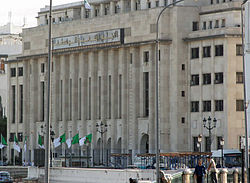
People's National Assembly building (Algiers). Assemblee populaire nationale (Algerie).jpg
People's National Assembly building (Algiers).

The People's National Assembly has less power relative to the executive branch than many parliaments and has been described as "rubber-stamping" laws proposed by the president. [2]

As of 2012 there were 462 seats in parliament. In the May 2012 election the government reported a 42.9% turnout, though the BBC reported that correspondents saw "only a trickle of voters" at polling places. [2] In that election 44 political parties participated with the ruling National Liberation Front winning more than any other group—220 seats—and an alliance of moderate Islamists coming in second with 66 seats. The Islamists disputed the results. [3]

Council of the Nation

Political parties and elections

In keeping with its amended Constitution, the Algerian Government espouses participatory democracy and free-market competition. The government has stated that it will continue to open the political process and encourage the creation of political institutions. More than 40 political parties, representing a wide segment of the population, are currently active in Algerian national politics. The most recent legislative election was 2017. President Bouteflika pledged to restructure the state as part of his overall reform efforts. However, no specifics are yet available as to how such reforms would affect political structures and the political process itself.

In the 2002 elections, there were 17,951,127 eligible voters, and 8,288,536 of them actually voted which made a turn out of 46.17%. Out of the ballots cast, there were 867,669 void ballots according to the Interior ministry and 7,420,867 which went to the various candidates.

Legislative elections

Results of the 2021 legislative elections:

People's National Assembly 2021.svg
PartyVotes%Seats+/–
National Liberation Front 287,8286.2498−66
Movement of Society for Peace 208,4714.5265+32
Democratic National Rally 198,7584.3158−42
Future Front 153,9873.3448+34
National Construction Movement 106,2032.3039New
Voice of the People 13,1030.283+2
Freedom and Justice Party 10,6180.2320
New Algeria Front 7,9160.1710
Justice and Development Front 7,6670.172
New Dawn 7,4330.162New
Dignity Party 5,9420.131−2
Good Governance Front 3,7240.082New
Jil Jadid 3,5760.081New
Algerian National Front 1,2070.031+1
Minor independent lists that won seats256,7325.5784+56
Others parties and independent lists3,337,48772.390
Total4,610,652100.00407−55
Valid votes4,610,65282.01
Invalid/blank votes1,011,74917.99
Total votes5,622,401100.00
Registered voters/turnout24,453,99222.99
Source: Official Algerian Journal [4]

Presidential elections

Results of the 2024 presidential election:

CandidatePartyVotes%
Abdelmadjid Tebboune Independent7,976,29184.30
Abdelaali Hassani Cherif  ( fr ) Movement of Society for Peace 904,6429.56
Youcef Aouchiche  ( fr ) Socialist Forces Front 580,4956.14
Total9,461,428100.00
Valid votes9,461,42884.28
Invalid/blank votes1,764,63715.72
Total votes11,226,065100.00
Registered voters/turnout24,351,55146.10
Source: Algeria Press Service

Administrative divisions

Algeria is divided into 58 wilayas (provinces) headed by walis (governors) who report to the Minister of Interior. Each wilaya is further divided into daïras, themselves divided in communes. The wilayas and communes are each governed by an elected assembly.

Media

Algeria has more than 30 daily newspapers published in French and Arabic, with a total publication run of more than 1.5 million copies. Although relatively free to write as they choose, in 2001, the government amended the penal code provisions relating to defamation and slander, a step widely viewed as an effort to rein in the press. Government monopoly of newsprint and advertising is seen as another means to influence the press, although it has permitted newspapers to create their own printing distribution networks.

See also List of Algerian newspapers.

International organization participation

AU, ABEDA, AfDB, AFESD, AL, AMF, AMU, ECA, FAO, G-15, G-20, G-24, G-77, IAEA, IBRD, ICAO, ICFTU, ICRM, IDA, IDB, IFAD, IFC, IFRCS, IHO, ILO, IMF, International Maritime Organization, Inmarsat, Intelsat, Interpol, INTOSAI, IOC, IOM (observer), ISO, ITU, MONUC, NAM, OAPEC, OAS, OIC, OPCW, OPEC, OSCE (partner), UN, UNCTAD, UNESCO, UNHCR, UNIDO, UNWTO, UPU, WCL, WCO, WHO, WIPO, WMO, WTO (applicant)

See also

Notes

    References

    1. "Algeria lifts 19-year-old state of emergency". Thomson Reuters. 2011-02-24. Retrieved 2025-09-15.
    2. 1 2 Algeria votes in parliamentary elections Archived 2019-04-15 at the Wayback Machine 10 May 2012
    3. Ruling Party Wins Big in Algerian Elections [ dead link ]| voanews.com| May 11, 2012
    4. "Journal Officiel de la Republique Algerienne № 51" (PDF). Secretariat General du Gouvernement (in French). 29 June 2021. Retrieved 31 August 2021.