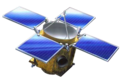
In 2020,Trident was selected along with three other Discovery proposals for further study,with two expected to be selected to fly as Discovery 15 and 16.[5] On 2 June 2021,NASA selected the Venus missions DAVINCI+ and VERITAS over Trident and the Io Volcano Observer.[6]
Background
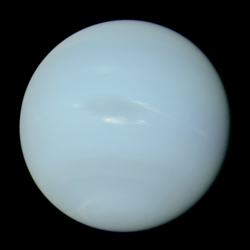
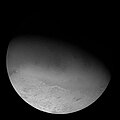
Triton is the largest moon of Neptune. In 1989,Voyager 2 flew past the moon at a distance of 40,000km (25,000mi),[7] and discovered several cryovolcanoes on its surface. Triton is geologically active. Its surface is young and has relatively few impact craters. It has a very thin atmosphere. Voyager 2 was only able to observe approximately 40% of Triton's surface.
The Trident concept was proposed in March 2019 to NASA's Discovery Program. The mission concept was supported by NASA's Ocean Worlds Exploration Program and it was intended to help answer some of the questions generated by Voyager 2's flyby in 1989.[8]
Overview
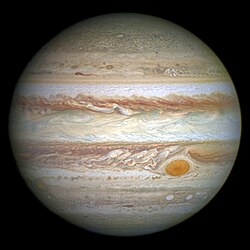
Trident would have taken advantage of an efficient gravity assist alignment of Jupiter and Neptune (that occurs once every 13 years) to capitalize on a narrow observational window enabling assessment of changes in Triton's plume activity and surface characteristics since the previous Neptune-Triton encounter by Voyager 2 in 1989.[3][9]
With the advances of high-resolution imaging and a unique orbital configuration of Triton in 2038,Trident would have been able to obtain a near-complete map of Neptune's moon during its flyby. Trident would have passed through Triton's thin atmosphere,within 500km (310mi) of the surface,sampling its ionosphere with a plasma spectrometer and performing magnetic induction measurements to assess the potential existence of an internal ocean.[3] The principal investigator was Louise Prockter,director of the Lunar and Planetary Institute in Houston,Texas.[9]
The launch vehicle proposed for Trident was the Atlas V 401,possibly to be replaced by the Vulcan.[2]
The proposed launch date in October 2025 (with a backup in October 2026) would have taken advantage of a once-in-13-years window when Earth is properly aligned with Jupiter. The spacecraft would use the gravitational pull of Jupiter as a slingshot to Triton for an extended 13-day encounter in 2038.[1]
Neptune Moon Triton - Proposed Trident Mission (16 June 2020)
Missions are ordered by launch date. Sign † indicates failure en route or before intended mission data returned. ‡ indicates use of the planet as a gravity assist en route to another destination.
Symbol † indicates failure en route or before intended mission data returned
This page is based on this Wikipedia article Text is available under the CC BY-SA 4.0 license; additional terms may apply. Images, videos and audio are available under their respective licenses.