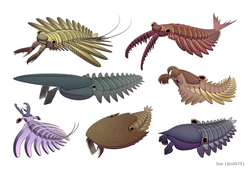
Verrocaris is known from two specimens: the holotype, NMNS P-A-2300, and a referred specimen, USNM PAL 90827 (part) and NMNS P-A 388 (counterpart), both of which consist exclusively of frontal appendages. The referred specimen was previously referred to Tamisiocaris aff. borealis.[1] Both specimens were discovered in the outcrops of the Kinzers Formation in Lancaster County, Pennsylvania.[2]
The genus name, Verrocaris, comes from the Latinverrere, meaning "to sweep", and caris, meaning "crab". The specific name, kerrymatti, honours Kerry D. Matt.[2]
Description
The frontal appendage is divided into a peduncle and a distal articulated region. The peduncle is composed of a single podomere, while the distal articulated region is composed of 15 podomeres. The endites are long and lack auxiliary spines. They do not alternate in length like the endites of Anomalocaris and Lenisicaris do.[2]
Verrocaris may be an intermediate form between other anomalocaridids, which may have been bottom-feeders, and taxa like Tamisiocaris, which were suspension feeders.[2]
Paleobiology
Verrocaris likely preyed on worm-like organisms living in loose substrate on the seafloor, which were probably consumed using suction. The frontal appendages may have been used to brush away sediment that was covering [2]
References
↑Pates, Stephen; Daley, Allison C. (30 July 2018). "The Kinzers Formation (Pennsylvania, USA): the most diverse assemblage of Cambrian Stage 4 radiodonts". Geological Magazine. 156 (7): 1233–1246. doi:10.1017/S0016756818000547. ISSN0016-7568.
This page is based on this Wikipedia article Text is available under the CC BY-SA 4.0 license; additional terms may apply. Images, videos and audio are available under their respective licenses.