Yorkville, Tennessee

Last updated

Yorkville, Tennessee
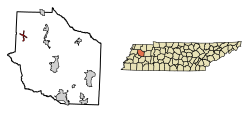
Gibson County Tennessee Incorporated and Unincorporated areas Yorkville Highlighted 4782360.svg
Location of Yorkville in Gibson County, Tennessee.
Coordinates: 36°5′55″N89°7′8″W / 36.09861°N 89.11889°W / 36.09861; -89.11889
Country United States
State Tennessee
County Gibson
Established1830 [1]
Incorporated1848 [2]
Named after Yorkville, South Carolina [1]
Area
[3]
  Total
1.30 sq mi (3.37 km2)
  Land1.30 sq mi (3.37 km2)
  Water0 sq mi (0.00 km2)
Elevation
381 ft (116 m)
Population
 (2020) [4]
  Total
236
  Density181.6/sq mi (70.13/km2)
Time zone UTC-6 (Central (CST))
  Summer (DST) UTC-5 (CDT)
ZIP code
38389
Area code 731
FIPS code 47-82360 [5]
GNIS feature ID1304709 [6]

Yorkville is a city in Gibson County, Tennessee. As of the 2020 census, Yorkville had a population of 236. [7]

Contents

Geography

Yorkville is located at 36°5′55″N89°7′8″W / 36.09861°N 89.11889°W / 36.09861; -89.11889 (36.098738, -89.119021). [8]

According to the United States Census Bureau, the city has a total area of 1.4 square miles (3.6 km2), all land.

Demographics

Historical population
CensusPop.Note
1880 99
1970 243
1980 27211.9%
1990 34727.6%
2000 293−15.6%
2010 286−2.4%
2020 236−17.5%
Sources: [9] [10] [4]

2020 census

As of the 2020 census, Yorkville had a population of 236. The median age was 44.1 years. 21.2% of residents were under the age of 18 and 22.5% of residents were 65 years of age or older. For every 100 females there were 107.0 males, and for every 100 females age 18 and over there were 102.2 males age 18 and over. [11]

0.0% of residents lived in urban areas, while 100.0% lived in rural areas. [12]

There were 91 households in Yorkville, of which 33.0% had children under the age of 18 living in them. Of all households, 60.4% were married-couple households, 15.4% were households with a male householder and no spouse or partner present, and 16.5% were households with a female householder and no spouse or partner present. About 15.4% of all households were made up of individuals and 4.4% had someone living alone who was 65 years of age or older. [11]

There were 107 housing units, of which 15.0% were vacant. The homeowner vacancy rate was 5.1% and the rental vacancy rate was 14.3%. [11]

Racial composition as of the 2020 census [13]
RaceNumberPercent
White 22193.6%
Black or African American 10.4%
American Indian and Alaska Native 31.3%
Asian 00.0%
Native Hawaiian and Other Pacific Islander 00.0%
Some other race62.5%
Two or more races 52.1%
Hispanic or Latino (of any race)73.0%

2000 census

As of the 2000 census, there was a population of 293, with 116 households and 88 families residing in the city. The population density was 206.4 inhabitants per square mile (79.7/km2). There were 125 housing units at an average density of 88.1 per square mile (34.0/km2). The racial makeup of the city was 99.66% White and 0.34% Native American. Hispanic or Latino of any race were 0.34% of the population. [5]

There were 116 households, out of which 33.6% had children under the age of 18 living with them, 62.1% were married couples living together, 10.3% had a female householder with no husband present, and 23.3% were non-families. 20.7% of all households were made up of individuals, and 13.8% had someone living alone who was 65 years of age or older. The average household size was 2.53 and the average family size was 2.90.

In the city, the population was spread out, with 25.3% under the age of 18, 4.4% from 18 to 24, 31.1% from 25 to 44, 17.4% from 45 to 64, and 21.8% who were 65 years of age or older. The median age was 39 years. For every 100 females, there were 92.8 males. For every 100 females age 18 and over, there were 88.8 males.

The median income for a household in the city was $26,111, and the median income for a family was $37,813. Males had a median income of $28,125 versus $21,250 for females. The per capita income for the city was $13,805. About 3.4% of families and 9.2% of the population were below the poverty line, including 14.7% of those under the age of eighteen and 15.1% of those 65 or over.
Notable people

Media

Radio Stations

History

John C. Kuykendall, from York District, South Carolina, first settled on the site in 1830, building a home and a store. Other settlers arrived shortly thereafter. By 1850 Yorkville was incorporated, with W.H. Miller as its first mayor. [14]

The Yorkville Hotel opened in 1840, and a flour mill and cotton gin were operating in Yorkville by 1870. [1]

Education

Gibson County Special School District is the area school district. [15] Gibson County High School is a comprehensive high school of the district.

Churches

The town has three churches: Yorkville Cumberland Presbyterian Church, Bethel Baptist Church and the Yorkville Church of Christ.

References

  1. 1 2 3 Gibson County: Past and Present (Turner Publishing Company, 1961), p. 247.
  2. Tennessee Blue Book , 2005-2006, pp. 618-625.
  3. "ArcGIS REST Services Directory". United States Census Bureau. Retrieved October 15, 2022.
  4. 1 2 "Census Population API". United States Census Bureau. Retrieved October 15, 2022.
  5. 1 2 "U.S. Census website". United States Census Bureau . Retrieved January 31, 2008.
  6. "US Board on Geographic Names". United States Geological Survey. October 25, 2007. Retrieved January 31, 2008.
  7. "2020 Decennial Census Redistricting Data (Public Law 94-171)". United States Census Bureau. 2021. Retrieved February 4, 2026.
  8. "US Gazetteer files: 2010, 2000, and 1990". United States Census Bureau. February 12, 2011. Retrieved April 23, 2011.
  9. "Census of Population and Housing: Decennial Censuses". United States Census Bureau . Retrieved March 4, 2012.
  10. "Incorporated Places and Minor Civil Divisions Datasets: Subcounty Resident Population Estimates: April 1, 2010 to July 1, 2012". Population Estimates. U.S. Census Bureau. Archived from the original on June 11, 2013. Retrieved December 11, 2013.
  11. 1 2 3 "2020 Decennial Census Demographic Profile (DP1)". United States Census Bureau. 2021. Retrieved February 8, 2026.
  12. "2020 Decennial Census Demographic and Housing Characteristics (DHC)". United States Census Bureau. 2023. Retrieved February 8, 2026.
  13. "2020 Decennial Census Redistricting Data (Public Law 94-171)". United States Census Bureau. 2021. Retrieved February 8, 2026.
  14. Goodspeed's History of Tennessee; Gibson County Past and Present, by Frederick M. Culp and Mrs. Robert E. Ross;
  15. "2020 CENSUS - SCHOOL DISTRICT REFERENCE MAP: Gibson County, TN" (PDF). U.S. Census Bureau . Retrieved October 6, 2024. - Text list