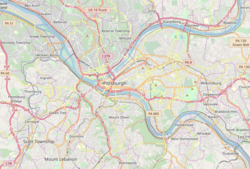
The Buhl Building is a historic commercial building in downtown Pittsburgh, Pennsylvania, United States. Built in 1913 in the Italianate style, the building is faced with multi-colored terra cotta tiles.
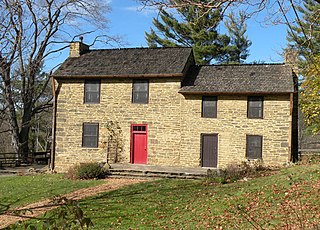
Oliver Miller Homestead, site of the James Miller House, is a public museum that commemorates pioneer settlers of Western Pennsylvania. It is located in Allegheny County, Pennsylvania's South Park 10 miles (16 km) south of downtown Pittsburgh near Bethel Park, Pennsylvania.

St. John the Baptist Ukrainian Catholic Church is a Ukrainian Catholic parish in the South Side Flats neighborhood of Pittsburgh, Pennsylvania under the authority of the Eparchy of St. Josaphat in Parma, Ohio.

South Side Market Building is a historic market house at 12th and Bingham Streets in the South Side Flats neighborhood of Pittsburgh, Pennsylvania.

Baxter High School is a historic high school building in the Homewood North neighborhood of Pittsburgh, Pennsylvania. Built in 1908, is now home to the Pittsburgh Student Achievement Center, an alternative school for grades 6-12. It was listed on the National Register of Historic Places in 1986.

The Byers-Lyons House in the Allegheny West neighborhood of Pittsburgh, Pennsylvania, is a building from 1898. It was added to the List of City of Pittsburgh historic designations on March 15, 1974, the National Register of Historic Places on November 19, 1974, and the List of Pittsburgh History and Landmarks Foundation Historic Landmarks in 1989.
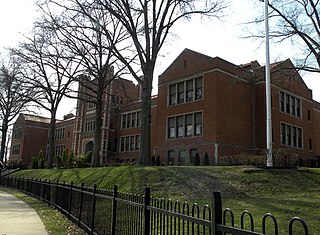
The Colfax Elementary & Middle School is a public school in Pittsburgh, Pennsylvania, United States. Its building, built in 1911, was listed on the National Register of Historic Places in 1986. The school recently added a new building with a glass bridge connecting the two buildings.

The Dilworth Elementary School in Pittsburgh, Pennsylvania, is a historic school building, completed in April 1915. As of March 2015 it is a traditional Magnet school for pre-kindergarten through the fifth grade in the Pittsburgh Public Schools system. It was listed on the National Register of Historic Places in 1986.

The Madison Elementary School is a former elementary school in the Upper Hill neighborhood of Pittsburgh, Pennsylvania, was built in 1902, and added to in 1929. The exterior features ornately decorated Romanesque-inspired doors and windows. It was listed on the National Register of Historic Places in 1986.
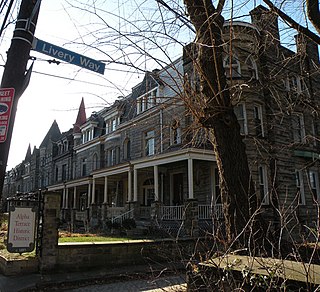
The Alpha Terrace Historic District is a historic district in the East Liberty neighborhood of Pittsburgh, Pennsylvania, United States. The site consists of twenty-five stone rowhouses, which were built between 1889 and 1894 using a heterogeneous mix of Queen Anne and Romanesque revival architectural influences. Until they were subdivided and individually sold in the 1950s, the properties were part of a single block of upper-middle-class rental units; for a time, U.S. Steel leased a number of the homes for use by corporate executives.
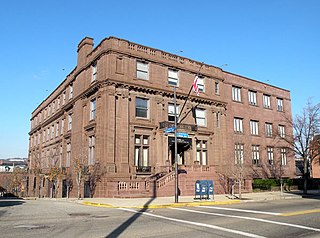
The William Penn Snyder House at 850 Ridge Avenue in the Allegheny West neighborhood of Pittsburgh, Pennsylvania, was built in 1911. It was added to the List of Pittsburgh History and Landmarks Foundation Historic Landmarks in 1972, the List of City of Pittsburgh historic designations on March 15, 1974, and the National Register of Historic Places on May 3, 1976. Babb, Inc., an insurance brokerage firm currently owns and occupies the building.

The Frederick J. Osterling Office and Studio at 228 Isabella Street in the North Shore neighborhood of Pittsburgh, Pennsylvania, was built in 1917. This Gothic Revival building was designed by architect Frederick J. Osterling, and was used as his office and studio in 1918.
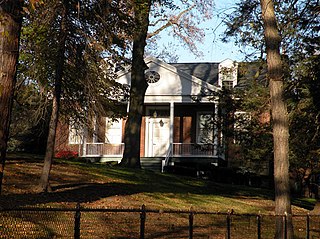
The Nicholas Way House at 108 Beaver Road in Edgeworth, Pennsylvania, was built in 1838. This Greek Revival house was added to the National Register of Historic Places on September 13, 1978, and the List of Pittsburgh History and Landmarks Foundation Historic Landmarks in 2002.

The Walker-Ewing Log House in Collier Township, Allegheny County, Pennsylvania, was built circa 1790. It is said that between 1760 and 1790, Gabriel Walker built a log cabin about two miles (3 km) northwest of present-day Rennerdale, Pennsylvania.

Woodland Hills Academy is a historic school in Turtle Creek, Pennsylvania. It is part of the Woodland Hills School District. It was built in 1917 as the Turtle Creek High School. In 2009, the school re-opened as the Woodland Hills Academy; it currently serves grades K–8.
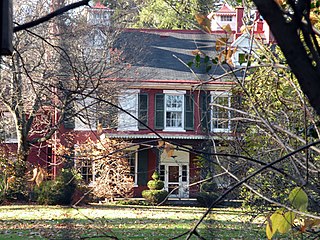
The David Shields House at the corner of Shields Lane and Beaver Road in Edgeworth, Pennsylvania, was built in 1823. This Federal style house was added to the National Register of Historic Places on October 29, 1975, and the List of Pittsburgh History and Landmarks Foundation Historic Landmarks in 1976.

The Isaac Lightner House at 2407 Mount Royal Boulevard in Shaler Township, Allegheny County, Pennsylvania, United States, was built in 1833. This Greek Revival house was added to the National Register of Historic Places on April 20, 1978, and the List of Pittsburgh History and Landmarks Foundation Historic Landmarks in 1976.
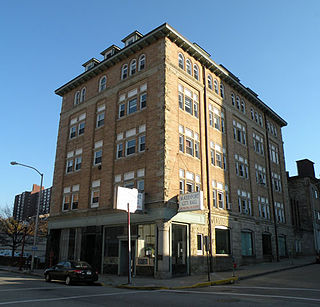
McKeesport National Bank located at 5th Avenue and Sinclair Street in McKeesport, Pennsylvania, was built from 1889 to 1891. It was added to the National Register of Historic Places on August 29, 1980, and the List of Pittsburgh History and Landmarks Foundation Historic Landmarks in 1981.

Elmridge located at 1 Breck Drive in Leetsdale, Pennsylvania, was built in 1869. The architectural plans were published in Hobbs Architecture, 1873. The house was added to the National Register of Historic Places on May 10, 2005, and to the List of Pittsburgh History and Landmarks Foundation Historic Landmarks in 2007.

The H. J. Heinz Company complex, part of which is currently known as Heinz Lofts, is a historic industrial complex in the Troy Hill neighborhood of Pittsburgh, Pennsylvania. The buildings were built by the H. J. Heinz Company from 1907 through 1958. The complex is listed on the National Register of Historic Places (NRHP) and five of the buildings are listed as a Pittsburgh History and Landmarks Foundation Historic Landmark.