It has been requested that the title of this article be changed to 2005 Taiwanese National Assembly election . Please see the relevant discussion. The page should not be moved unless the discussion is closed; summarizing the consensus achieved in support of the move. |
| |||||||||||||||||||||||||||||||||||||||||
All 300 seats to the National Assembly | |||||||||||||||||||||||||||||||||||||||||
|---|---|---|---|---|---|---|---|---|---|---|---|---|---|---|---|---|---|---|---|---|---|---|---|---|---|---|---|---|---|---|---|---|---|---|---|---|---|---|---|---|---|
| |||||||||||||||||||||||||||||||||||||||||
Election results | |||||||||||||||||||||||||||||||||||||||||
| This article is part of a series on the politics and government of the Republic of China |
|---|
|
Other branches |
Related topics |
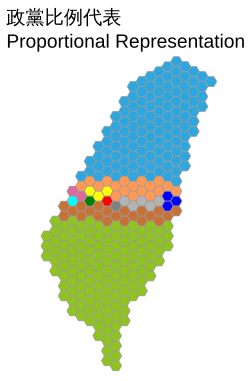
An election for the National Assembly took place in Taiwan on Saturday 14 May 2005, from 07:30 to 16:00 local time. It elected an ad hoc National Assembly whose only function was to serve as a constitutional convention in order to approve or reject amendments to the Constitution of the Republic of China already proposed by the Legislative Yuan. The results indicated that the amendments would be approved, as the parties supporting them won an overwhelming majority, and indeed the amendments were passed on June 7, 2005. The election was carried out using purely the party-list proportional representation system. The official campaign period was 07:00 to 22:00 each day from 4 May 2005 to 13 May 2005. Official election broadcasts by the ad hoc coalitions (officially termed 'unions') and (established) parties were provided by the Public Television Service Taiwan on 7 May 2005; several unofficial debates were also arranged. Notably, this election saw the temporary breakdown of the traditional two-coalition system in Taiwanese politics: instead of dividing into the Pan-Green Coalition and Pan-Blue Coalition over the political status of Taiwan, the parties divided themselves into larger and smaller parties, with the larger Democratic Progressive Party and Kuomintang in support of the amendments and the smaller People First Party and Taiwan Solidarity Union against them.
The official results showed that the turnout was only 23.36%, a record low despite the Central Election Commission holding an official raffle for those who turned out to vote. The parties supporting the amendments won 249 out of a total of 300 seats, compared to the opposition's 51 seats, which was enough to ensure that the constitutional amendments were passed by the elected National Assembly. Though this election was not campaigned along the coalition tendencies, some analysts are inclined to see it as a forerunner for the upcoming elections such as the county-level gubernatorial, mayoral, and council elections that may take place later in the year. Tallying along those lines, Pan-Green Coalition has won 49.6% of the vote and 149 seats out of the 300, with strength in southern Taiwan; the Pan-Blue Coalition garnered 45.9% with 138 seats, strongest in the north.
| Parties | Votes | Percentage (%) | Seats | |
|---|---|---|---|---|
| Parties in favor of the amendments | 249 | |||
| Democratic Progressive Party | 1,647,791 | 42.52 | ![]() | 127 |
| 1,508,384 | 38.92 | ![]() | 117 | |
| ___ Chinese People's Party | 41,940 | 1.08 | ![]() | 3 |
| ___ Peasant Party | 15,516 | 0.40 | ![]() | 1 |
| ___ Civil Party | 8,609 | 0.22 | ![]() | 1 |
| Parties not in favor of the amendments | 51 | |||
| 273,147 | 7.05 | ![]() | 21 | |
| 236,716 | 6.11 | ![]() | 18 | |
| ___ Democratic Action Alliance led by Chang Ya-chung | 65,081 | 1.68 | ![]() | 5 |
| 34,253 | 0.88 | ![]() | 3 | |
| 25,162 | 0.65 | ![]() | 2 | |
| 11,500 | 0.30 | ![]() | 1 | |
| ___ 20 persons union led by Wang Ting Sing | 7,499 | 0.19 | ![]() | 1 |
| Total (turnout ) | 300 | |||
The 300 seats in the National Assembly were up for election. The follow parties fielded candidates on their party lists (followed by number of candidates for each):
Each party or coalition, by law, had to register and announce whether it supported or disapproved of the proposed amendment; this was announced in the short gazette that was distributed along with the poll card. Since this assertion was binding on the members elected, the election was de facto a referendum on the proposed amendments. Only the Kuomintang, the governing DPP, and the three minor party registered their support for the amendments; the others have announced objection. [1] [2] Notably, the political tendencies dubbed pan-green and pan-blue coalitions were each split down the middle in their opinions on the proposed amendments, with the dominant partner in each coalition supporting the amendments, probably because the proposed electoral system would benefit large parties.
Each individual in the electorate voted for one from the 10 parties and 2 coalitions. The seats were distributed amongst the parties and coalitions based on the total number of votes garnered by each. There was to be at least 1 female member guaranteed for every 4 elected in each party/coalition; and 1 aboriginal member guaranteed for every 30 in each party/coalition.
The elections themselves generated very little interest in Taiwan, which accounted for the record-low turnout. Polls indicated that most Taiwanese did not plan to vote and had little interest in or knowledge of what the election is about. In addition, most parties did not spend very much in campaign funds. Terrible weather in the north of Taiwan on election day also affected the turnout.
The only authority of the National Assembly was to accept or reject amendments which were proposed almost unanimously by the Legislative Yuan in August 2004, one of which was to abolish the National Assembly.
The proposed amendments may be summarized as follows:
Using referendums to ratify constitutional amendments has been portrayed by some as a step toward Taiwan independence. However, the requirement that such a referendum must first be approved by a three-fourths vote of the Legislative Yuan, and that at least 50% of the whole electorate had to vote for the change for the referendum to succeed considerably reduced the chance that these amendments would trigger a conflict with China.
One question which was unresolved until after the elections was the threshold for passage of the amendments. The DPP and KMT had advocated a majority vote for passage, while the smaller parties advocated a three-fourths threshold. It wasn't until the week after the election that the Legislature agreed on the three-quarters voting threshold - when it was already clear that the parties which supported the amendments controlled more than 75% of the National Assembly. Also, the TSU has advocated voting on the amendments separately, which was impossible as the inter-party agreement for these amendments stipulated that they be adopted all or none.
The proposed system of electing Legislative Yuan members is unfavorable to smaller parties, but was originally supported by the two smaller parties in Taiwan for different reasons.
This election initially generated little interest, as it was largely a procedural formality to elect a new National Assembly whose sole purpose would be to deal with the amendments, which were passed almost unanimously by the Legislative Yuan in August 2004. However, the unexpected pan-blue coalition victory in the December 2004 legislative election considerably changed the electoral landscape.
Originally, the Taiwan Solidarity Union supported the constitutional amendments on the belief that they would be a prelude to a more thorough move toward Taiwan independence. The Constitutional amendments were part of a package originally promoted by the Democratic Progressive Party, but were passed almost unanimously after compromises were made on the wording. However, after the December elections, which returned a pan-blue majority opposed to a rapid move toward independence, the TSU reconsidered its support, and has announced its opposition to the amendments.
Similarly, the People First Party changed its position. Most analysts believe that PFP leader James Soong had initially planned to have a major role in a reformed KMT which would consist of a merger of the KMT and PFP. However, the PFP performed poorly in the December elections, and after the elections Soong ended any talk of a merger and began an effort to improve relations with the DPP. The reconsideration of support is widely believed to be because the reforms would hurt small parties such as the PFP.
Following the visit by Kuomintang leader Lien Chan to mainland China and a similar trip by PFP leader James Soong, the election has been unexpectedly turned into a referendum on pan-blue and pan-green plans for relations with China. During the week before the election, President Chen Shui-bian gave a television interview in which he argued that a vote against the constitutional amendments would play into the hands of the PRC and that the amendments marked a step toward legal Taiwan independence. However, these arguments have were widely criticized in Taiwan, since the Kuomintang, which is anti-Taiwan independence strongly supported the amendments, while the pro-independence Taiwan Solidarity Union strongly opposed them.
The Democratic Progressive Party (DPP) is a Taiwanese nationalist and centre-left political party in Taiwan. Controlling both the Taiwan Presidency and the unicameral Legislative Yuan, it is the majority ruling party and the dominant party in the Pan-Green Coalition.
The politics of the Republic of China take place in a framework of a representative democratic republic, whereby the President is head of state and the Premier is head of government, and of a multi-party system. Executive power is exercised by the government. Legislative power is vested in primarily with the parliament and limited by government. The Judiciary is independent of the executive and the legislature. The party system is dominated by the Kuomintang, which favors closer links to mainland China, and the Democratic Progressive Party, which favors Taiwanese independence.
The pan-Blue coalition, pan-Blue force or pan-Blue groups is a loose political coalition in Taiwan, consisting of the Kuomintang (KMT), the People First Party (PFP), New Party (CNP) and Non-Partisan Solidarity Union (NPSU). The name comes from the party colours of the Kuomintang. This coalition tends to favor a Chinese nationalist identity over a separate Taiwanese one and favors a softer policy and greater economic linkage with the People's Republic of China, as opposed to the Pan-Green Coalition.
The People First Party is a center-right political party in Taiwan.
James Soong Chu-yu is a Taiwanese politician. He is the founder and current Chairman the People First Party.
The Taiwan Solidarity Union is a political party in Taiwan which advocates Taiwan independence, Taiwanese localization movement and social liberalism. It was officially founded on 12 August 2001 and is considered part of the Pan-Green Coalition. Unlike the Democratic Progressive Party, its larger companion party in the Pan-Green Coalition, the TSU actively campaigns for the creation of a de jure Republic of Taiwan. The future of the party is in doubt after the 2016 elections as the party failed to secure enough votes to be eligible for state funding.
The Legislative Yuan is the unicameral legislature of the Republic of China now based in Taiwan. It is one of the five branches of government stipulated by the Constitution of the Republic of China, which follows Sun Yat-sen's Three Principles of the People.
The National Assembly were several national parliamentary government organizations of the Republic of China, now commonly known as Taiwan.
During the National Constituent Assembly session on December 25, 1946 in Nanjing, the fifth and current Chinese constitution, known as the Constitution of the Republic of China, was ratified by the Kuomintang and adopted on December 25, 1947. Since 1949, the constitution, along with its Additional Articles, remains effective in ROC-controlled territories.
The 10th President and Vice President election of the Republic of China was held on March 18, 2000, to elect the 10th-term President and Vice-President of the Republic of China under the 1947 Constitution. With a voter turnout of 82.69%, Chen Shui-bian and Annette Lu of the Democratic Progressive Party were elected president and vice president respectively with a slight plurality. This put an end to more than half a century of Kuomintang rule on Taiwan.
The Election for the 6th Legislative Yuan (第六屆立法委員選舉) of Taiwan was held on December 11, 2004. All 225 seats of the Legislative Yuan were up for election: 168 elected by popular vote, 41 elected on the basis of the proportion of nationwide votes received by participating political parties, eight elected from overseas Chinese constituencies on the basis of the proportion of nationwide votes received by participating political parties, eight elected by popular vote among the aboriginal populations. Members served three-year terms beginning on February 1, 2005, and ending January 31, 2008. The next term served four years.
This is a timeline of the Republic of China.
The Election for the 5th Legislative Yuan of Taiwan was held on 1 December 2001. All 225 seats of the Legislative Yuan were up for election: 168 elected by popular vote, 41 elected on the basis of the proportion of nationwide votes received by participating political parties, eight elected from overseas Chinese constituencies on the basis of the proportion of nationwide votes received by participating political parties, eight elected by popular vote among the Taiwanese aboriginal populations. Members served three year terms from February 1, 2002 to February 1, 2005.
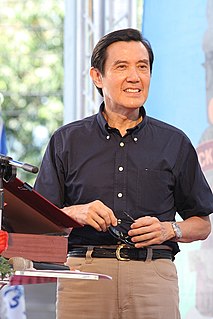
The Kuomintang chairmanship election of 2005 was held on July 16, 2005 in Taiwan between Ma Ying-jeou and Wang Jin-pyng. The election was triggered by the retirement of chairman Lien Chan.
The Election for the 7th Legislative Yuan of Taiwan was held on January 12, 2008. The results gave the Kuomintang (KMT) and the Pan-Blue Coalition a supermajority in the legislature, handing a heavy defeat to then-President Chen Shui-bian's Democratic Progressive Party, which won the remaining 27 seats only. The junior partner in the Pan-Green Coalition, the Taiwan Solidarity Union, won no seats.
Referendums in Taiwan at both the national and local level are governed by the Referendum Act of Taiwan, which was enacted by the Legislative Yuan in December 2003. Citizens can propose laws via referendums at the national and local levels. The Referendum Act also allowed people to make changes or abolish laws by referendums.
The 13th President and Vice President election of the Republic of China was held on 14 January 2012. The election was held concurrently with legislative elections. It was the fifth direct election for the President of the Republic of China. Prior to 1996, the President was elected by the ROC's National Assembly and not directly by the people.
General elections were held in Taiwan, officially the Republic of China, on Saturday, 16 January 2016 to elect the 14th President and Vice President of the Republic of China, and all 113 members of the ninth Legislative Yuan:
Chung Shao-ho is a Taiwanese politician who served in the Legislative Yuan from 1999 to 2012.
Chen Chin-ting is a Taiwanese politician who served in the Legislative Yuan from 1999 to 2008.