2021 Nobel Prizes

Last updated

The 2021 Nobel Prizes were awarded by the Nobel Foundation, based in Sweden. Six categories were awarded: Physics, Chemistry, Physiology or Medicine, Literature, Peace, and Economic Sciences. [1]

Contents

Nobel Week took place from December 6 to 12, including programming such as lectures, dialogues, and discussions. The award ceremony and banquet for the Peace Prize were scheduled in Oslo on December 10, while the award ceremony and banquet for all other categories were scheduled for the same day in Stockholm. [2] [3]

Prizes

Physics

Awardee(s)
Crafoord Prize EM1B0732 (42329290061).jpg Syukuro Manabe

(b. 1931)

Flag of Japan.svg Japanese

Flag of the United States.svg American [4]

"for the physical modelling of Earth's climate, quantifying variability and reliably predicting global warming" [5]
No image.svg Klaus Hasselmann

(b. 1931)

Flag of Germany.svg German
Parisi Giorgio (3x4 cropped).jpg Giorgio Parisi

(b. 1948)

Flag of Italy.svg Italian"for the discovery of the interplay of disorder and fluctuations in physical systems from atomic to planetary scales"

Chemistry

Awardee(s)
Benjamin List (cropped).jpg Benjamin List

(b. 1968)

Flag of Germany.svg German"for the development of asymmetric organocatalysis" [6]
David MacMillan (cropped).jpg David W.C. MacMillan

(b. 1968)

Flag of the United Kingdom.svg British

Physiology or Medicine

Awardee(s)
Dr David Julius by christopher michel in 2022 (3x4 cropped).jpg David Julius

(b. 1955)

Flag of the United States.svg United States "for the discovery of receptors for temperature and touch" [7]
Ardem Patapoutian by C Michel 67.jpg Ardem Patapoutian

(b. 1967)

Flag of Lebanon.svg Lebanon

Flag of the United States.svg United States

Literature

Awardee(s)
Abdulrazak Gurnah 2022 (cropped2).jpg Abdulrazak Gurnah

(b. 1948)

Flag of Tanzania.svg Tanzania

Flag of the United Kingdom.svg United Kingdom (born in the Sultanate of Zanzibar)

"for his uncompromising and compassionate penetration of the effects of colonialism and the fate of the refugee in the gulf between cultures and continents" [8]

Peace

Awardee(s)
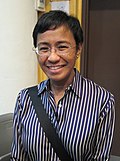
Maria Ressa.jpg Maria Ressa

(b. 1963)

Flag of the Philippines.svg Philippines

Flag of the United States.svg United States

"for their efforts to safeguard freedom of expression, which is a precondition for democracy and lasting peace." [9]
Dmitry Muratov Four Freedoms Award 2010.jpg Dmitry Muratov

(b. 1961)

Flag of Russia.svg Russia

Economic Sciences

Awardee(s)
David Card - Nobel prize interview screenshot (cropped, portrait).png David Card

(b. 1956)

Flag of Canada (Pantone).svg Canada

Flag of the United States.svg United States

"for his empirical contributions to labour economics" [10]
Joshua Angrist - 2011 (cropped).jpg Joshua Angrist

(b. 1960)

Flag of the United States.svg United States

Flag of Israel.svg Israel

"for their methodological contributions to the analysis of causal relationships"
Guido Imbens Lemley Lecture 1.jpg Guido Imbens

(b. 1963)

Flag of the United States.svg United States

Flag of the Netherlands.svg Netherlands

Reactions

Physiology or Medicine

In announcing the winners, Thomas Perlmann, secretary-general of the Karolinska Institute, said: "This really unlocks one of the secrets of nature. It’s actually something that is crucial for our survival, so it’s a very important and profound discovery." [11] [12] The Nobel Committee believed that Julius and Patapoutian's discoveries address "one of the greatest mysteries facing humanity" – the sensation of the environment. [11] [13] Oscar Marín, director of the MRC Centre for Neurodevelopmental Disorders at King's College London, expressed that the choice of this year's winners underscored how little scientists knew about that question before the discoveries and how much there still is to learn. [11] [14]

Jan Adams, chief officer at Grünenthal, which markets pain relief skin patches and creams based on the TRPV1 capsaicin receptor discovered by Julius, said their discoveries had "opened up a whole new field of research for new non-opioid pain therapies". [12] [14] Fiona Boissonade, pain specialist at the University of Sheffield, said the Nobel laureates' work was especially relevant for the one in five people globally that suffer from chronic pain. She said: "Their research may lead us to identify new compounds that are effective in treating pain that don't come with the devastating impact of opioids." [11] [12]

References

  1. "All Nobel Prizes 2021". NobelPrize.org. Retrieved 2024-12-09.
  2. "2021 Nobel Peace Prize Award Ceremony - Nobel Peace Prize". www.nobelpeaceprize.org. 2022-01-06. Retrieved 2024-12-09.
  3. Royen, Ulrika (2021-11-05). "The Nobel Prize award ceremony 2021". NobelPrize.org. Retrieved 2024-12-09.
  4. "He is considered a U.S. citizen by Nobel Prize Committee". Reuters . Archived from the original on 5 October 2021. Retrieved 5 October 2021.
  5. "The Nobel Prize in Physics 2021". Nobel Foundation. 5 October 2021. Archived from the original on 4 May 2024. Retrieved 6 October 2022.
  6. "The Nobel Prize in Chemistry 2021". Nobel Foundation. Archived from the original on 6 October 2021. Retrieved 7 October 2021.
  7. "The Nobel Prize in Physiology or Medicine" (PDF). Nobel Foundation. Archived (PDF) from the original on 4 October 2021. Retrieved 2021-10-04.
  8. "The Nobel Prize in Literature 2021". NobelPrize.org. Archived from the original on 7 October 2021. Retrieved 7 October 2021.
  9. "The Nobel Peace Prize 2021 - Press Release". NobelPrize.org. Archived from the original on 24 February 2022. Retrieved 2021-10-08.
  10. "The Sveriges Riksbank Prize in Economic Sciences in Memory of Alfred Nobel 2021". Nobel Foundation. Archived from the original on 2021-10-11. Retrieved 2021-10-11.
  11. 1 2 3 4 "2 Win Medicine Nobel for Showing How We React to Heat, Touch". U.S. News & World Report . 4 October 2021. Retrieved 20 August 2021.
  12. 1 2 3 Johan Ahlander and Ludwig Burger (5 October 2021). "Two Americans win Medicine Nobel for work on heat and touch". Reuters . Retrieved 20 August 2022.
  13. Tanya Lewis (8 October 2021). "2021 Medicine Nobel Prize Winner Explains the Importance of Sensing Touch". Scientific American . Retrieved 20 August 2022.
  14. 1 2 David Keyton and Maria Cheng (5 October 2021). "2 win medicine Nobel for showing how we react to heat, touch". AP News . Retrieved 20 August 2022.