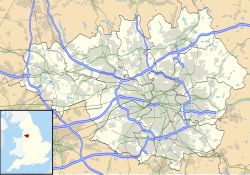
Ashton Old Baths (officially listed as Former Municipal Baths) is a Victorian-era former public bathhouse in Ashton-under-Lyne, a town within Tameside, Greater Manchester, England. Built between 1870 and 1871, it was among the earliest and largest municipal swimming facilities in the United Kingdom. The building is notable for its Italian Romanesque architectural style, its imposing brick structure, and its distinctive 120-foot (37m) chimney, which served as a flue for steam boilers. Today, the baths are recognised as a Grade II* listed building, reflecting its architectural and historic significance.
Following its closure in 1975 and decades of dereliction, the building underwent a major restoration in 2016. The project adopted a "building within a building" concept, transforming the interior into a modern digital and creative business hub while preserving the historic exterior.
History
The baths were commissioned by the Ashton-under-Lyne Corporation and designed by architects Henry Paull and George Robinson. The foundation stone was laid in October 1869 by Henry T.Darnton, the mayor of Ashton-under-Lyne, on a site donated by the Earl of Stamford.[1] Construction cost approximately £16,000, and the facility officially opened in 1870.[2] The project was undertaken in response to growing concerns about public health and sanitation during the Victorian era, reflecting the period's emphasis on improving hygiene and leisure opportunities for urban communities.[3]
The building originally housed a range of facilities. At its core was a main swimming pool, measuring 100 feet (30m) by 40 feet (12m), intended primarily for male bathers. A smaller pool, measuring 27 feet (8.2m) by 15 feet (4.6m), was provided for female bathers.[4] In addition to these, the complex included private bathrooms and Turkish baths, catering to different bathing preferences and social norms of the time.[5]
Beyond bathing facilities, the structure incorporated ancillary spaces, including a police station and a fire engine station, underscoring its role as a multifunctional civic building within the town.[5]
During winter months, the main pool was covered with a wooden floor and converted into a skating rink, concert hall, and meeting venue, accommodating up to 4,000 people.[5] A water filtration system was added in 1915. The baths remained in use until 1975, after which they closed due to the opening of modern facilities.[4]
On 2 April 1975, Ashton Old Baths was designated a Grade II* listed building for its architectural and historic significance.[6] The building then fell into disrepair and was placed on the Heritage at Risk Register.[7]
After decades of dereliction, the building underwent a major restoration completed in 2016, funded by the Heritage Lottery Fund, the European Regional Development Fund, and Tameside Council.[8] The redevelopment introduced a "building within a building" concept, creating a modern digital and creative business hub inside the historic shell.[9] This adaptive reuse preserved the Victorian exterior while securing the structure's future as a community and commercial asset.[10]
Architecture
Ashton Old Baths is constructed in Flemish bond brickwork with a slate roof and stone dressings, designed in the Italian Romanesque style. The principal feature is a large swimming hall, arranged in five bays, with a prominent tower at the north-east corner and subsidiary accommodation to the east.[11]
The swimming hall is articulated with flat pilasters and a machicolatedfrieze below the eaves. Each bay of the upper storey contains three round-headed windows with hood moulds and glazing bars. Other elevations follow a similar treatment. At ground level, a lean-to structure incorporates a central entrance feature with two arched doorways and numerous small arched lights beneath drip moulds.[6]
The Lombardic tower includes vent openings near the top, set between bold machicolations, while a similarly detailed chimney rises from the roof apex. To the left of the tower, an elaborate entrance surround leads to a two-storey wing, which features paired windows on the lower floor and 11 round windows on the first floor.[11]
Interior restoration
The 2016 restoration incorporated an approach to adapt the historic structure for contemporary use. A self-contained steel and glass framework was installed inside the original pool hall, providing modern office and meeting spaces while retaining the visibility of the Victorian walls and roof trusses.[12] This design allows the original architectural features, such as the hammerbeam roof and arched brickwork, to remain exposed, preserving the character of the building alongside its new function as a digital and creative business hub.[13]
↑Project to bring Ashton Old Baths into use(PDF). Tameside Metropolitan Borough Council (Report). Strategic Planning and Capital Monitoring Panel. 1 December 2014. Retrieved 3 December 2025.
This page is based on this Wikipedia article Text is available under the CC BY-SA 4.0 license; additional terms may apply. Images, videos and audio are available under their respective licenses.