This article's lead sectionmay need to be rewritten. The reason given is: to make the lead compliant with WP:VERIFY and WP:LEAD, not presenting unsourced material, and not presenting material unique to the lead, rather than summary (e.g., see "Lady Usher", "14th century", "unicameral", etc.). Please review the lead guide and help improve the lead of this article if you can.(December 2025) ( Learn how and when to remove this message )
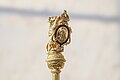
The ceremonial rod used by the Black Rod of New Zealand
The Gentleman or Lady Usher of the Black Rod,[1] often shortened to Black Rod, is a senior parliamentary officer similar to a serjeant-at-arms, responsible for ceremonial protocol and maintaining order within a legislative chamber. The role originated in the House of Lords of the Parliament of England during the 14th century,[not verified in body] and was exported to the upper houses of other Westminster system legislatures. Besides the British House of Lords, the office now exists in Australia's federal and state upper houses, in Canada's federal upper house and some unicameral provincial houses, and for ceremonial purposes in New Zealand and the Cook Islands.[not verified in body] The position is named after the staff of office carried by the official, a black rod. The Gentleman/Lady Usher often has a deputy called the Yeoman Usher of the Black Rod.
The office was created in 1350 by royal letters patent, though the current title dates from 1522. The position was adopted by other members of the Commonwealth when they adopted the British Westminster system. The title is derived from the staff of office, an ebony staff topped with a golden lion, which is the main symbol of the office's authority.
A ceremonial rod or staff is a common symbol indicating the authority of the office holder. Depictions of ancient authority figures in many cultures include such a rod (alternatively called a sceptre). Another early example is the fasces (a bound bundle of rods) carried by guards ("lictors") who accompanied high-level officials in the Roman Republic and later Empire.
By country
Ushers of the Black Rod are typically responsible for arresting any senator or intruder who disrupts the proceedings.
Black Rod is formally appointed by the Crown based on a recruitment search performed by the Clerk of the Parliaments (who is the employer of all House of Lords officials).[citation needed] As well as being an officer of the House of Lords, Black Rod is an officer of the Order of the Garter; they are appointed by letters patent under the Garter Seal.[2] Black Rod also acts as Secretary to the Lord Great Chamberlain by virtue of which they oversee certain ceremonial arrangements and day-to-day management of the Royal parts of the Palace of Westminster. Black Rod also holds the office of Serjeant-at-Arms, to which they are separately appointed by letters patent under the Great Seal; it is in this capacity that Black Rod attends upon the Lord Speaker.[2] Black Rod's deputy is the Yeoman Usher of the Black Rod and Deputy Serjeant-at-Arms.[3]
Since 8 July 2025, the post of Gentleman Usher of the Black Rod has been held by Lieutenant GeneralEdward Davis;[4] he is the first Royal Marine to hold the post.
Black Rod is principally responsible for controlling access to and maintaining order within the House of Lords and its precincts,[1] as well as for ceremonial events within those precincts. Previous responsibilities for security, and the buildings and services of the Palace of Westminster, have been passed, respectively, to the Parliamentary Security Director (as of the post's creation in January 2016) and Lords Director of Facilities (as of that post's creation and the retirement of the then-Black Rod in May 2009).[5]
Black Rod's official duties also include responsibility as the usher and doorkeeper at meetings of the Most Noble Order of the Garter; the personal attendant of the Sovereign in the Lords; as secretary to the Lord Great Chamberlain and as the Serjeant-at-Arms and Keeper of the Doors of the House, in charge of the admission of strangers to the House of Lords. Either Black Rod or their deputy, the Yeoman Usher, is required to be present when the House of Lords, the upper house of Parliament, is in session, and plays a role in the introduction of all new Lords Temporal in the House (but not of bishops as new Lords Spiritual). Black Rod also arrests any Lord guilty of breach of privilege or other Parliamentary offence, such as contempt or disorder, or the disturbance of the House's proceedings. Their equivalent in the House of Commons is the Serjeant at Arms.
Former Black Rod David Leakey said that 30% of his work as Black Rod was within or for the House of Commons.[6]
Black Rod, along with their deputy, is responsible for organising ceremonial events within the Palace of Westminster, providing leadership in guiding the significant logistics of running such events.
Ceremonial duties
Mace
Black Rod is in theory responsible for carrying the Mace into and out of the chamber for the Speaker of the House of Lords (formerly the Lord Chancellor, now the Lord Speaker), though this role is delegated to the Yeoman Usher and Deputy Serjeant-at-Arms, or on judicial occasions, to the Lord Speaker's deputy, the Assistant Serjeant-at-Arms.[citation needed]
State Opening of Parliament
Sarah Clarke, Lady Usher of the Black Rod, knocks on the door to the House of Commons at the 2024 State Opening.
Black Rod is best known for their part in the ceremonies surrounding the State Opening of Parliament and the Speech from the throne. Black Rod summons the Commons to attend the speech and leads them to the Lords. As part of the ritual, the doors to the chamber of the House of Commons are slammed in the approaching Black Rod's face. This is to symbolise the Commons' independence of the Sovereign. Black Rod then strikes the door three times with their staff, and is then admitted and issues the summons of the monarch to attend.[7]
This ritual also happens whenever the Lords have a commission to be read and Black Rod summons MPs to hear it. For example, on Tuesday 17 December 2019 this ritual happened twice.[8]
This ritual is derived from the attempt by Charles I to arrest Five Members in 1642, in what was seen as a breach of the constitution. This and prior actions of the King led to the Civil War. After that incident, the House of Commons has maintained its right to question the right of the monarch's representatives to enter their chamber, although they cannot bar them from entering with lawful authority[citation needed].
List of Black Rods in England, Great Britain and the UK from 1361
This list is derived from one published by the Parliamentary Archives in 2011, with alterations from later research.[9]
c.1361–1387: Walter Whitehorse
1387–1399: John Cray
1399–1410: Thomas Sy
1410–1413: John Sheffield
1413–1415: John Athelbrigg
1415–1418: William Hargroave
1418–1423: John Clifford
1423–1428: John Carsons
1428–1459: William Pope
1438–1459: Robert Manfield (joint)
1459–1461: John Penycok
1461–1471: Vacant?
1471–1485: William Evington
1483–1485: Edward Hardgill (joint)
1485–1489: Robert Marleton
1489–1513: Ralph Assheton
1495–30 December 1511: Hugh Denys (jointly with Assheton until Denys's death)[10]
1642–1649: Alexander Thayne (as recognised by Parliament); jointly with James Maxwell until c. 1646. The Lords was abolished in 1649 and Thayne made a claim to the title at the Restoration in 1661, but was denied.[11]
2 March 1645 – 1661: Peter Newton (as recognised by the Royalists; Edward Ellis discharged the duties in 1642 and Newton in 1644, but neither seems to have been formally appointed at the time.[11])
Technically the serjeant-at-arms was an officer of the Lord Chancellor (the former presiding officer of the House of Lords), rather than of the House of Lords.[20] He was appointed by the Sovereign "to be Serjeant-at-Arms in Ordinary to Her [or His] Majesty" and "to attend the Right Honourable the Lord Chancellor, Lord Keeper or Lord Commissioner for the Great Seal of the Realm for the time being".[21] He was appointed for life until 1713 and during good behaviour thereafter, originally receiving a daily remuneration and from 1806 an annual salary. The post was merged with that of Yeoman Usher of the Black Rod in 1962,[20] and with that of Gentleman Usher of the Black Rod in 1971.
The following is a list of Serjeants-at-Arms to the Lord Chancellor since 1660:
1660: Humphrey Leigh
1668: Edward Wood (in Extraordinary; did not succeed to the reversion)
1671: Sir George Charnock (in Extraordinary)
1673: Sir George Charnock (in Ordinary) jointly with Roger Charnock[22]
Since 1971 the office of Serjeant at Arms has been held by the Gentleman Usher of the Black Rod.
Devolved assemblies
The Parliament of Northern Ireland was created in 1921, suspended in 1972, and abolished in 1973. The Senate of Northern Ireland, its upper house, had a Black Rod throughout its existence,[32][33] who carried messages from the Senate to the House of Commons, and at the annual opening of Parliament summoned MPs and Senators to the foot of the "Imperial Staircase" in Parliament Buildings from where the Governor of Northern Ireland made the speech.[34] The "Gentleman Usher of the Black Rod in attendance on the Senate of Northern Ireland" was also appointed "Deputy Sergeant-at-Arms in attendance on the House of Commons of Northern Ireland", and likewise the Commons Sergeant-at-Arms was Deputy Black Rod. Black Rod's wand, uniform, and sword are now part of the collection of the Northern Ireland Assembly Commission.[35] The wand is an ebony staff, 37 inches (940mm) long, with silver gilt mounts dated London 1923. It was in storage in 2007,[36] and on display in the First Ministers office in 2012.[37] The first Black Rod was Sir Frederick Moneypenny,[38] the Belfast City Chamberlain and Private Secretary to the Lord Mayor,[39] who served on a provisional basis and took no salary.[40] Later holders of the office were Major Thomas Dalby Hutcheson Hackett (1921–1954),[41][42] Brigadier John Young Calwell (1954–1968),[42][43][44] and Captain (RN) J. C. Cartwright (1969–1972).[45]
The current Usher of the Black Rod for the Australian Senate is John Begley.[47] In the Australian Senate, the Usher of the Black Rod assists with the administration and security of the Senate and has the power to take anyone into custody who causes a disturbance in or near the Senate chamber.[48]
The Usher of the Black Rod for the Senate of Canada is the equivalent to the Black Rod office for the House of Lords. The position was also known as the Gentleman Usher of the Black Rod until 1997, when the appointment of the first female Black Rod prompted the word gentleman to be dropped from the title.
In 2023, the Cook Islands adopted a black rod (Cook Islands Māori: Te Mato Mana) carved from mato wood salvaged from the gallery of the Ziona Tapu Church in Avarua. The black rod was designed by Tangata Vainerere, the clerk of the Cook Islands parliament, and carved by Wireless Tomokino. The piece of wood it was carved from is thought to be over 160 years old.[50] It was first used at the ceremonial opening of the 18th parliament on 22 March 2023.[51]
Ireland
In the Kingdom of Ireland, the Parliament of Ireland was modelled on the English Parliament. In the Irish House of Lords, "the gentleman ussher to the lord chauncellor" is mentioned in 1586,[52] the "Gentleman-Usher" and "Yeoman-Usher" in 1634,[32][53] and the "Gentleman-Usher of the Black-Rod" in 1646, when Black Rod disputed with the Keeper of the King's Robes as to which had the right to appoint the Yeoman Usher, and the Lords ruled that it should be Black Rod, because that was the case in England.[54]Andrew Fountaine received £200 for attending the whole of the 1707 session, £50 more than "the last Gentleman-Usher attending but a Part of a Session".[55] The post was in the gift of the Lord Lieutenant of Ireland,[56] and generally given at the start of a parliamentary session; these lasted several months and were initially held irregularly, later every two years, and finally every year. In 1765, the Marquess of Hertford moved from minister in France to viceroy in Dublin, and offered his secretary David Hume the post of Black Rod, suggesting that from the annual fees of £800–£900, he could employ a deputy for £300; Hume declined the offer.[56] The Irish Black Rod became Usher of the Order of St Patrick upon its establishment in 1783. The Acts of Union 1800, in uniting Ireland with the Kingdom of Great Britain to form the United Kingdom of Great Britain and Ireland, abolished the Irish Parliament and its House of Lords, but the Order of St Patrick continued, and so did the office of Black Rod/Usher. The holder in 1800, Thomas Lindsay, received £8458s11d compensation for the loss of income from Lords fees.[57] With the creation of the Irish Free State in 1922, the Order of St Patrick fall into disuse and no Black Rod was appointed thereafter.
Usher of the Black Rod Sandra McKie at the State Opening of the New Zealand Parliament in 2023
In New Zealand, where the Legislative Council was abolished in 1951, the Usher of the Black Rod continues to summon MPs to the chamber for the Throne Speech.[111] It is not a full-time position.
Arthur Bothamley was the first person to hold the role;[112] he was usher of the black rod for 45 years from 1892 until August 1937. In September 1937, he was succeeded by Captain Douglas Bryan, who retired in June 1957.[112][113] John Everitt Seal took over from Bryan in June 1957[114] and held the role until his death on 1 November 1964.[115] Alexander John Mackay Manson was appointed in May 1965 to succeed Seal in time for the opening of the second term of the 34th New Zealand Parliament later that month.[116] Manson retired in June 1971.[117] In May 1972, Melville Harvey Scott Innes-Jones was appointed to succeed Manson.[118] Innes-Jones retired in 1991.[119]
William Nathan, appointed in 1993,[120] was the first Māori Gentleman Usher of the Black Rod.[121] Colonel Nathan retired in 2005,[122] and was followed by David Baguley.[123] David Williams was appointed as the acting Usher of the Black Rod in 2017 for the opening of the 52nd New Zealand Parliament.[124] Sandra McKie was appointed to act in the role in 2020 for the opening of the 53rd Parliament, the first woman to hold the position.[125][126][127] McKie was permanently appointed to the role effective from 17 October 2022, following the formal retirement of Baguley.[128][129][130]
The ceremonial black rod was presented to Parliament by Governor-GeneralCharles Bathurst, 1st Viscount Bledisloe in January, 1931. Made of polished black ebony, it is topped by a golden lion rampant holding a shield bearing the royal cypher of King George V and has a 1931 gold sovereign set in its base. Due to the fragility of the original 1931 black rod, a regular black baton acting as a black rod is now used during the official openings of Parliament.[131]
The ceremonial black rod of New Zealand in a case
Detail of the top of the ceremonial black rod
Inscription on the base of the ceremonial black rod
South Africa
The Senate of South Africa had a Gentleman Usher of the Black Rod from its inception in 1910 to abolition in 1980. When the Senate was restored in 1994 the renamed position of Usher of the Black Rod returned with it, continuing in the new National Council of Provinces.[132]
↑Mackintosh served as "Secretary to the Lord Great Chamberlain, Yeoman Usher of the Black Rod and Serjeant-at-Arms".[30]
↑Twiss had been appointed Gentleman Usher of the Black Rod in 1970; in 1971 he was in addition appointed Secretary to the Lord Great Chamberlain, Serjeant at Arms to the Lord Chancellor and the Agent of the Administration Committee.[31]
Johnston-Liik, Edith Mary, ed. (2002). History of the Irish Parliament 1692–1800: Commons, Constituencies and Statutes. Belfast: Ulster Historical Foundation. ISBN9781903688717.
References
12"Black Rod". UK Parliament. Retrieved 7 April 2019.
↑Parliamentary Staff (16 August 2016). "UK Parliament: Glossary—Yeoman Usher". Parliament.uk. London, England: Parliament of the United Kingdom. Retrieved 16 August 2016.
↑Sainty, J.C. (October 2014). "Black Rod and the Office of Usher of the Parliament Chamber". Parliamentary History. 33 (3): 511–515. doi:10.1111/1750-0206.12109.
123Sainty, J.C. (June 2018). "A Biographical Note on James Maxwell, Gentleman Usher of the Black Rod". Parliamentary History. 37 (2): 293–298. doi:10.1111/1750-0206.12366. S2CID149684886.
12Wilding, Norman; Laundy, Philip (1968). An Encyclopaedia of Parliament (Thirded.). New York: Frederick A. Praeger. pp.671–673. Retrieved 29 August 2025.
12"No. 45274". The London Gazette. 5 January 1971. p.137.
123456Chris Cook and John Stevenson, British Historical Facts 1688–1760 (1988) p. 97.
1234Chris Cook and John Stevenson, British Historical Facts 1760–1830 (1980) p. 50.
12345Chris Cook and Brendan Keith, British Historical Facts 1830–1900 (1975) p. 104.
↑"No. 28437". The London Gazette. 15 November 1910. p.8163.
↑"No. 34252". The London Gazette. 4 February 1936. p.729.
↑"No. 34608". The London Gazette. 17 March 1939. p.1844.
↑"No. 37806". The London Gazette. 3 December 1946. p.5913.
↑"No. 42627". The London Gazette. 20 March 1962. p.2327.
↑Parliament of Northern Ireland (1922). "Principal Officers of the Senate". Parliamentary Debates: The Senate Official Report. Vol.1: First Session of the First Parliament of Northern Ireland: 12 George IV. Belfast: HMSO.
12Parliament of Northern Ireland (1955). "Principal Officers of the Senate". Parliamentary Debates: The Senate Official Report. Vol.38: First Session of the Eighth Parliament of Northern Ireland: 2 & 3 Elizabeth II. Belfast: HMSO. p.iv.
↑Parliament of Northern Ireland (1969). "Principal Officers of the Senate". Parliamentary Debates (Hansard): The Senate Official Report. Vol.51: Third Session of the Eleventh Parliament of Northern Ireland: 16 Elizabeth II. Belfast: HMSO. p.iv.
"No. 2523". The Belfast Gazette. 27 December 1968. p.479.Parliament of Northern Ireland (1972). "Principal Officers of the Senate". Parliamentary Debates (Hansard): The Senate Official Report. Vol.56: Third Session of the Twelfth Parliament of Northern Ireland: 20 Elizabeth II. Belfast: HMSO. p.iv.
↑Northern Ireland Department (1972). The Future of Northern Ireland: A Paper for Discussion. HMSO. p.68. ISBN978-0-11-700498-6.
↑Odgers, James Rowland (2016). Odgers' Australian Senate practice / As revised by Harry Evans / edited by Rosemary Laing (14thed.). Department of the Senate. p.104. ISBN978-1-76010-503-7.
↑Routledge, F. J. (1914). "Journal of the Irish House of Lords in Sir John Perrot's Parliament (3 May 1585–13 May 1586)". The English Historical Review. XXIX (CXIII): 116. doi:10.1093/ehr/XXIX.CXIII.104. JSTOR551269.
↑Journal of the Irish House of Lords v.1 pp. 2, 24
12Beynon, H.; Greig, J. Y. T. (1931–1932). "Calendar of Hume MSS. In the Possession of the Royal Society of Edinburgh". Proceedings of the Royal Society of Edinburgh. 52: Nos [II, 37] and [V, 57]. doi:10.1017/S0370164600019416.
↑Lodge, John (1789). "Fitz-William, Viscount Fitz-William". The Peerage of Ireland: or, A genealogical history of the present nobility of that kingdom. Vol.4. Dublin: J. Moore. p.320.
↑Journal of the Irish House of Lords v.3 pp. 657, 765
↑Journal of the Irish House of Commons v.9 pp. 56, 300
↑Burke, John Bernard; Burke, Sir Bernard, eds. (1898). "Grevis-James of Ightham Court". A genealogical and heraldic history of the landed gentry of Great Britain & Ireland. Vol.1 (9thed.). p.805.
Butler, Beatrice Bayley (1953). "John and Edward Lees: Secretaries of the Irish Post Office, 1774–1831". Dublin Historical Record. 13 (3/4): 138–139. ISSN0012-6861. JSTOR30103817.
1234567891011121314Galloway, Peter (1999). The most illustrious Order: The Order of St Patrick and its knights (2nded.). London: Unicorn. p.253. ISBN0-906290-23-6.
This page is based on this Wikipedia article Text is available under the CC BY-SA 4.0 license; additional terms may apply. Images, videos and audio are available under their respective licenses.