| Campito Formation | |
|---|---|
| Stratigraphic range: [1] | |
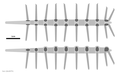
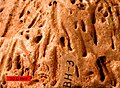
| White Mountains mousetails, growing on substrate within the Campito Formation | |
| Type | Formation |
| Sub-units | See: Members |
| Underlies | Poleta Formation [2] |
| Overlies | Deep Spring Formation [2] |
| Thickness | 0–3,500 ft (0–1,067 m) [3] |
| Lithology | |
| Primary | Quartzite |
| Other | Siltstone, Sandstone |
| Location | |
| Region | California, Nevada |
| Country | United States |
The Campito Formation is a geologic formation in the Last Chance Range, California, and Esmeralda County, Nevada. It preserves fossils dating back to the Cambrian period.
The Campito Formation is mainly composed of very fine to fine-grained quartzite, with small amounts of siltstone, getting up to 3,500 ft (1,100 m) thick. [3]
The formation is split into two distinct members, which are as follows, in ascending age:
The Campito Formation contains a number of fossils, most of which are found within the Montenegro Member. They range from archeocyathid sponges like Ethmophyllum , to arthropod trilobites like Nevadia , [3] and a wealth of ichnogenera, from burrows like Skolithos , to resting traces like Rusophycus . [4]
Color key
| Notes Uncertain or tentative taxa are in small text; |
| Genus | Species | Notes | Images |
|---|---|---|---|
| Fritzaspis [5] |
| Fallotaspidoid trilobite. | |
| Amplifallotaspis [5] |
| Fallotaspidoid trilobite. | |
| Profallotaspis (?) [5] |
| Fallotaspidoid trilobite. | |
| Archaeaspis [6] |
| Fallotaspidoid trilobite. | |
| Cirquella [6] |
| Fallotaspidoid trilobite. | |
| Cambroinyoella [6] |
| Fallotaspidoid trilobite. | |
| Fallotaspis [3] [7] [8] [9] |
| Fallotaspidoid trilobite. | |
| Daguinaspis [3] |
| Fallotaspidoid trilobite. | |
| Repinaella [9] [5] [5] |
| Fallotaspidoid trilobite. | |
| Eofallotaspis [9] |
| Fallotaspidoid trilobite. | |
| Nevadia [3] |
| Nevadiid trilobite. | |
| Judomia (?) [3] |
| Nevadiid trilobite, assignment to genus is very tentative. | |
| Montezumaspis [10] |
| Holmiid trilobite. | |
| Esmeraldina [3] [10] [9] |
| Holmiid trilobite. E. cometes was previously identified as Fallotaspis tazemmourtensis. [9] | |
| Holmiella [10] |
| Holmiid trilobite. | |
| Palmettaspis [10] |
| Holmiid trilobite. | |
| Grandinasus [10] |
| Holmiid trilobite. | |
| Genus | Species | Notes | Images |
|---|---|---|---|
| Microdictyon [11] [12] |
| Xenusid lopopod. | |
| Genus | Species | Notes | Images |
|---|---|---|---|
| Microcornus [12] |
| Lophotrochozoan hyolith. | |
| Ladatheca [9] |
| Lophotrochozoan hyolith. | |
| Parkula [12] |
| Lophotrochozoan hyolith. | |
| Hyolithellus (?) [12] |
| Lophotrochozoan hyolith. | |
| Obolella [13] |
| Obelellid brachiopod. | |
| Pelagiella [12] |
| Pelagiellid mollusc. | |
| Nisusia (?) [13] [9] |
| Kutorginid brachiopod. | |
| Sabellidites (?) [9] |
| Tubular fossil. | |
| Brachiopod indet. [13] |
| Indeterminate brachiopod, most likely an internal mold, possibly a poorly preserved Nisusia (?)sp. specimen, or another kutorginid brachiopod. | |
| Obelellid molds [9] |
| Molds of obelellid brachiopods. | |
| Genus | Species | Notes | Images |
|---|---|---|---|
| Allonia [12] |
| Chancelloriid organism. | |
| Chancelloria [12] |
| Chancelloriid organism. | |
| Genus | Species | Notes | Images |
|---|---|---|---|
| Paiutitubulites [14] |
| Anthozoan cnidarian. | |
| Genus | Species | Notes | Images |
|---|---|---|---|
| Ethmophyllum (?) [1] |
| Archeocyathid sponge. | |
| Genus | Species | Notes | Images |
|---|---|---|---|
| Helicoplacus [7] |
| Oblong echinoderm. | |
| Isolated plates [15] |
| Isolated plates, possibly of eocrinoid origin. | |
| Genus | Species | Notes | Images |
|---|---|---|---|
| Platysolenites [7] |
| Agglutinated hyperamminid foraminiferan. | |
| Genus | Species | Notes | Images |
|---|---|---|---|
| Onuphionella [8] |
| Tubular fossil. | |
| Volborthella [16] |
| Tubular fossil, originally described as Campitius. [7] | |
| Genus | Species | Notes | Images |
|---|---|---|---|
| Cruziana [4] |
| Trails. | |
| Planolites [4] |
| Burrows. | |
| Helminthopsis [4] |
| Feeding trails. | |
| Belorhaphe [4] |
| Burrows. | |
| Cochlichnus [4] |
| Burrows. | |
| Scolicia [4] |
| Burrows. | |
| Rusophycus [4] |
| Resting trace of trilobites. | |
| Bergaueria [4] |
| Resting trace of cnidarians. | |
| Zoophycus [4] |
| Polychaete feeding traces. | |
| Arthrophycus [4] |
| Polychaete trace. | |
| Teichichnus [4] |
| Feeding trace. | |
| Treptichnus [4] |
| Burrow, originally described as Phycodes. | |
| Diplichnites [4] |
| Arthropod trackways. | |
| Skolithos [4] |
| Burrows. | |