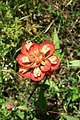
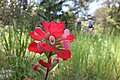
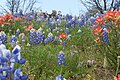
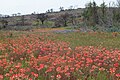
Castilleja, commonly known as paintbrush, Indian paintbrush, or prairie-fire, is a genus of about 200 species of annual and perennial herbaceous plants native to the west of the Americas from Alaska south to the Andes, northern Asia, and one species as far west as the Kola Peninsula in northwestern Russia. These plants are classified in the broomrape family Orobanchaceae. They are hemiparasitic on the roots of grasses and forbs. The generic name honors Spanish botanist Domingo Castillejo.

Inks Lake State Park is a state park located in Burnet County, Texas, United States, next to Inks Lake on the Colorado River. The landscape of the park is hilly, with many cedar, live oak, prickly pear cacti, and yuccas. The ground is rocky, mainly consisting of gneiss rock.

Castilleja applegatei is a species of Castilleja known by the common names Applegate's Indian paintbrush and wavyleaf Indian paintbrush.

Castilleja exserta is a species of plant in the genus Castilleja which includes the Indian paintbrushes. Its common names include purple owl's clover, escobita, and exserted Indian paintbrush.

Castilleja angustifolia is a species of wildflower known by the common names northwestern Indian paintbrush and desert Indian paintbrush. It is an herbaceous perennial native to the desert, scrublands, and woodlands of western North America. It grows in hot sandy soils and rock crevices in dry conditions.

Castilleja linariifolia is a perennial plant, native to the United States and is the state flower of Wyoming. It has a number of common names including Wyoming Indian paintbrush, narrow-leaved Indian paintbrush, desert paintbrush, Wyoming desert paintbrush, Wyoming paintbrush, linaria-leaved Indian Paintbrush, and Indian paintbrush.
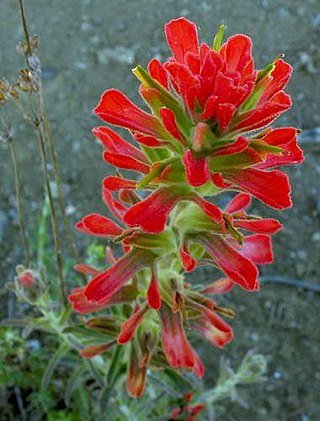
Castilleja foliolosa is a species of Indian paintbrush, known by the common names woolly Indian paintbrush and Texas Indian paintbrush.

Castilleja miniata is a species of Indian paintbrush known by the common name giant red Indian paintbrush. It is native to western North America from Alaska to Ontario to California to New Mexico, where it grows usually in moist places in a wide variety of habitat types.
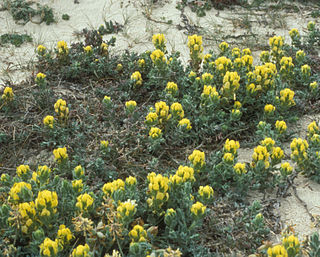
Castilleja mollis is a species of Indian paintbrush known by the common name softleaf Indian paintbrush. It is endemic to the Channel Islands of California, where it is currently known only from Santa Rosa Island. An occurrence was once noted on San Miguel Island, but the plant has not been found there since 1938. Its habitat is the coastal sage scrub around the windy sand dunes and bluffs.

Castilleja parviflora is a species of Indian paintbrush known by the common name mountain Indian paintbrush. It is native to western North America from Alaska to California, where it grows in high mountain habitat, including areas of alpine climate.

Castilleja subinclusa is a species of Indian paintbrush known by the common names longleaf Indian paintbrush and Franciscan paint brush.

Castilleja levisecta is a rare species of flowering plant in the family Orobanchaceae known by the common name golden paintbrush, or golden Indian paintbrush, listed under the Endangered Species Act in 1997. It is native to British Columbia and Washington, where it is known from eleven remaining populations. It occurred in Oregon but all natural occurrences there have been extirpated. It has been reintroduced to a few areas in Oregon, but it remains to be seen if the plants will survive. The plant is a federally listed endangered species of Canada and was listed as threatened in the United States in 1997. On June 30, 2021, the plant was proposed for delisting due to recovery. Effective August 18, 2023, the U.S. Fish and Wildlife Service (USFWS) issued a rule removing golden paintbrush from the Federal List of Endangered and Threatened Plants

Castilleja septentrionalis is a species of Indian paintbrush known by several common names, including northern paintbrush, sulfur paintbrush, and pale painted cup. There is taxonomic disagreement as to if it is one species widely distributed in mountain and alpine environments of North America or if there is a second species, Castilleja sulphurea, in the Rocky Mountains.
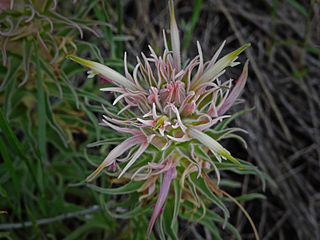
Castilleja sessiliflora is a species of flowering plant in the family Orobanchaceae known by the common names downy Indian paintbrush and downy paintedcup. It is native to the Great Plains of North America from southern Canada, through the central United States, to northern Mexico. It occurs as far west as the eastern slopes of the Rocky Mountains.

Liatris punctata is a species of flowering plant in the family Asteraceae known by the common names dotted gayfeather, dotted blazingstar, and narrow-leaved blazingstar. It is native to North America, where it occurs throughout the plains of central Canada, the central United States, and northern Mexico.

Castilleja coccinea, commonly known as scarlet Indian paintbrush or scarlet painted-cup, is a biennial flowering plant in the Orobanchaceae (broomrape) family. It is usually found in prairies, rocky glades, moist and open woodlands, thickets, and along streams in central and eastern North America.

Castilleja integra, with the common names orange paintbrush, Southwestern paintbrush, and wholeleaf paintbrush, is an partially parasitic herbaceous perennial plant native to the Southwestern United States and Northern Mexico. It is better suited to cultivation that most other species in the paintbrush genus (Castilleja) and is there for used in xeriscape gardens and naturalistic meadows, even outside its native range.
Castilleja kerryana is a species of flowering plant in the family Orobanchaceae. It is commonly known as Kerry's Indian paintbrush or Kerry’spaintbrush. It was formally described in 2013 and so far it is known only from a small population in the state of Montana, in the Northwestern United States.

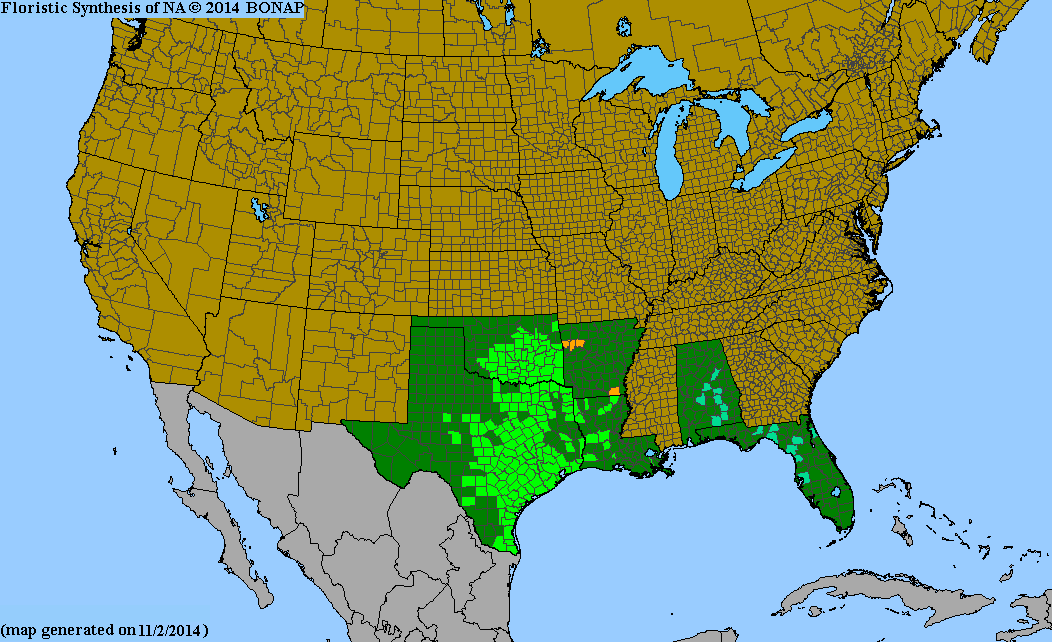
Castilleja purpurea, known as downy Indian paintbrush, is a wildflower native to Texas, Oklahoma, Kansas, and Missouri. The flowers of various subspecies display a wide variety of forms and colors. Blooms may be white, pale yellow, peach, or tinged with pink and the foliage may be green or purple.

Castilleja bella is a species in the Castilleja genus known by the common name Arteaga Indian paintbrush. It is native to northeastern Mexico, primarily the states of Nuevo León and Coahuila, where it grows in montane habitats.