
The Albert Kahn House is in Midtown Detroit, Michigan, within the Brush Park district. It is currently the headquarters of the Detroit Urban League. The house was designated a Michigan State Historic Site in 1971 and listed on the National Register of Historic Places in 1972.

The East Ferry Avenue Historic District is a historic residential district in Midtown Detroit, Michigan. The nationally designated historic district stretches two blocks from Woodward Avenue east to Brush Street; the locally designated historic district includes a third block between Brush and Beaubien. The district includes the separately designated Col. Frank J. Hecker House and the Charles Lang Freer House. It was designated a Michigan State Historic Site in 1976 and listed on the National Register of Historic Places in 1980.

The Wayne State University historic district consists of three buildings on 4735-4841 Cass Avenue in Midtown Detroit, Michigan: the Mackenzie House, Hilberry Theatre, and Old Main, all on the campus of Wayne State University. The buildings were designated a Michigan State Historic Site in 1957 and listed on the National Register of Historic Places in 1978.

The George W. Loomer House is a private residence located at 71 West Hancock Street in Midtown Detroit, Michigan. It was listed on the National Register of Historic Places in 1994.

The Mulford T. Hunter House is a private residence located at 77 West Hancock Street in Midtown Detroit, Michigan. It was listed on the National Register of Historic Places on July 22, 1994.

The Sugar Hill Historic District is a historic district in Detroit, Michigan. It contains 14 structures located along three streets: East Forest, Garfield, and East Canfield, between Woodward Avenue on the west and John R. on the east. The district was listed on the National Register of Historic Places in 2003.

The Cass Park Historic District is a historic district in Midtown Detroit, Michigan, consisting of 25 buildings along the streets of Temple, Ledyard, and 2nd, surrounding Cass Park. It was listed on the National Register of Historic Places in 2005 and designated a city of Detroit historic district in 2016.

The Annapolis Park Historic District is a historic district located along Julius, Matthew, Hanover, Farnum, Alan, and Paul Streets in Westland, Michigan, covering 71 acres (290,000 m2) and 354 buildings. It was listed on the National Register of Historic Places in 2006.

The former Eighth Precinct Police Station is a building located at 4150 Grand River Avenue in the Woodbridge Historic District of Detroit, Michigan, United States. It is the second-oldest police building in Detroit, and was designated a Michigan State Historic Site in 1973 and listed on the National Register of Historic Places in 1974. The building now houses the Detroit Castle Lofts.

The Ephraim and Emma Woodworth Truesdell House is a private house located at 1224 Haggerty Road in Canton Township, Michigan. The structure is significant because it is one of the most finely crafted houses in the township and because of its association with one of the most important families in the area. It was listed on the National Register of Historic Places in 2003.
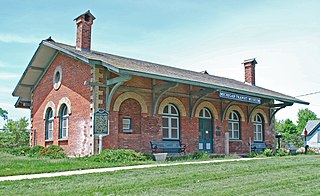
Mount Clemens station is a historic railroad depot located at 198 Grand Street in Mt. Clemens, Michigan. Thomas Edison learned telegraphy at this station in his youth. The building was listed on the National Register of Historic Places in 1981 as the Grand Trunk Western Railroad, Mount Clemens Station and designated a Michigan State Historic Site in 1973. It is now operated as the Michigan Transit Museum.

The Tushiyah United Hebrew School, later known as the Scott Memorial Methodist Episcopal Church, is an educational building located at 609 East Kirby Street in Detroit, Michigan. This building, an important work of architect Isadore M. Lewis, was constructed as the Tushiyah United Hebrew School and served as the headquarters of the United Hebrew Schools of Detroit. It later served as the Scott Memorial Methodist Episcopal Church, the first mainline African-American Methodist Episcopal church in Detroit. It was listed on the National Register of Historic Places in 2011.
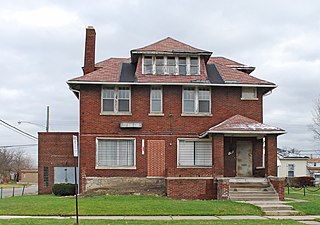
The Nacirema Club is a social club located at 6118 30th Street in Detroit, Michigan; it was the first African American social club in Michigan. It was listed on the National Register of Historic Places in 2011.

Jackson Park Town Site Addition Brick Row is a group of three historic houses and two frame garages located on the west side of the 300 block of South Third Street in Lander, Wyoming. Two of the homes were built in 1917, and the third in 1919. The properties were added to the National Register of Historic Places on February 27, 2003.

The Norwayne Historic District, or Norwayne Subdivision, is an historic residential subdivision, originally built for World War II defense workers. It is located in Westland, Michigan and roughly bounded by Palmer Road on the north, Wildwood Road on the west, Merriman Road on the east, and Glenwood Road and the Wayne County Lower Rouge Parkway on the south. It was listed on the National Register of Historic Places in 2013.

Dr. Rosa Slade Gragg was an American activist and politician. She founded the first black vocational school in Detroit, Michigan; and was the advisor to three United States presidents. She was inducted in 1987 into the Michigan Women's Hall of Fame.

The Checker Cab Building was built as a garage and office building located at 2128 Trumbull Avenue in Detroit, Michigan. It was listed on the National Register of Historic Places in 2019. The building has been rehabilitated into residences, and is now part of the Elton Park lofts.

The Rosa L. (McCauley) and Raymond Parks Flat, or simply the Rosa Parks Flat, is a two-story brick duplex located at 3201-3203 Virginia Park Street in Detroit, Michigan. The building is significant as the home of civil rights icon Rosa Parks, who lived in the first floor flat with her husband Raymond from 1961 to 1988. The building was listed on the National Register of Historic Places in 2021.

Alpha House is a fraternity house located at 293 Eliot Street in Detroit, Michigan. It is significant as the longtime headquarters of the Gamma Lambda Chapter of Alpha Phi Alpha fraternity. The house was listed on the National Register of Historic Places on August 26, 2021.

The Frances Harper Inn is a house located at 307 Horton Street in Detroit, Michigan. It is significant for its operation, between about 1915 and 1950, by the Christian Industrial Club, a Detroit Black women's club. The club used the house to provide safe and affordable housing for Black women and girls who did not have families to house them. The building was listed on the National Register of Historic Places in 2023.


