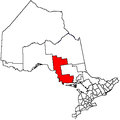
The town is located along the Algoma Central Railway, on Highway 519, 32 kilometres (20mi) east of Highway 17. The turnoff from Highway 17 is located 40 kilometres (25mi) north from the town of Wawa and 45 kilometres (28mi) south of the town of White River.
Dubreuilville was founded as a company town in 1961, by the Dubreuil Brothers and their employees, originally from Taschereau, Quebec. They obtained logging rights in the area, built a sawmill, and relocated their operations, including houses, from their previous site on the Magpie River to the new town site upstream on the Magpie River where it meets the Algoma Central Railway. In 1962, the road connecting the town to Highway 17 was built.[5]
In 1977, Dubreuilville was incorporated as a twonship municipality. No longer a closed company town, its houses were sold to the sawmill employees, and municipal infrastructure was built, such as a school, arena, medical clinic, water and waste water facilities.[5]
In 1988, the sawmill was sold to Jean-Paul Dubreuil, son of one of the original founders, and sold again in 1989 to Buchanan and James River Paper. In November 2008, the sawmill shutdown due to poor economic conditions in the industry. Since then, the town has relied on gold mining operations in the area, as well as on tourism.[5]
Demographics
In the 2021 Census of Population conducted by Statistics Canada, Dubreuilville had a population of 576 living in 248 of its 284 total private dwellings, a change of -6% from its 2016 population of 613. With a land area of 87.53km2 (33.80sqmi), it had a population density of 6.6/km2 (17.0/sqmi) in 2021.[1]
↑Michael Commito, " 'A sparkling example of what aggressiveness, imagination, and skill can accomplish': The Rise of Dubreuil Brothers Limited, 1948-1973" Ontario History Vol. CV, 2 (Autumn 2013): 212-229
This page is based on this Wikipedia article Text is available under the CC BY-SA 4.0 license; additional terms may apply. Images, videos and audio are available under their respective licenses.