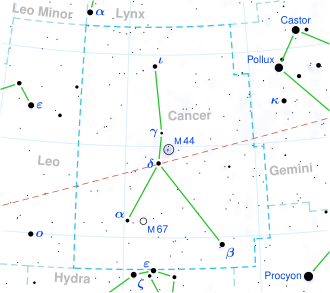
  EI Cancri Location of EI Cancri in the constellation Cancer | |
| Observation data Epoch J2000 Equinox J2000 | |
|---|---|
| Constellation | Cancer [1] |
| A | |
| Right ascension | 08h 58m 15.07493s [2] |
| Declination | +19° 45′ 48.2581″ [2] |
| Apparent magnitude (V) | 13.93 [3] |
| B | |
| Right ascension | 08h 58m 15.14813s [4] |
| Declination | +19° 45′ 48.8367″ [4] |
| Apparent magnitude (V) | 13.75 [3] |
| Characteristics | |
| A | |
| Spectral type | M8Ve [5] |
| B | |
| Spectral type | M7V [6] |
| Astrometry | |
| A | |
| Radial velocity (Rv) | 13 ± 5 [7] km/s |
| Proper motion (μ) | RA: −767.060 mas/yr [2] Dec.: −100.176 mas/yr [2] |
| Parallax (π) | 194.1443±0.1228 mas [2] |
| Distance | 16.80 ± 0.01 ly (5.151 ± 0.003 pc) |
| B | |
| Proper motion (μ) | RA: −937.133 mas/yr [4] Dec.: −34.559 mas/yr [4] |
| Parallax (π) | 196.2619±0.1976 mas [4] |
| Distance | 16.62 ± 0.02 ly (5.095 ± 0.005 pc) |
| Details | |
| A | |
| Mass | 0.120±0.014 [8] M☉ |
| Radius | 0.136±0.020 [9] R☉ |
| Luminosity (bolometric) | 0.00135±0.00040 [10] L☉ |
| Temperature | 2,890±79 [10] K |
| Metallicity [Fe/H] | +0.08 [9] dex |
| Rotation | ≤10.76 [8] days |
| Rotational velocity (v sin i) | 16.70±0.64 [11] km/s |
| B | |
| Mass | 0.103±0.014 [8] M☉ |
| Radius | 0.119±0.021 [9] R☉ |
| Luminosity (bolometric) | 0.000937±0.000028 [10] L☉ |
| Temperature | 2,802±78 [10] K |
| Metallicity [Fe/H] | +0.14 [9] dex |
| Rotation | ≤9.60 [8] days |
| Rotational velocity (v sin i) | 16.70±0.64 [11] km/s |
| Other designations | |
| EI Cnc, GJ 1116, WDS J08582+1945AB, G 9-38, G 47-14, G 41-11, LP 426-40, LTT 12343, PLX 2144.03, GSC 01397-01138, 2MASS J08581519+1945470 | |
| A: Gaia DR2 660597997696173440, LHS 2076, NLTT 20638 [12] | |
| B: Gaia DR2 660597997697274752, LHS 2077, NLTT 20637 [13] | |
| Database references | |
| SIMBAD | The system |
| A | |
| B | |
EI Cancri, also known as G 9-38 and GJ 1116, is a binary star system consisting of two M-type stars. [14] Located at a distance of 16.7 light-years, it is among the nearest star systems. [15]
This system consist of two very-low-mass stars that are orbiting each other at an assumed orbital separation of 7.0 astronomical units and an estimated period of 42 years. [16] Component A has an apparent magnitude 13.93, [3] 0.127 times the Sun's mass, 0.136 times the Sun's radius, [9] and 0.14% of the Sun's luminosity. [10] Component B has an apparent magnitude 13.75, [3] 0.111 times the Sun's mass, 0.119 times the Sun's radius, [9] and 0.09% of the Sun's luminosity. [10] At the very end of the main sequence, with spectral classifications of M8Ve [5] and M7V [6] respectively, their effective temperatures are below 3,000 K . [10] A 2015 search for a third star in the system has yielded inconclusive results. [17]

In 1985, Bjørn Ragnvald Pettersen announced his discovery that the star shows very high stellar flare activity, with an average of five flares per hour. [18] It was given its variable star designation, EI Cancri, in 1987. [19]
