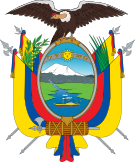
The politics of Ecuador are multi-party. The central government polity is a four-yearly elected presidential, unicameral representative democracy. The President of Ecuador is head of state and head of government on a multi-party system, leading a cabinet with further executive power. Legislative power is not limited to the National Assembly as it may to a lesser degree be exercised by the executive which consists of the President convening an appointed executive cabinet. Subsequent acts of the National Assembly are supreme over Executive Orders where sufficient votes have been cast by the legislators. The judiciary is independent of the executive and the legislature.There is also constitutional republic
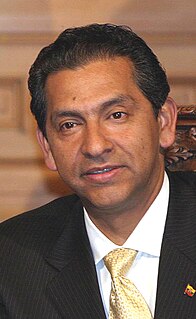
Lucio Edwin Gutiérrez Borbúa served as 43rd President of Ecuador from January 15, 2003 to April 20, 2005.
PRIAN, which means Institutional Renewal Party of National Action was a right-wing populist Political Party in Ecuador.

The Ecuadorian Roldosist Party was a populist political party in Ecuador. The party was named after former President Jaime Roldós. It was founded after Roldós' death by his brother-in-law Abdalá Bucaram as a more leftish spin-off from the Concentration of People's Forces. Bucaram was elected President in 1996 but was impeached the following year. Though Jaime Roldós's brother León Roldós is still very involved in Ecuadorian politics, he is not a member of the Roldosist Party.

Álvaro Fernando Noboa Pontón is an Ecuadorian businessman and politician.
General elections were held in Ecuador on 20 October 2002, with a second round of the presidential elections on 24 November. The result was a victory for Lucio Gutiérrez of the PSP–MUPP–NP alliance, who won the run-off with 54.8% of the vote. The Social Christian Party emerged as the largest party in the National Congress, winning 24 of the 100 seats.
PAIS Alliance is an Ecuadorian center-left social democratic political party.

An early general election was held on 26 April 2009 in Ecuador following the approval of a new constitution in a referendum held on 28 September 2008. President Rafael Correa ran for his first term under the new constitution. The election was initially expected to be held in October 2010.

General elections were held in Ecuador on 31 May 1998, with a second round of the presidential elections on 12 July. The result was a victory for Jamil Mahuad of the Popular Democracy (DP) party, who won the run-off with 51.2% of the vote. The DP alliance also emerged as the largest party in the National Congress, winning 32 of the 120 seats.
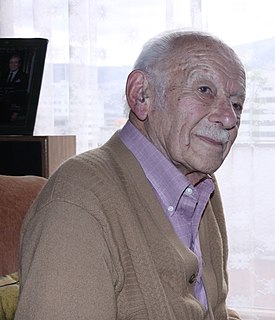
General elections were held in Ecuador on 17 May 1992, with a second round of the presidential elections on 5 July. The presidential elections resulted in a victory for Sixto Durán Ballén of the Republican Union Party–Conservative Party alliance, who received 57.3% of the vote in the run-off. The Social Christian Party emerged as the largest party in the House of Representatives, winning 21 of the 77 seats.
This article is about the history of Ecuador from 1990 to the present.

General elections were held in Ecuador on 29 January 1984, with a second round of the presidential elections on 6 May. After finishing second in the first round, León Febres Cordero of the Social Christian Party won the run-off with 51.5% of the vote. The Democratic Left emerged as the largest faction in the National Congress, winning 24 of the 69 seats.

Presidential elections were held in the Dominican Republic on 16 May 1996, with a second round on 30 June. Whilst José Francisco Peña Gómez won the most votes in the first round, he was defeated by Leonel Fernández in the second round, after the Social Christian Reformist Party, whose candidate had lost in the first round, declared their support for Fernández. Voter turnout was 78.6% in the first round and 76.8% in the second.
General elections were held in Bosnia and Herzegovina on 18 November 1990, with a second round of voting in the House of Peoples elections on 2 December. These were the final general elections to be held in Bosnia and Herzegovina while it was still a constituent republic of the Socialist Federal Republic of Yugoslavia.

General elections were held in Ecuador in 1978 and 1979. The first round of the presidential election was held on 16 July 1978, with a second round held alongside parliamentary elections on 29 April 1979. The presidential election was won by Jaime Roldós Aguilera of the Concentration of People's Forces (CPF), who received 68.5% of the vote in the run-off, becoming the country's first freely-elected president. The CPF emerged as the largest party in the National Congress, winning 29 of the 69 seats.
General elections were held in Ecuador on 17 February 2013 to elect the President, the National Assembly, Provincial Assemblies and members of the Andean Parliament. The incumbent President Rafael Correa was re-elected by a wide margin. Correa's closest electoral rival, Guillermo Lasso, conceded the election shortly after it concluded.
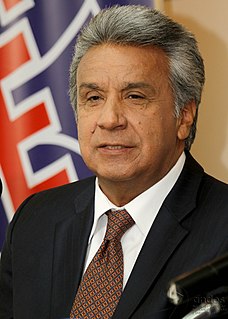
General elections were held in Ecuador on 19 February 2017 alongside a referendum on tax havens. Voters elected a new President and National Assembly. Incumbent President Rafael Correa of the PAIS Alliance was not eligible for re-election, having served two terms. In the first round of the presidential elections, PAIS Alliance candidate Lenín Moreno received 39% of the vote. Although he was more than 10% ahead of his nearest rival, Guillermo Lasso of the Creating Opportunities party, Moreno was just short of the 40% threshold required to avoid a run-off. As a result, a second round was held on 2 April. In the second round Moreno was elected President with 51.16% of the vote.

Fuerza Ecuador is a political party in Ecuador.