| ||||||||||||||||||||
| ||||||||||||||||||||
| ||||||||||||||||||||
Map of results of the second round by provinces. | ||||||||||||||||||||
| ||||||||||||||||||||
| This article is part of a series on the politics and government of Ecuador |
|---|
Legislative |
Judiciary |
General elections were held in Ecuador on 31 May 1998, with a second round of the presidential elections on 12 July. [1] The result was a victory for Jamil Mahuad of the Popular Democracy (DP) party, who won the run-off with 51.2% of the vote. [2] The DP alliance also emerged as the largest party in the National Congress, winning 32 of the 120 seats. [3]
Ecuador, officially the Republic of Ecuador, is a country in northwestern South America, bordered by Colombia on the north, Peru on the east and south, and the Pacific Ocean to the west. Ecuador also includes the Galápagos Islands in the Pacific, about 1,000 kilometres (620 mi) west of the mainland. The capital city is Quito and the largest city as well.
Jorge Jamil Mahuad Witt is an Ecuadorian lawyer, academic and former politician, he was the 39th President of Ecuador from August 10, 1998 to January 21, 2000.
The Christian Democratic Union , formerly known as Popular Democracy was a Christian democratic political party in Ecuador. It was formed in the 1970s by centrist Christian Democrats who had left the Social Christian Party and the left wing of the Conservative Party who were oriented towards Liberation theology. It officially registered as a political party in 1979. It was originally considered a centre-left party. Later in the 1990s, it shifted to the centre-right.
Following the 1996 general elections, President Abdalá Bucaram was removed from office by Congress nine months later on grounds of mental incapacity. Fabian Alarcon thereupon took his place as caretaker Head of State.

Abdalá Jaime Bucaram Ortiz is an Ecuadorian politician and lawyer who was President of Ecuador from August 10, 1996, to February 6, 1997. As President, Abdalá Bucaram was nicknamed "El Loco" and was removed from office after being declared mentally unfit to rule by the National Congress of Ecuador. Bucaram and his followers claim that all cases against him have been dismissed. After having lived in Panama under political asylum, he returned to Ecuador in 2017 when the charges against him expired.
The leading contestants of the six (including two women) vying for the presidency were Jamil Mahuad (DP), the mayor of Quito, and Álvaro Noboa (Ecuadorian Roldosist Party), a wealthy businessman. Campaign debates were marked by personal accusations of drug links and threatened lawsuits between the two rivals, alongside statements on substantive policy questions relating primarily to corruption and the country’s ailing economy. Problems in this latter sector (high inflation, budget deficit) had been aggravated by the sociological and infrastructural damage caused by the climatic phenomenon known as El Niño and the worldwide drop in oil prices, Ecuador’s main export earner. Mahuad advocated an intense program of private investment to achieve a 5% annual growth rate, privatizations, job creation and housing construction.
Quito is the capital and the largest city of Ecuador, and at an elevation of 2,850 metres (9,350 ft) above sea level, it is the second-highest official capital city in the world, after La Paz, and the one which is closest to the equator. It is located in the Guayllabamba river basin, on the eastern slopes of Pichincha, an active stratovolcano in the Andes Mountains. With a population of 2,671,191 according to statistical projections (2019), Quito is the most populous city in Ecuador. It is also the capital of the Pichincha province and the seat of the Metropolitan District of Quito. The canton recorded a population of 2,239,191 residents in the 2010 national census. In 2008, the city was designated as the headquarters of the Union of South American Nations.
Álvaro Fernando Noboa Pontón is an Ecuadorian businessman and politician.

The Ecuadorian Roldosist Party was a populist political party in Ecuador. The party was named after former President Jaime Roldós. It was founded after Roldós' death by his brother-in-law Abdalá Bucaram as a more leftish spin-off from the Concentration of People's Forces. Bucaram was elected President in 1996 but was impeached the following year. Though Jaime Roldós's brother León Roldós is still very involved in Ecuadorian politics, he is not a member of the Roldosist Party.
| Candidate | Party | First round | Second round | ||
|---|---|---|---|---|---|
| Votes | % | Votes | % | ||
| Jamil Mahuad | Popular Democracy | 1,342,114 | 34.9 | 2,243,000 | 51.2 |
| Álvaro Noboa | Ecuadorian Roldosist Party | 1,022,667 | 26.6 | 2,140,481 | 48.8 |
| Rodrigo Borja Cevallos | Democratic Left | 619,581 | 16.1 | ||
| Freddy Ehlers | Pachakutik Plurinational Unity Movement – New Country | 566,917 | 14.7 | ||
| Rosalía Arteaga | Independent Movement for an Authentic Republic | 195,000 | 5.1 | ||
| Maria Eugenia Lima | Democratic People's Movement | 97,522 | 2.5 | ||
| Invalid/blank votes | 694,021 | – | 576,594 | – | |
| Total | 4,537,822 | 100 | 4,960,075 | 100 | |
| Registered voters/turnout | 7,072,496 | 64.2 | 7,072,496 | 70.1 | |
| Source: Nohlen | |||||
| Party | Nationwide | District | Seats | +/– | ||||
|---|---|---|---|---|---|---|---|---|
| Votes | % | Votes | % | |||||
| Social Christian Party | 839,567 | 23.8 | 5,114,369 | 23.5 | 26 | –1 | ||
| Popular Democracy | 669,473 | 19.0 | 6,008,940 | 27.6 | 32 | +21 | ||
| Ecuadorian Roldosist Party | 628,265 | 17.8 | 4,429,114 | 20.3 | 24 | +5 | ||
| Democratic Left | 544,088 | 15.4 | 3,006,737 | 13.8 | 15 | +11 | ||
| Pachakutik Plurinational Unity Movement – New Country | 325,365 | 9.2 | 127,891 | 0.6 | 5 | –3 | ||
| Democratic People's Movement | 151,096 | 4.3 | 980,253 | 4.5 | 2 | 0 | ||
| FRA | 54,137 | 1.5 | 559,548 | 2.6 | 3 | +3 | ||
| Concentration of People's Forces | 37,507 | 1.1 | 241,002 | 1.1 | 0 | –1 | ||
| Ecuadorian Revolutionary Popular Action | 28,837 | 0.8 | 180,399 | 0.8 | 0 | –2 | ||
| National Alfarismo Party | 51,515 | 1.5 | – | – | 13 | – | ||
| Latin American People's Union | 14,043 | 0.4 | 145,410 | 0.7 | ||||
| Other parties | – | – | 980,253 | 4.5 | ||||
| Invalid/blank votes | 1,009,881 | – | 953,033 | – | – | – | ||
| Total | 4,537,822 | 100 | 3,478,524 | 100 | 120 | +38 | ||
| Registered voters/turnout | 7,072,496 | 64.2 | 7,072,496 | 49.2 | – | – | ||
| Source: Nohlen | ||||||||
The History of Ecuador extends over an 8,000-year period. During this time a variety of cultures and territories influenced what has become the Republic of Ecuador. The history can be divided into five eras: Pre-Columbian, the Conquest, the Colonial Period, the War of Independence, Gran Colombia, and Simón Bolívar the final separation of his vision into what is known today as the Republic of Ecuador.
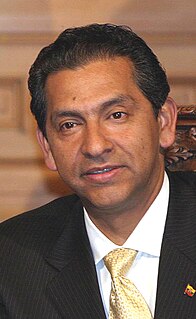
Lucio Edwin Gutiérrez Borbúa served as 43rd President of Ecuador from January 15, 2003 to April 20, 2005.
Gustavo José Joaquín Noboa Bejarano is an Ecuadorian politician, former President of Ecuador and Vice President during Jamil Mahuad's government.
The Democratic Party is a center-right party in Bulgaria led by Alexander Pramatarski. The party is a member of the European People's Party (EPP).
General elections were held in Luxembourg on 13 June 1999, alongside European Parliament elections. The Christian Social People's Party remained the largest party, winning 19 of the 60 seats in the Chamber of Deputies. It formed a coalition government with the Democratic Party.
General elections were held in Ecuador on 20 October 2002, with a second round of the presidential elections on 24 November. The result was a victory for Lucio Gutiérrez of the PSP–MUPP–NP alliance, who won the run-off with 54.8% of the vote. The Social Christian Party emerged as the largest party in the National Congress, winning 24 of the 100 seats.
Lebanese Ecuadorians are Ecuadorians who are descended from migrants from Lebanon. There are approximately 98,000 Lebanese people and their descendants living in Ecuador.

General elections were held in Ecuador on 19 May 1996, with a second round of the presidential elections on 7 July. Although Jaime Nebot of the Social Christian Party received the most votes in the first round, Abdalá Bucaram of the Ecuadorian Roldosist Party won the run-off with 54.5% of the vote. The Social Christian Party remained the largest in the Chamber of Deputies, winning 27 of the 82 seats.
General elections were held in Ecuador on 17 May 1992, with a second round of the presidential elections on 5 July. The presidential elections resulted in a victory for Sixto Durán Ballén of the Republican Union Party–Conservative Party alliance, who received 57.3% of the vote in the run-off. The Social Christian Party emerged as the largest party in the House of Representatives, winning 21 of the 77 seats.
General elections were held in Ecuador on 31 January 1988, with a second round of the presidential elections on 8 May. Rodrigo Borja Cevallos of the Democratic Left won the presidential elections, receiving 54% of the vote in the second round, whilst the Democratic Left remained the largest faction in the National Congress, winning 31 of the 72 seats.
The 1998-1999 Ecuador financial crisis was a period of economic instability that resulted from a combined banking crisis, currency crisis, and sovereign debt crisis. Severe inflation and devaluation of the Ecuadorean Sucre lead to President Jamil Mahuad announcing on January 9, 2000 that the US dollar would be adopted as the national currency. Poor economic conditions and subsequent protests against the government resulted in the 2000 Ecuadorian coup d’état in which Jamil Mahuad was forced to resign and was replaced by his Vice President, Gustavo Noboa.
This article is about the history of Ecuador from 1990 to the present.
The 2000 Ecuadorian coup d'état took place on 21 January 2000 and resulted in President Jamil Mahuad being deposed, and replaced by Vice President Gustavo Noboa. The coup coalition brought together a short-lived junta composed by the country's most powerful indigenous group, Confederation of Indigenous Nationalities of Ecuador (CONAIE), and a group of junior military officers led by Lieutenant Colonel Lucio Gutiérrez.
General elections were held in Ecuador on 29 January 1984, with a second round of the presidential elections on 6 May. After finishing second in the first round, León Febres Cordero of the Social Christian Party won the run-off with 51.5% of the vote. The Democratic Left emerged as the largest faction in the National Congress, winning 24 of the 69 seats.
The Miss Ecuador 1998 was held on March 21, 1998. There were 15 candidates for the national title, the crown passed from Monica Chala from Pichincha to Soraya Hogonaga from same province, but the new Miss Ecuador 1998 was crowned by Jamil Mahuad who was the mayor of the Quito, the future presidential candidate for the 1998 presidential election and the future president of Ecuador. Soraya competed at Miss Universe 1998.
General elections were held in Ecuador in 1978 and 1979. The first round of the presidential election was held on 16 July 1978, with a second round held alongside parliamentary elections on 29 April 1979. The presidential election was won by Jaime Roldós Aguilera of the Concentration of People's Forces (CPF), who received 68.5% of the vote in the run-off, becoming the country's first freely-elected president. The CPF emerged as the largest party in the National Congress, winning 29 of the 69 seats.
Alexandra Blanca Vela Puga is an Ecuadorian lawyer and politician originally from El Salvador. She is currently a dean of the Faculty of Law at the University of the Americas Ecuador.
Ana Lucía Armijos Hidalgo is an Ecuadorian politician and economist. She was the first female Ecuadorian Minister of the Interior.