Related Research Articles
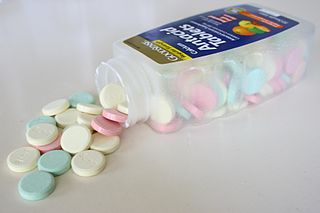
An antacid is a substance which neutralizes stomach acidity and is used to relieve heartburn, indigestion or an upset stomach. Some antacids have been used in the treatment of constipation and diarrhea. Currently marketed antacids contain salts of aluminum, calcium, magnesium, or sodium. Some preparations contain a combination of two salts, such as magnesium carbonate and aluminum hydroxide.
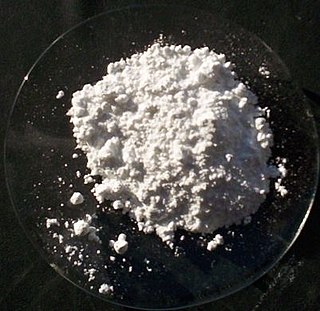
Calcium carbonate is a chemical compound with the formula CaCO3. It is a common substance found in rocks as the minerals calcite and aragonite (most notably as limestone, which is a type of sedimentary rock consisting mainly of calcite) and is the main component of pearls and the shells of marine organisms, snails, and eggs. Calcium carbonate is the active ingredient in agricultural lime and is created when calcium ions in hard water react with carbonate ions to create limescale. It has medical use as a calcium supplement or as an antacid, but excessive consumption can be hazardous and cause poor digestion.
In the context of nutrition, a mineral is a chemical element required as an essential nutrient by organisms to perform functions necessary for life. However, the four major structural elements in the human body by weight, are usually not included in lists of major nutrient minerals. These four elements compose about 96% of the weight of the human body, and major minerals (macrominerals) and minor minerals compose the remainder.
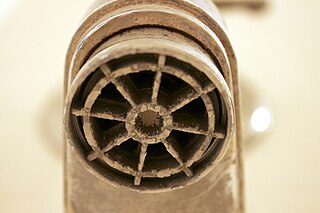
Hard water is water that has high mineral content. Hard water is formed when water percolates through deposits of limestone, chalk or gypsum which are largely made up of calcium and magnesium carbonates, bicarbonates and sulfates.

Calcium citrate is the calcium salt of citric acid. It is commonly used as a food additive (E333), usually as a preservative, but sometimes for flavor. In this sense, it is similar to sodium citrate. Calcium citrate is also found in some dietary calcium supplements. Calcium makes up 24.1% of calcium citrate (anhydrous) and 21.1% of calcium citrate (tetrahydrate) by mass. The tetrahydrate occurs in nature as the mineral Earlandite.

Lithium orotate (C5H3LiN2O4), is a salt of orotic acid and lithium. It is available as the monohydrate, LiC5H3N2O4·H2O. In this compound, lithium is non-covalently bound to an orotate ion, rather than to a carbonate or other ion, and like other salts, dissociates in solution to produce free lithium ions. It is marketed as a dietary supplement, though only barely researched between 1973–1986 to treat certain medical conditions, such as alcoholism and Alzheimer's disease.
Degrees of general hardness (dGH or °GH) is a unit of water hardness, specifically of general hardness. General hardness is a measure of the concentration of divalent metal ions such as calcium (Ca2+) and magnesium (Mg2+) per volume of water. Specifically, 1 dGH is defined as 10 milligrams (mg) of calcium oxide (CaO) per litre of water. Since CaO has a molar mass of 56.08 g/mol, 1 dGH is equivalent to 0.17832 mmol per litre of elemental calcium and/or magnesium ions.

Dolomite (also known as dolomite rock, dolostone or dolomitic rock) is a sedimentary carbonate rock that contains a high percentage of the mineral dolomite, CaMg(CO3)2. In old USGS publications, it was referred to as magnesian limestone, a term now reserved for magnesium-deficient dolomites or magnesium-rich limestones. Dolomite has a stoichiometric ratio of nearly equal amounts of magnesium and calcium. Most dolomite rock formed as a magnesium replacement of limestone or lime mud before lithification. Dolomite rock is resistant to erosion and can either contain bedded layers or be unbedded. It is less soluble than limestone in weakly acidic groundwater, but it can still develop solution features (karst) over time. Dolomite rock can act as an oil and natural gas reservoir.

Calcium sulfide is the chemical compound with the formula CaS. This white material crystallizes in cubes like rock salt. CaS has been studied as a component in a process that would recycle gypsum, a product of flue-gas desulfurization. Like many salts containing sulfide ions, CaS typically has an odour of H2S, which results from small amount of this gas formed by hydrolysis of the salt.
Carbothermic reactions involve the reduction of substances, often metal oxides, using carbon as the reducing agent. These chemical reactions are usually conducted at temperatures of several hundred degrees Celsius. Such processes are applied for production of the elemental forms of many elements. The ability of metals to participate in carbothermic reactions can be predicted from Ellingham diagrams.
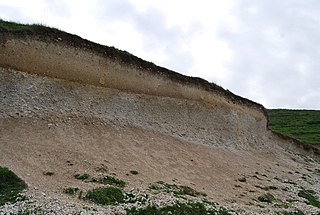
Calcareous is an adjective meaning "mostly or partly composed of calcium carbonate", in other words, containing lime or being chalky. The term is used in a wide variety of scientific disciplines.
Carbonate hardness, is a measure of the water hardness caused by the presence of carbonate and bicarbonate anions. Carbonate hardness is usually expressed either in degrees KH (dKH), or in parts per million calcium carbonate. One dKH is equal to 17.848 mg/l (ppm) CaCO
3, e.g. one dKH corresponds to the carbonate and bicarbonate ions found in a solution of approximately 17.848 milligrams of calcium carbonate(CaCO
3) per litre of water. Both measurements are usually expressed as mg/l CaCO
3 – meaning the concentration of carbonate expressed as if calcium carbonate were the sole source of carbonate ions.
Caltrate is a brand name calcium supplement sold by Pfizer Consumer Healthcare and in Japan by Hisamitsu Pharmaceutical. The Caltrate brand is supplied in many different formulas; calcium carbonate is the common ingredient serving as the calcium supplement source. Caltrate contains 600 mg of calcium carbonate as opposed to 200 mg in a typical multivitamin product. Caltrate Plus also contains 800 IU of vitamin D (cholecalciferol), 20 mcg vitamin K1, 50 mg magnesium, 7.5 mg zinc oxide, 1 mg copper, and 1.8 mg of manganese (II) sulfate monohydrate.

Magnesium citrate is a magnesium preparation in salt form with citric acid in a 1:1 ratio. The name "magnesium citrate" is ambiguous and sometimes may refer to other salts such as trimagnesium citrate which has a magnesium:citrate ratio of 3:2.
Magnesium aspartate, the chelated magnesium salt of aspartic acid, it is a mineral supplement.

Wood ash is the powdery residue remaining after the combustion of wood, such as burning wood in a fireplace, bonfire, or an industrial power plant. Gardeners traditionally use it as a good source of potash to ameliorate soil.
The alkali–carbonate reaction is an alteration process first suspected in the 1950s in Canada for the degradation of concrete containing dolomite aggregates.

Amorphous calcium carbonate (ACC) is the amorphous and least stable polymorph of calcium carbonate. ACC is extremely unstable under normal conditions and is found naturally in taxa as wide-ranging as sea urchins, corals, mollusks, and foraminifera. It is usually found as a monohydrate, holding the chemical formula CaCO3·H2O; however, it can also exist in a dehydrated state, CaCO3. ACC has been known to science for over 100 years when a non-diffraction pattern of calcium carbonate was discovered by Sturcke Herman, exhibiting its poorly-ordered nature.
Magnesium salts are available as a medication in a number of formulations. They are used to treat magnesium deficiency, low blood magnesium, eclampsia, and several other conditions. Magnesium is important to health.

Calcium supplements are salts of calcium used in a number of conditions. Supplementation is generally only required when there is not enough calcium in the diet. By mouth they are used to treat and prevent low blood calcium, osteoporosis, and rickets. By injection into a vein they are used for low blood calcium that is resulting in muscle spasms and for high blood potassium or magnesium toxicity.