Enantiornithes is a group of extinct avialans, the most abundant and diverse group known from the Mesozoic era. Almost all retained teeth and clawed fingers on each wing, but otherwise looked much like modern birds externally. Over 80 species of enantiornitheans have been named, but some names represent only single bones, so it is likely that not all are valid. Enantiornitheans became extinct at the Cretaceous–Paleogene boundary, along with hesperornithids and all other non-avian dinosaurs. Enantiornitheans are thought to have left no living descendants.

Yanornis is an extinct genus of fish-eating Early Cretaceous birds. Two species have been described, both from Liaoning province, China: Yanornis martini, based on several fossils found in the 120-million-year-old Jiufotang Formation at Chaoyang, and Yanornis guozhangi, from the 124-million-year-old Yixian Formation.
Boluochia zhengi was an enantiornithine bird. It lived during the Early Cretaceous in the time span 121.6-110.6 mya and is known from fossils found in the Jiufotang Formation of Liaoning province, People's Republic of China. Boluochia was first described by Zhou in 1995. A re-analysis of the specimen by Jingmai O'Connor and colleagues found that it was closely related to Longipteryx and could be assigned to the family Longipterygidae.
Vescornis is a genus of enantiornithine bird. One species is named, V. hebeiensis. The holotype fossil is in the collection of the Nanjing Institute of Geology and Paleontology, Chinese Academy of Sciences. Its catalog number is CAGS 130722. The fossil was found in Early Cretaceous rocks first attributed to the Yixian Formation, Senjitu, Fengning County, Hebei Province, China. However, later study of area geology showed that these rocks actually belong to the Huajiying Formation.

Pygostylia is a group of avialans which includes the Confuciusornithidae and all of the more advanced species, the Ornithothoraces.
Pengornis is the largest known enantiornithine bird from the Early Cretaceous of northeast China. The name derives from "Peng", which refers to a mythological bird from Chinese folklore, and "-ornis", which means bird in Greek.

Shanweiniao is a genus of long-snouted enantiornithean birds from Early Cretaceous China. One species is known, Shanweiniao cooperorum. There is one known fossil, a slab and counterslab. The fossil is in the collection of the Dalian Natural History Museum, and has accession number DNHM D1878/1 and DNHM1878/2. It was collected from the Lower Cretaceous Dawangzhengzi Beds, middle Yixian Formation, from Lingyuan in the Liaoning Province, China.
Huoshanornis is a genus of enantiornithine birds which existed in what is now Jiufotang Formation of Western Liaoning Province, China during the early Cretaceous period. Its fossil remains were found at Chaoyang City. It was first named by Xia Wang, Zihui Zhang, Chunling Gao, Lianhai Hou, Qingjin Meng and Jinyuan Liu in 2010 and the type species is Huoshanornis huji.

Bohaiornis is a genus of enantiornithean birds. Fossils have been found from the Lower Cretaceous Jiufotang Formation of western Liaoning, China. The only known species, Bohaiornis guoi, was named by Dongyu Hu, Li Li, Lianhaim Hou and Xing Xu in 2011 on the basis of a fully articulated and well-preserved skeleton of a sub-adult. This specimen, LPM B00167, preserved two long, ribbon-like feathers attached to the tail rather than a fan of shorter pennaceous feathers. It was similar to the slightly older Eoenantiornis, but much larger in size.Bohaiornis is the type species of Bohaiornithidae, a family of large predatory enantiornitheans from the Early Cretaceous.
Camptodontornis is an extinct genus of enantiornithine bird which existed in what is now Chaoyang in Liaoning Province, China during the early Cretaceous period. It is known from a well-preserved skeleton including a skull found in the Jiufotang Formation of Liaoning Province. Its original generic name was "Camptodontus" ; it was named by Li Li, En-pu Gong, Li-dong Zhang, Ya-jun Yang and Lian-hai Hou in 2010. However, the name had previously been used for a genus of beetle. The type species is "Camptodontus" yangi. Demirjian (2019) coined a replacement generic name Camptodontornis. The status of C. yangi as a distinct species is disputed, with Wang et al. (2015) considering it to be a probable synonym of Longipteryx chaoyangensis.
Gracilornis is an extinct genus of early bird from the lower Cretaceous. It is a cathayornithid enantiornithine which lived in what is now western Liaoning Province, China. It is known from a nearly complete skull and postcranial skeleton, which was found from the Jiufotang Formation, in Chaoyang. It was first named by Li Li and Hou Shilin in 2011 and the type species is Gracilornis jiufotangensis. The generic name is derived from Latin gracilis, "slender" and Greek ornis, "bird", and refers to its slender skeleton. The specific name was named after the Jiufotang Formation, in which the holotype was collected.
Xiangornis is an enantiornithine bird from the Lower Cretaceous of Western Liaoning, China.

Sulcavis is a genus of enantiornithean birds. One species is named, Sulcavis geeorum. The fossil was found in Early Cretaceous rocks in Liaoning Province, China.
Zhouornis is an extinct genus of enantiornithine dinosaur known from the Early Cretaceous Jehol Group of western Liaoning Province, northeastern China. Zhouornis was first named by Zihui Zhang, Luis M. Chiappe, Gang Han and Anusuya Chinsamy in 2013 and the type species is Zhouornis hani.
Bohaiornithidae is a group of early predatory enantiornitheans from the early Cretaceous Period of China. All known specimens come from the Jiufotang Formation and Yixian Formation, dating to the early Aptian age, 125-120 million years ago. Bohaiornithidae was first coined as a family of enantiornithean birds by Wang and colleagues in 2014. They defined it as the natural group formed by all descendants of the common ancestor of the type species, Bohaiornis guoi, and Shenqiornis mengi.

Pengornithidae is a group of early enantiornithines from the early Cretaceous Period of China. Specimens of these animals have been found both in the Huajiying Formation and Jiufotang Formation of Liaoning and Hebei provinces, dating from the Hauterivian age to the Aptian age.
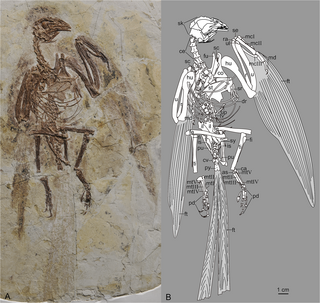
Parapengornis is an extinct genus of enantiornithine bird from the Lower Cretaceous of what is now China. The holotype specimen was discovered in the Jiufotang Formation near Lingyuan, western Liaoning province, and was catalogued as IVPP V18687. The nearly complete, articulated specimen is preserved on a slab and has impressions of pennaceous feathers. Only parts of the sternum, the left hand, and right foot are missing. In 2015, it became the basis of the new genus and species Parapengornis eurycaudatus, named by the Chinese palaeontologists Han Hu, Jingmai K. O’Connor, and Zhonghe Zhou. The generic name consists of the Latin word para and the name of the related genus Pengornis, indicating their close relationship. The name Pengornis is itself derived from "Peng", a mythological bird from Chinese folklore, and ornis, which means bird in Greek. The specific name is derived from the Latin words eury, meaning broad, and caudatus, meaning tail, in reference to the broad and expanded pygostyle. A nearly complete specimen formerly assigned to Pengornis was also reassigned to Parapengornis by these authors.
Alethoalaornis is an extinct genus of enantiornithine found in the Jiufotang Formation, China and is the only genus in the family Alethoalaornithidae. The type species is Alethoalaornis agitornis.
Grabauornis is an extinct genus of enantiornithine found in the Yixian Formation, China. The type species is Grabauornis lingyuanensis. The proportions of this enantiornithean's wings as well as the presence of an alula suggest that it was a good flier.