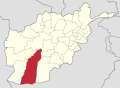
Grishk is at an elevation of approximately 817m (2,680ft) above sea level. It is located about an hour's drive northeast of Lashkargah where the Kandahar–Herat Highway passes over the Helmand River, some 120km (75mi) northwest of Kandahar and about the same distance southeast of Delaram. Upstream lies the Kajaki Dam which diverts water to the Boghra Irrigation Canal, an essential infrastructure for the region's crops. Grishk Dam is also nearby. The city was originally built around a fort on the east bank of the Helmand River but was later rebuilt on the west.
Grishk has a hot desert climate (KöppenBWh), characterised by little precipitation and high variation between summer and winter temperatures. The average temperature in Grishk is 19.6°C (67.3°F), while the annual precipitation averages 117mm (4.6in). Summers start in mid-May, last until late-September, and are extremely dry. July is the hottest month of the year with an average temperature of 32.2°C (90.0°F). The coldest month January has an average temperature of 7.0°C (44.6°F).
Grishk has an estimated population of 146,506 people.[1] They are primarily Pashtuns followed by Hazaras and Tajiks.[5] Grishk was under the control of Noorzai tribe during the Islamic Emirate of Afghanistan (1996–2001), and Mullah Mir Hamza an ethnic Pashtun from Noorzai tribe was the District governor of Grishk, while Mullah Mahmmad Azam an ethnic Pashtun from Noorzai tribe was the commander of Taliban forces in Grishk.[6][7]
In November 2003, an Afghan civilian Abdul Wahed died inside the U.S. Special Forces base in Grishk, after being exposed to torture.[8] In April 2008 the 2nd Battalion 7th Marines, Echo Co, which was sent there to help support train the Afghan National Police, worked with the Danish and British military.[9]
On December 4, 2008, two Danish soldiers were killed near Grishk.[10]
This page is based on this Wikipedia article Text is available under the CC BY-SA 4.0 license; additional terms may apply. Images, videos and audio are available under their respective licenses.


 Afghanistan