Agriculture is the science and art of cultivating plants and livestock. Agriculture was the key development in the rise of sedentary human civilization, whereby farming of domesticated species created food surpluses that enabled people to live in cities. The history of agriculture began thousands of years ago. After gathering wild grains beginning at least 105,000 years ago, nascent farmers began to plant them around 11,500 years ago. Pigs, sheep and cattle were domesticated over 10,000 years ago. Plants were independently cultivated in at least 11 regions of the world. Industrial agriculture based on large-scale monoculture in the twentieth century came to dominate agricultural output, though about 2 billion people still depended on subsistence agriculture into the twenty-first.
Business is the activity of making one's living or making money by producing or buying and selling products. Simply put, it is "any activity or enterprise entered into for profit. It does not mean it is a company, a corporation, partnership, or have any such formal organization, but it can range from a street peddler to General Motors."
The Louisiana State Legislature is the state legislature of the U.S. state of Louisiana. It is a bicameral body, comprising the lower house, the Louisiana House of Representatives with 105 representatives, and the upper house, the Louisiana Senate with 39 senators. Members of both houses are elected from single-member constituencies.
Harry S. Truman was the 33rd president of the United States from 1945 to 1953, succeeding upon the death of Franklin D. Roosevelt after serving as vice president. He implemented the Marshall Plan to rebuild the economy of Western Europe, and established the Truman Doctrine and NATO.
Humble is a city located in Harris County, Texas, United States, within the Houston metropolitan area. Famously Humble became an Oil Boomtown in the early 20th century when oil was first discovered there in 1903. By 1905 the Humble oilfield was the largest producing oilfield in Texas. Humble was home of Humble Oil a predecessor of Exxon.
Harris County is a county located in the U.S. state of Texas, located in the southeastern part of the state near Galveston Bay. As of the 2010 Census, the population was 4,092,459, making it the most populous county in Texas and the third most populous county in the United States. Its county seat is Houston, the largest city in Texas and fourth largest city in the United States. The county was founded in 1836 and organized in 1837. It is named for John Richardson Harris, who founded the town of Harrisburg on Buffalo Bayou in 1826. According to a July 2017 Census estimate, Harris County's population had grown to 4,652,980, comprising over 16 percent of Texas's population.
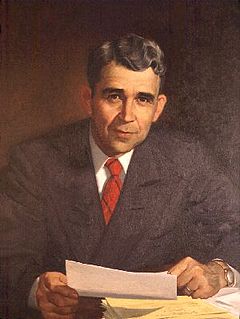
Montgomery taught agriculture at Haughton High School in Haughton in Bossier Parish east of Shreveport. At that time he met Azalee Wilson (1902-1985), the postmistress at Haughton. After three years in Haughton, Montgomery moved to Ruston, the seat of Lincoln Parish, where he taught vocational agriculture at Ruston High School. He received many honors for his teaching abilities and his love and dedication for his students. He was also known to paddle recalcitrant boys.[3] In 1955, Montgomery attended the White House Conference on Education.[4]
Haughton is a town in Bossier Parish, Louisiana, United States. The population was 3,454 at the 2010 census. It is part of the Shreveport–Bossier City Metropolitan Statistical Area.
A postmaster is the head of an individual post office. When a postmaster is responsible for an entire mail distribution organization, the title of Postmaster General is commonly used. Responsibilities of a postmaster typically include management of a centralized mail distribution facility, establishment of letter carrier routes, supervision of letter carriers and clerks, and enforcement of the organization's rules and procedures.
Ruston is a small city and the parish seat of Lincoln Parish, Louisiana, United States. It is the largest city in the Eastern Ark-La-Tex region. As of the 2010 United States Census, the population was 21,859, reflecting an increase of 6.4 percent from the count of 20,546 counted in the 2000 Census. Ruston is near the eastern border of the Ark-La-Tex region and is the home of Louisiana Tech University. Its economy is therefore based on its college population. Ruston hosts the annual Peach Festival.
While he was teaching in Ruston, Montgomery became aware that the area needed a feed store to supply his farmer friends. He used his savings to rent a building on West Mississippi Avenue in Ruston that became "Montgomery's Feed and Seed".[3]
"Father of the poultry industry" in Louisiana
Montgomery also invested in the mass production of broiler chickens. He understood before others that the production of poultry could be a money-maker for the farmers of north Louisiana and also provide a more ready market for his feed products. At the time, broiler chickens were produced only in small groups of five hundred or fewer because it was thought that the poultry should not be kept continuously in a chicken house. It was believed that the chickens should be let out in a yard for several hours a day to remain healthy. Since Montgomery realized that placing the chickens in a yard was not economically feasible, he raised five thousand chickens in an enclosed environment. His foresight earned him the title of "father of the poultry industry" in Louisiana.[3]
Poultry are domesticated birds kept by humans for their eggs, their meat or their feathers. These birds are most typically members of the superorder Galloanserae (fowl), especially the order Galliformes.
Patent on the rotary blade mower
Montgomery renamed his feed and seed store the Montgomery Distributing Company when he began to specialize in gasolinelawnmowers.
Gasoline, gas or petrol is a colorless petroleum-derived flammable liquid that is used primarily as a fuel in spark-ignited internal combustion engines. It consists mostly of organic compounds obtained by the fractional distillation of petroleum, enhanced with a variety of additives. On average, a 42-U.S.-gallon (160-liter) barrel of crude oil yields about 19 U.S. gallons of gasoline after processing in an oil refinery, though this varies based on the crude oil assay.
Montgomery held the first patent on a rotary blade mower. In the late 1940s and the early 1950s, mowers were equipped with a rotating reel assembly that was pushed by hand or was propelled by a small gasoline engine. That kind of mower worked well in short grass, but it clogged up in tall grass. Montgomery did not invent that mower, but he obtained the patent from a frustrated inventor in Chicago, Illinois. The first commercially-produced rotary mower, the Yazoo Master Mower, was then produced by a small manufacturing plant in Jackson, Mississippi. Montgomery was the Louisiana distributor of Yazoo until 1981, when he closed his lawnmower business in Ruston.[3]
Ranch Azalee
Montgomery's original house at his Ranch Azalee, purchased in 1953 and formerly known as the Bryan House, was added to the National Register of Historic Places in 1999.
Through good management and, in Montgomery's belief, divine guidance, his business flourished, and he was financially able to marry Azalee on Valentine's Day 1945 after an 11-year courtship. The couple had one child, A. Harold Montgomery Jr., known as "Hal" (September 17, 1946 – September 8, 2015).[1] Montgomery then purchased their dream place, a farm south of the village of Doyline in Webster Parish. He named the habitation and land "Ranch Azalee," after his beloved wife. The Montgomerys occupied the estate in May 1953.[3]
Ranch Azalee was formerly known as the Bryan House, having originally begun c. 1804 by James Jackson Bryan. It was built in the late Federal/Greek revival style of architecture with an open dogtrot core. After Montgomery's death, Ranch Azlee was added in 1999 to the National Register of Historic Places.[5]
Because his business interests and his legislative duties were a considerable distance from Ranch Azalee, Montgomery drove tens of thousands of miles per year. Such a demanding schedule made him a workhorse. It also made him aware of the need for highway improvements in Louisiana.
Election to Louisiana State Senate
Montgomery ran unsuccessfully for the state Senate in the 1955-1956 Democratic primaries, having been defeated by 192 votes in the runoff election held on February 21, 1956, by Herman "Wimpy" Jones (1905–1967), the owner of the Jones Kitchen restaurant (later known as the Southern Kitchen) in Minden. Jones was later the Minden municipal fire marshal in Minden, the seat of government for Webster Parish. Jones received 6,734 votes (50.7 percent) to Montgomery's 6,542 (49.3 percent).[6] Other candidates in the primary for the state Senate seat included Minden educator Lloyd C. Starr (1899–1982), an Arkansas native who served on the Webster Parish School Board and was an insurance agent. Starr polled 2,039 votes. A fourth candidate, James B. Wells, an attorney from Bossier City, finished with 917 ballots.[7]
Montgomery successfully challenged Jones in the 1959-1960 primary cycle. In the December 7 primary, Montgomery led Jones, 7,929 (46.6 percent) to 6,542 (38.5 percent), but two other candidates polled a critical 2,536 votes (14.9 percent). In the runoff election on January 9, Montgomery easily defeated Jones, 11,116 (66.5 percent) to 5,611 (33.5 percent) and won sixty-eight of the seventy precincts in what is now a revised District 36.[8] In his five state senate campaigns (two unsuccessful), Montgomery never faced a Republican opponent.
Jones filed to oppose Montgomery in the Democratic primary held on December 7, 1963, but he withdrew from the race and left Montgomery unopposed. Calling himself an "Independent," Jones endorsed the unpledged elector movement for the 1964 presidential campaign, a position originally held by Montgomery himself.[9]
Oddly, Montgomery and colleague Danny Roy Moore, who represented Claiborne and Bienville parishes, had side-by-side desks in the far-right corner of the Senate chamber. Also, Moore noted that he and Montgomery were the most conservative members of the chamber during the 1964-1968 term.[10]
According to Montgomery's obituary in the Shreveport Times, he was indeed "known as a staunch conservative. Fellow conservatives loved him, and even those who disagreed with his views respected him. All who knew him either personally or by reputation respected him for his impeccable veracity, honesty, patriotism, fairness, dedication, and his love of God, family, home, and country."[3]
In the 1959 and 1963 gubernatorial election years, Montgomery, like most of his constituents, opposed the candidacy of fellow Democrat deLesseps S. Morrison Sr., the mayor of New Orleans and later ambassador to the Organization of American States. Montgomery believed that Morrison, as governor, would work to dismantle the segregated school system still in place in the state even though Morrison was openly committed to maintaining segregation. Montgomery supported State Senator William M. Rainach of neighboring Claiborne Parish in the gubernatorial primary. When Rainach finished third in the balloting, Montgomery, like virtually all of Rainach's supporters, backed a former governor, Jimmie Davis, in the Democratic runoff. Davis then defeated Morrison and thereafter turned aside Republican Francis Grevemberg in the general election held on April 19, 1960.
Montgomery in a 1966 appearance said that the Louisiana legislature is independent only when a two-thirds vote is required for select issues; otherwise, the governor's program is nearly always automatically adopted. "The way Louisiana is governed is by the man we elect governor of this state. With a bad governor we'll fail," Montgomery said. His legislative ally, B. H. "Johnny" Rogers of Grand Cane in DeSoto Parish, agreed: "The government of Louisiana cannot be any better than the governor of Louisiana."[11] Rogers urged citizens interested in good government to come to committee hearings in Baton Rouge. In such cases, their mere presence would impress legislators.[11]
Further political developments
In 1960, Montgomery opposed increases requested by the new Davis administration in the salaries of elected and appointed state officials, instead of pay hikes for the lower-income state workers.[12] The same year, he supported legislation to make the dumping of litter or trash along roads in the state or parish road systems a crime punishable by fines of up to $100 or thirty days in jail.[13]
In 1962, Montgomery introduced a resolution in the State Senate, which condemned the activities of the Federal Bureau of Investigation in Louisiana: "We are outraged by the prostitution of the once great FBI, and its present misuse as a political police force, not dissimilar in method and result to the Gestapo or the NKVD." United States Attorney GeneralRobert F. Kennedy, not FBI Director J. Edgar Hoover, was especially singled out for responsibility. Montgomery, in fact, admired Hoover for his strong anticommunism.[14]
In 1963, Montgomery had supported Louisiana Public Service CommissionerJohn McKeithen in the Democratic runoff election against Morrison. Then, he quietly supported McKeithen's Republican opponent, Charlton Lyons of Shreveport, in the March 3, 1964, general election. In time, Montgomery and McKeithen seemed consistently at political odds.
In 1963, Montgomery was elected chairman of the Louisiana Committee for Free Electors, an organization that grew from a meeting of some two hundred conservative Democrats in Baton Rouge. Two representatives from each congressional district were chosen.[15] Montgomery called for the free elector slate to remain viable in the event that New York GovernorNelson Rockefeller of New York was named the national Republican nominee or if the Republican platform was too liberal to include conservatives.[16] Another free-elector supporter, Taylor W. O'Hearn, subsequently one of the first two Republican members of the Louisiana House of Representatives since Reconstruction, called for electors being chosen by congressional district, rather than at-large statewide. O'Hearn also cited major differences between the two parties despite the influence of such liberals as Rockefeller and US SenatorJacob Javits in the Republican Party.[17] Ultimately, the free elector movement was abandoned with the nomination in July 1964 of US Senator Barry M. Goldwater of Arizona as the Republican nominee.[18]
In a state Senate speech, Montgomery excoriated US PresidentLyndon B. Johnson after Johnson signed into law the Civil Rights Act of 1964. The address highlighted Johnson's long political life and declared him a "political thief," a "habitual liar," and "not worthy of your respect or mine."[19] Montgomery's Senate colleague, Jamar Adcock of Monroe, disputed the remarks: "Lyndon Johnson is our president, and I will respect him and the office of President."[19] Montgomery pitched a tent on the state capitol grounds to protest the public accommodations section of the Civil Rights Act after he learned that the hotel in which he had been staying had been desegregated by a black couple.[19][20]
Battle of the Montgomerys, 1967
McKeithen was a prohibitive favorite for renomination in 1967 and ran unopposed in the February 6, 1968 general election. The governor supported 31-year-old Springhillattorney, John Willard "Jack" Montgomery Sr. in the senatorial primary against Harold Montgomery. Despite their surname, the two were not related. The "battles of the Montgomerys" (there was a rematch in 1971) were the most heated state senate races in the district in many years.
Jack Montgomery's campaign produced a newspaper advertisement listing the Springhill dignitaries behind the young candidate's campaign: Mayor James Allen of Springhill and educators Ed Olive, the principal of Springhill High School, and D.C. Wimberly, a decorated World War IIPOW and an elementary-school principal in Springhill.[21] Jack Montgomery questioned why state highway funding for Bossier and particularly Webster Parishes lagged behind other parishes in the region. In a newspaper advertisement, he cited a study which ranked Bossier in 14th and Webster in 20th among the 23 parishes of north Louisiana in highway appropriations.[22] Some educators rallied behind Harold Montgomery in an advertisement claiming to "Keep Good Government."[23]
In his own advertising, Harold Montgomery touted his 100 percent Senate attendance record, the best score since such records began to be kept in 1958 by the nonpartisan Public Affairs Research Council. Montgomery was one of five state senators who claimed a 100 percent "good government" rating from the Chamber of Commerce.[24]
Though Harold had led Jack in the primary contest by 448 votes, Jack easily prevailed in the lower-turnout runoff election, 10,037 (55.1 percent) to 7,177 (44.9 percent). The results were nearly as bad for Harold Montgomery as they had been for "Wimpy" Jones in 1960.[25] Harold Montgomery thereafter concentrated on his business and sought a comeback in 1971.
In a 1975 interview in Alexandria, Harold Montgomery said that he thought that Tom Colten, the Republican mayor of Minden, had done a good job in office, but he never understood Colten's reported favoritism toward Jack Montgomery, a loyal Democrat, as Harold Montgomery had sometimes supported Republican candidates, including Goldwater.
Harold Montgomery's loss was attributed to the pro-McKeithen sentiment in the district but also to the impact of the Voting Rights Act of 1965, which applied in Louisiana State Senate elections for the first time in 1967. Large numbers of previously-unregistered black voters came to the polls, and most of them chose the McKeithen-endorsed Jack Montgomery. Opposing McKeithen in the primary was segregationist US RepresentativeJohn Richard Rarick of St. Francisville in West Feliciana Parish. Rarick ran so poorly both statewide and in the Bossier-Webster district that his candidacy offered no help for Harold Montgomery's reelection prospects even though the latter concentrated on his own race and was not involved in the gubernatorial primary.
The battle of the Montgomerys, 1971
In 1971, Harold Montgomery challenged the renomination of State Senator Jack Montgomery in the Democratic primary. In a newspaper appeal to voters entitled "Public Feels Cheated", Montgomery decried "the loss of confidence in government, ... the thievry in office ... a governor [McKeithen] who appoints political hacks to office" and "the failure of authorities to reign in dope pushers and drunk drivers". Montgomery also criticized "employees who don't work" and "politicians who continually ask for more money without showing any accomplishment in return." He predicted a large turnover in legislative ranks.[26] Harold also won the endorsement of the then conservative Shreveport Journal.[27]
Montgomery urged voter to support him -- "the Right Montgomery! -- as he referred to himself. Harold Montgomery narrowly won the primary rematch with Jack Montgomery, 14,595 (51.2 percent) to 13,889 (48.8 percent),[28] and headed back to the state Senate in 1972 to begin his third and final term. Though the vote was close, Harold prevailed district-wide except in Claiborne Parish.
Harold Montgomery allied himself with newly elected Governor Edwin Washington Edwards, who had been Montgomery's state Senate colleague in 1964 and 1965. Edwards had personally befriended Harold Montgomery, and Montgomery was hence eager to get along with the new governor, considering his earlier differences with McKeithen. Edwards was a pallbearer at Montgomery's funeral; Montgomery died in the final months of Edwards' fourth gubernatorial term.
Hal Montgomery said that his father did not approve of Edwards' flamboyant life-style but thought that Edwards was "a great governor who did as much for the state as any other who ever held the office." In the late 1970s, Louisiana was leading the nation in industrial recruitment. In the 1980s, as the jobs picture improved nationwide, the state economy took a downturn in Louisiana. Hal Montgomery said that while his father and Jack Montgomery were "not friends" when the 1967 campaign began, they were "not enemies" after Harold Montgomery's return to the state senate. Hal Montgomery also said that politics was frequently discussed in the Montgomery household when he was growing up in the 1960s, but he never shared his father's interests in politics.
Religious Right
Harold Montgomery, for a time, supported the Reverend Billy James Hargis's Christian Crusade radio and college ministry, which operated during the 1960s and 1970s from Tulsa, Oklahoma. Hargis often cited Montgomery by name on his radio broadcasts. A forerunner of what became known as the "Religious Right," Hargis and Montgomery also shared a hostility to communism. Hargis ran into morals allegations, which dampened his ministry in 1976. Until his own death, Hargis's son, Billy James Hargis, II, who spent his later years in Houston, Texas, conducted a reduced version of his father's ministry.
By Montgomery's last senate term, segregation had legally ended, and the issue ceased to be a viable political matter. Montgomery noe avoided discussion of racial matters but instead concentrated on getting state projects into northwestern Louisiana. It helped to have a friend in the governor's office, Edwin Edwards, during Montgomery's last term in office.
Retirement
In 1974, Montgomery was an elected delegate to the first of three midterm conventions of the Democratic National Committee, held in Kansas City, Missouri.[29] Such meetings were also held in 1978 and 1982 but thereafter discontinued.
Montgomery did not seek a fifth term in November 1975, under the state's newly-instituted nonpartisan blanket primary or jungle primary. His senate seat in 1976 was taken by a fellow Democrat who was considered more liberal and populist than Montgomery, Foster L. Campbell Jr. of Bossier Parish. Like Montgomery, Campbell was a former educator and held the seat with little difficulty for seven terms (1976–2002), when he resigned, to become one of the five members of the elected Public Service Commission. Campbell unsuccessfully sought the governorship in the primary on October 20, 2007.
Montgomery's old seat is currently held by the Republican Ryan Gatti, a lawyer from Bossier City who is personally close to Democratic Governor John Bel Edwards. Prior to Gatti, the seat was held from 2003 to 2016 by the Democrat-turned-Republican Robert Adley of Benton. A former member of the Louisiana House of Representatives, Adley was a gubernatorial candidate himself in 1995.
Southern Methodist Church
For many years, Montgomery loyally supported the First Methodist Church in Haughton. As United Methodists moved to the theological left, hd helped, in April 1968, to organize a conservative Southern Methodist Church in Haughton on U.S. Highway 80, east of Bossier City. The organizing pastor was K. E. Griffith.[30] William Rainach had similarly helped to establish a Southern Methodist congregation in Claiborne Parish. According to Montgomery's obituary, "his deep conservative philosophy was reflected, not only in his political life, but also in his religious life. Those who knew and love him know that 'he told it like it was.'"
Death and legacy
In 1968, Montgomery helped to organize this Southern Methodist congregation in Haughton.Harold Montgomery's grave monument reads, "He Told It Like It Was".Harold Montgomery Road sign in south Webster Parish
A garrulous, extroverted, "people-type" of person, Montgomery was involved in civic activities: the Webster Parish Cattleman's Association, Masonic lodge, Shriners, and the Minden Lions International. He was on the board of the Lincoln Bank and Trust Company of Ruston and the former Peoples Bank and Trust Company (later Hibernia) in Minden.[31]
Montgomery died of heart failure while in an advanced stage of Alzheimer's disease. Azalee, who was nine years his senior, had died ten years earlier. Harold and Azalee Montgomery and their son are interred at the Haughton Cemetery in Bossier Parish.[1]
Harold Montgomery was survived by his son Hal Jr., daughter-in-law Linda Burge Montgomery, two granddaughters, Leigh Ann Montgomery Bates of Doyline and Tara Montgomery Madison of Baton Rouge, and three sisters, Audrey Rodes of Benton, Jean Morgan of Lake Charles, and Bobbie Steele of Memphis, Tennessee, and numerous nephews and nieces.
In addition to Governor Edwards, pallbearers included then U.S. Representative Jim McCrery, a Republican of Louisiana's 4th congressional district, former state legislative colleague Parey Branton, a Democrat from Shongaloo in Webster Parish, dairyman Roy D. "Don" Hinton (1912–2011) of Minden,[32] and attorney and then Webster Parish Library Board president Henry Grady Hobbs (1923-2012) of Minden,[33] who lost the 1960 and 1967 state House elections to Branton, and the Minden banker Ralph Williams.
Robert Floyd Kennon Sr., known as Bob Kennon, was the 48th Governor of Louisiana, serving from 1952 to 1956. From 1954 to 1955, he was chairman of the National Governors Association. In 1955, he was also the chairman of the Council of State Governments.
Walter Fox McKeithen served five terms as Secretary of State of Louisiana between 1988 and 2005. He is best known for merging the state's election divisions into one department and for the promotion of historical preservation.
Charlton Havard Lyons, Sr., also known as Big Papa Lyons, was a Shreveport oilman who in March 1964 waged, as a strong segregationist, the first determined Republican bid for the Louisiana governorship since Reconstruction. Lyons also made a strong but losing bid for Louisiana's 4th congressional district seat in the United States House of Representatives in a special election held in December 1961. At the time of his death, Lyons was considered "Louisiana's Mr. Republican".
Joseph David Waggonner Jr., better known as Joe D. Waggonner, was a Democratic U.S. Representative from Bossier Parish, Louisiana, who represented Louisiana's 4th congressional district from December 1961 until January 1979. A confidant of Republican U.S. President Richard M. Nixon, he hosted in 1978 Nixon's first public appearance after his resignation amid the Watergate scandal.
Jamar William Adcock was a high-profile banker and a Democratic state senator from Monroe, Louisiana, who served from 1960 to 1972. He was Senate president pro tempore in his third term from 1968 to 1972.
Parey Pershing Branton Sr. was a businessman from Shongaloo, Louisiana, who was from 1960 to 1972 a Democratic member of the Louisiana House of Representatives from what is now District 10 in Webster Parish. The district, which includes the parish seat of Minden in northwestern Louisiana, is now represented by the Democrat Gene Reynolds of Dubberly.
John Sidney Garrett was a conservative Democratic member of the Louisiana House of Representatives who served from 1948 to 1972 under four gubernatorial administrations. Garrett was a successful businessman in the small town of Haynesville in Claiborne Parish south of the Arkansas state line. In his last term, he was defeated for reelection even though he was the Speaker of the House. In 1966, Garrett made a strong but losing primary race for the Louisiana Public Service Commission to fill the seat vacated by the election of John McKeithen as governor. At the time, there were only three PSC districts; the number was increased to five under the Louisiana Constitution of 1974.
Billy Wayne Montgomery, also known as Coach Montgomery, is a former educator who represented the Bossier City-based District 9 in the Louisiana House of Representatives from 1988-2008. He was elected as a Democrat, but he switched affiliation to the Republican Party on October 3, 2006.
Foster Lonnie Campbell Jr., is an American politician and member of the Democratic Party from the U.S. state of Louisiana. Since 2003, he has been a member of the Louisiana Public Service Commission. He served in the Louisiana State Senate from 1976 to 2002.
Robert Roy Adley is a businessman and politician from Benton, Louisiana, who is a Republican former member of the Louisiana State Senate. In 2011, Adley ran without opposition in his bid for his third and final term in Senate District 36. Louisiana state legislators are term-limited after three terms or twelve years.
Francis Edward Kennon, Jr., usually known as Ed Kennon, is a multi-millionaire Shreveport real-estate developer from Shreveport, Louisiana, who is a former member of the Louisiana Public Service Commission, the regulatory body for oil, natural gas, and utilities.
John Smoker Hunt II was a nephew of Governors Huey Pierce Long Jr. and Earl Kemp Long who served on the elected Louisiana Public Service Commission from May 1964, to December 31, 1972. He was unseated in the September 30, 1972, Democratic primary runoff election by Francis Edward Kennon Jr., then of Minden in Webster Parish and a nephew of former Governor Robert F. Kennon, an intraparty rival of the Longs.
Henry Newton Brown, Jr., is a former Louisiana appellate judge, legal lecturer, and former district attorney. He is serving his third 10-year elected term on the Louisiana Second Circuit Court of Appeal, based in Shreveport, having been elected in 1990, 2000, and 2010.
John Willard Montgomery Sr., known as Jack Montgomery, is a retired attorney in the small city of Minden in Webster Parish in northwestern Louisiana, who represented the 36th District in the Louisiana State Senate for a single four-year term from 1968 to 1972. He unseated incumbent Harold Montgomery of Doyline in south Webster Parish in the 1967 Democratic runoff election. Four years later, the conservative Harold Montgomery staged a comeback and narrowly unseated Jack Montgomery. After this showdown, neither man ever ran for office again.
Henry Lee Burns is a Republican former member of the Louisiana House of Representatives for District 9 in Bossier Parish in northwestern Louisiana. He owns and operates the Wooden Spoon bakery in Bossier City and is a thoroughbred owner and breeder.
Herman "Wimpy" Jones was a businessman who served as a Democratic member of the Louisiana State Senate for Bossier and Webster parishes for a single term from 1956 to 1960. He was also the state fire marshal for Minden and for a time the assistant sergeant at arms of the Louisiana House of Representatives.
Danny Roy Moore is a civil engineer and land surveyor in Arcadia, Louisiana, who served as a conservative Democrat in the Louisiana State Senate from 1964 until 1968. He represented a north Louisiana district, then unnumbered, encompassing Claiborne and Bienville parishes.
Charles Emmett McConnell, also known as Jack McConnell, was an American attorney and Democratic politician, who was elected in 1954 as the mayor of Springhill in northern Louisiana,
Michael Joe Nerren, known as Mike Nerren, is the Division E judge of the 26th Judicial District Court based in Bossier and Webster parishes in northwestern Louisiana.
Jeffrey Stephen Cox, known as Jeff Cox, is a judge of the Louisiana Circuit Court of Appeal for the Second Circuit, based in Shreveport, Louisiana.
This page is based on this Wikipedia article Text is available under the CC BY-SA 4.0 license; additional terms may apply. Images, videos and audio are available under their respective licenses.