
Bees are winged insects closely related to wasps and ants, known for their roles in pollination and, in the case of the best-known bee species, the western honey bee, for producing honey. Bees are a monophyletic lineage within the superfamily Apoidea. They are currently considered a clade, called Anthophila. There are over 20,000 known species of bees in seven recognized biological families. Some species – including honey bees, bumblebees, and stingless bees – live socially in colonies while most species (>90%) – including mason bees, carpenter bees, leafcutter bees, and sweat bees – are solitary.
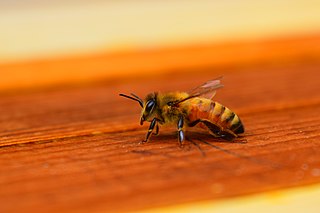
A honey bee is a eusocial flying insect within the genus Apis of the bee clade, all native to mainland Afro-Eurasia. After bees spread naturally throughout Africa and Eurasia, humans became responsible for the current cosmopolitan distribution of honey bees, introducing multiple subspecies into South America, North America, and Australia.

A pollinator is an animal that moves pollen from the male anther of a flower to the female stigma of a flower. This helps to bring about fertilization of the ovules in the flower by the male gametes from the pollen grains.

Ecosystem diversity deals with the variations in ecosystems within a geographical location and its overall impact on human existence and the environment.
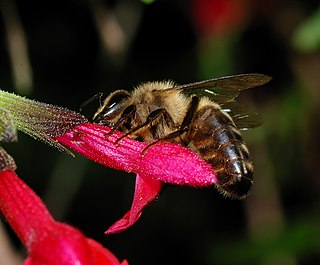
The Apis mellifera mellifera is a subspecies of the western honey bee, evolving in central Asia, with a proposed origin of the Tien Shan Mountains and later migrating into eastern and then northern Europe after the last ice age from 9,000BC onwards. Its original range included the southern Urals in Russia and stretched through northern Europe and down to the Pyrenees. They are one of the two members of the 'M' lineage of Apis mellifera, the other being in western China. Traditionally they were called the Black German Bee, although they are now considered endangered in Germany. However today they are more likely to be called after the geographic / political region in which they live such as the British Black Bee, the Native Irish Honey Bee, the Cornish Black Bee and the Nordic Brown Bee, even though they are all the same subspecies, with the word "native" often inserted by local beekeepers, even in places where the bee is an introduced foreign species. It was domesticated in Europe and hives were brought to North America in the colonial era in 1622 where they were referred to as the English Fly by the Native Americans.

Varroa destructor, the Varroa mite, is an external parasitic mite that attacks and feeds on honey bees and is one of the most damaging honey bee pests in the world. A significant mite infestation leads to the death of a honey bee colony, usually in the late autumn through early spring. Without management for Varroa mite, honey bee colonies typically collapse within 2 to 3 years in temperate climates. These mites can infest Apis mellifera, the western honey bee, and Apis cerana, the Asian honey bee. Due to very similar physical characteristics, this species was thought to be the closely related Varroa jacobsoni prior to 2000, but they were found to be two separate species after DNA analysis.
Varroa is a genus of parasitic mesostigmatan mites associated with honey bees, placed in its own family, Varroidae. The genus was named for Marcus Terentius Varro, a Roman scholar and beekeeper. The condition of a honeybee colony being infested with Varroa mites is called varroosis.

The Maltese honey bee, Apis mellifera ruttneri, is a subspecies of the western honey bee, endemic to the Maltese islands which are situated in the Mediterranean Sea.

Deformed wing virus (DWV) is an RNA virus, one of 22 known viruses affecting honey bees. While most commonly infecting the honey bee, Apis mellifera, it has also been documented in other bee species, like Bombus terrestris, thus, indicating it may have a wider host specificity than previously anticipated. The virus was first isolated from a sample of symptomatic honeybees from Japan in the early 1980s and is currently distributed worldwide. It is found also in pollen baskets and commercially reared bumblebees. Its main vector in A. mellifera is the Varroa mite. It is named after what is usually the most obvious deformity it induces in the development of a honeybee pupa, which is shrunken and deformed wings, but other developmental deformities are often present.

The western honey bee or European honey bee is the most common of the 7–12 species of honey bees worldwide. The genus name Apis is Latin for 'bee', and mellifera is the Latin for 'honey-bearing' or 'honey-carrying', referring to the species' production of honey.

Commercial Beekeeping in the United States dates back to the 1860s.

Beekeeping in New Zealand is reported to have commenced in 1839 with the importing of two skep hives by Mary Bumby, a missionary. It has since become an established industry as well a hobby activity.

Colony collapse disorder (CCD) is an abnormal phenomenon that occurs when the majority of worker bees in a honey bee colony disappear, leaving behind a queen, plenty of food, and a few nurse bees to care for the remaining immature bees. While such disappearances have occurred sporadically throughout the history of apiculture, and have been known by various names, the syndrome was renamed colony collapse disorder in early 2007 in conjunction with a drastic rise in reports of disappearances of western honey bee colonies in North America. Beekeepers in most European countries had observed a similar phenomenon since 1998, especially in Southern and Western Europe; the Northern Ireland Assembly received reports of a decline greater than 50%. The phenomenon became more global when it affected some Asian and African countries as well. From 1990 to 2021, the United Nation’s FAO calculated that the worldwide number of honeybee colonies increased 47%, reaching 102 million.
Beekeeping is first recorded in Ireland in the seventh century. It has seen a surge in popularity in modern times, with the membership of beekeeping associations exceeding 4,500. The median average number of hives per beekeeper is three hives, while the average honey output per hive is 11.4 kg. The growth in the practice has occurred despite increased pressures on bees and beekeepers due to parasites, diseases and habitat loss.
Beekeeping in the United Kingdom is the maintenance of bee colonies by humans within the United Kingdom. It is a significant commercial activity that provides those involved with honey, beeswax, royal jelly, queen bees, propolis, flower pollen and bee pollen. Honeybees also provide pollination services to orchards and a variety of seed crops.

Randal Plunkett, 21st Baron of Dunsany is an Irish filmmaker, landowner and rewilding advocate. Plunkett is the holder of a peerage title, and holds Dunsany Castle, one of the longest-inhabited houses in Ireland, and its remaining estate.

Beekeeping in Australia is a commercial industry with around 25,000 registered beekeepers owning over 670,000 hives in 2018. Most are found in the eastern states of Queensland, New South Wales, Victoria and Tasmania as well as the south-west of Western Australia.

Peter G. Kevan is a British-Canadian entomologist, applied ecologist and pollination biologist.

Kit Prendergast, nicknamed "The Bee Babette", is a wild bee ecologist from Perth, Western Australia.


