
List of notable or known members of German Student Corps .
List of notable or known members of German Student Corps .


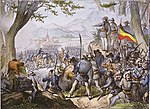


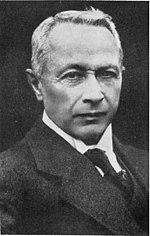





Corps (or Korps; "das ~" (n), German pronunciation:[ˈkoːɐ] (sg.), (pl.)) are the oldest still-existing kind of Studentenverbindung, Germany's traditional university corporations; their roots date back to the 15th century. The oldest corps still existing today was founded in 1789. Its members are referred to as corps students (Corpsstudenten). The corps belong to the tradition of student fraternities which wear couleur and practice academic fencing.

Studentenverbindung is the umbrella term for many different kinds of fraternity-type associations in German-speaking countries, including Corps, Burschenschaften, Landsmannschaften, Turnerschaften, and Catholic fraternities. Worldwide, there are over 1,600 Studentenverbindungen, about a thousand in Germany, with a total of over 190,000 members. In them, students spend their university years in an organized community, whose members stay connected even after graduation. A goal of this lifelong bond is to create contacts and friendships over many generations and to facilitate networking. The Lebensbund is very important for the longevity of these networks.

The Kösener Senioren-Convents-Verband is the oldest association of German, Austrian and Swiss Studentenverbindungen or students fraternities. It comprises roughly 105 German, Austrian and a Flemish (Belgian), Hungarian and Swiss Corps, all of which are based upon the principle of tolerance.
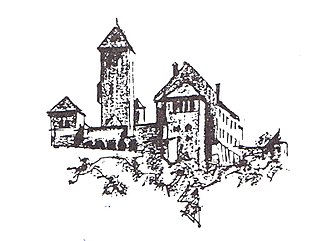
The Weinheimer Senioren-Convent is the second oldest association of German Studentenverbindungen. It comprises roughly 60 German Corps, all of which are based upon the principle of tolerance.

The Corps Hannovera Göttingen is one of the oldest German Student Corps, a Studentenverbindung or student corporation founded on January 18, 1809 at the Georg August University of Göttingen by students like Georg Kloss. The name was chosen because the founders had their home residences in the Kingdom of Hanover. As a corps it is a founder member (1848) of the Kösener Senioren-Convents-Verband (KSCV), the oldest governing body of such student associations in both Germany and Austria.

The Corps Suevia Freiburg is one of the oldest German Student Corps, known as a Studentenverbindung or student corporation. It is located at the Albert Ludwigs University of Freiburg.
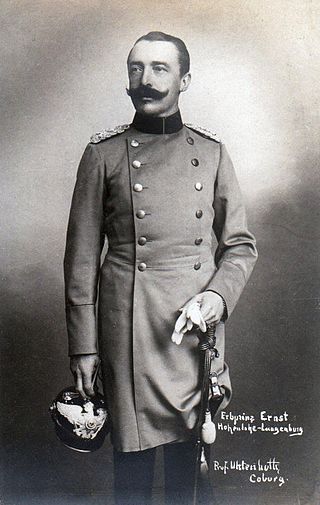
Ernst II was a German aristocrat and Prince of Hohenlohe-Langenburg. He served as the Regent of the Duchy of Saxe-Coburg and Gotha during the minority of his wife's cousin, Duke Charles Edward, from 1900 to 1905.
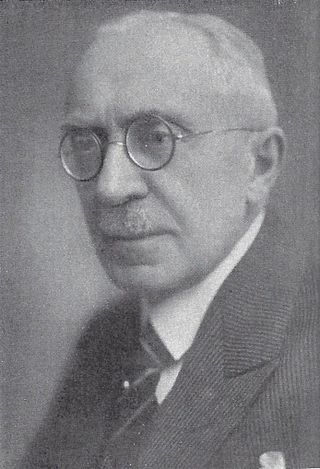
Dr. Ernst Ziehm was a Danzig-based German politician from the conservative German National People's Party and President of the Senate of the Free City of Danzig from 1931 to 1933. Born in Damerau, West Prussia, Ziehm studied jurisprudence and judicial Intern in Strasbourg and Marienweder from 1905 to 1914. Then he became judicial official in Oppeln. In 1914, he became an administrator in Danzig. From 1931 to 1933 he served as President of the Senate of the Free City of Danzig. After 1933, he was replaced by Hermann Rauschning, as Nazis seized control over the city-state's government. Ziehm died in Lübeck in 1962.

Corps Rhenania Heidelberg is a member Corps of the Kösener Senioren-Convents-Verband, the oldest association of student fraternities in Germany, Austria and Switzerland. Corps Rhenania is "pflichtschlagend", which refers to the fact that it requires of its members, that they participate in several ritual, organised duels with members of other specific student fraternities. Eligible applicants are those students, both current and former, of the Ruprecht Karl University in Heidelberg, Germany. Members of Corps Rhenania are colloquially referred to as "Rhenane".
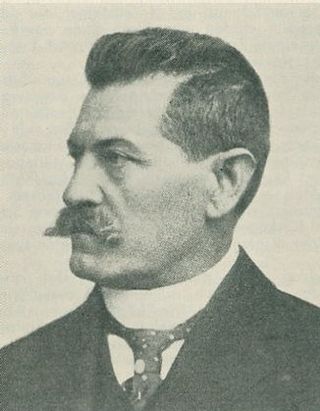
Hermann Kuhnt was a German ophthalmologist born in Senftenberg, Brandenburg.
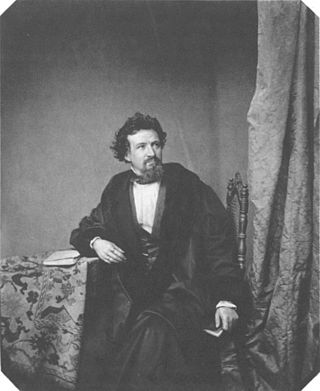
Hermann Lingg was a German poet who also wrote plays and short stories. His cousin, Maximilian von Lingg, was Bishop of Augsburg.

Ernst Immanuel Bekker was a German jurist and professor.

Rudolf August Johann Ludwig Wilhelm Berlin, also known as Rudolph Berlin, was a German ophthalmologist.
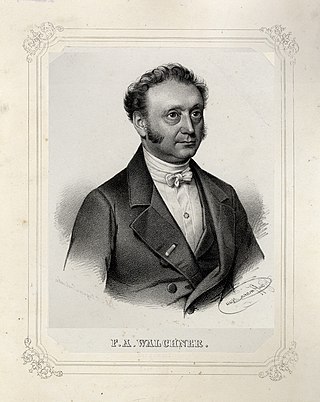
Friedrich August Walchner was a German geologist, chemist and mineralogist.

The Corps Saxo-Borussia Heidelberg is a German Student Corps at the University of Heidelberg.
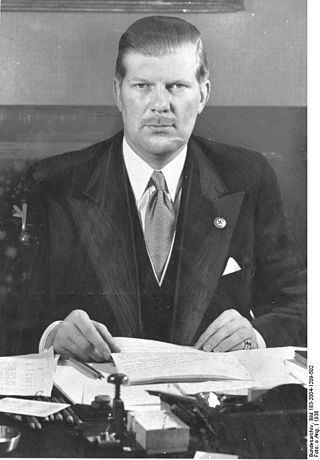
Alexander Freiherr von Dörnberg zu Hausen was a German jurist, diplomat and SS officer. He was head of the Protocol Department of the Foreign Office from 1938 to 1945.
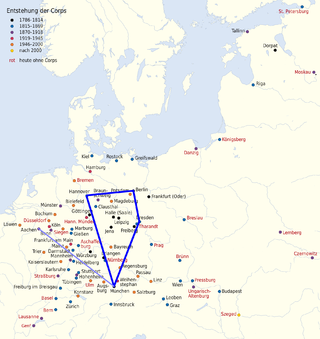
The Blaues Kartell is a circle of four German Student Corps, or Corps (Studentenverbindung) for short, who understand the union as "one fraternity spanning four cities". The member fraternities are the Corps Altsachsen Dresden, Saxo-Thuringia München, Berlin and Hannoverania Hannover.
August Albrecht Meckel (1790–1829) was a German physician. He was the grandson of Johann Friedrich Meckel the Elder and younger brother of Johann Friedrich Meckel.

Walter Julius Gustav Bloem was a German writer. He wrote novels that expressed a German nationalist attitude and made him one of the most widely read authors of his time with a total circulation of two million.
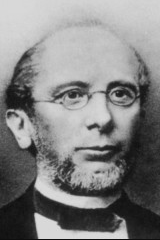
Friedrich Moritz Christian Pfeiffer was a German jurist and politician.