Little Neck, Queens

Last updated
Little Neck
Little Neck.png
Residential street
Location within New York City
Coordinates: 40°46′N73°44′W / 40.76°N 73.73°W / 40.76; -73.73 Coordinates: 40°46′N73°44′W / 40.76°N 73.73°W / 40.76; -73.73
Country Flag of the United States.svg  United States
State Flag of New York.svg  New York
County Queens
Ethnicity
  White71.1%
  Black1.1%
  Hispanic6.8%
  Asian23.9%
  Other1.9%
ZIP code
11362, 11363
Area code(s) 718, 347, 929, and 917

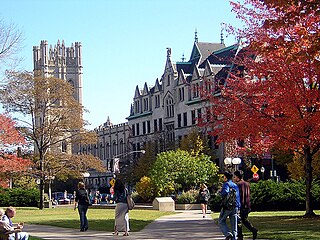
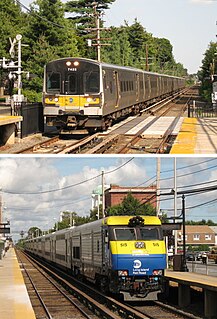
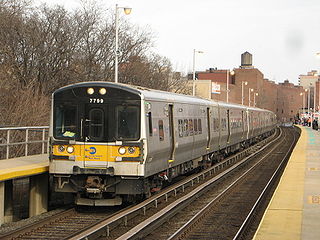
Little Neck is an upper middle class neighborhood of Queens, New York City, bordered on the north by Little Neck Bay and on the east by Great Neck in Nassau County. Due to this proximity to Nassau, Little Neck remains one of the most suburban-looking areas in New York City. The southern border is the Grand Central Parkway, and to the west is Douglaston. The Little Neck station is the easternmost New York City station on the busy Port Washington Branch of the Long Island Rail Road (LIRR), and thus Little Neck is home to the busiest of approximately a dozen remaining railway grade crossings in New York City. [1] The neighborhood is part of Queens Community Board 11. [2]

Upper middle class sociological concept

In sociology, the upper middle class is the social group constituted by higher status members of the middle class. This is in contrast to the term lower middle class, which is used for the group at the opposite end of the middle-class stratum, and to the broader term middle class. There is considerable debate as to how the upper middle class might be defined. According to sociologist Max Weber the upper middle class consists of well-educated professionals with postgraduate degrees and comfortable incomes.

Queens Borough in New York City and county in New York, United States

Queens is the easternmost of the five boroughs of New York City. It is the largest borough geographically and is adjacent to the borough of Brooklyn at the southwestern end of Long Island. To its east is Nassau County. Queens also shares water borders with the boroughs of Manhattan and the Bronx. Coterminous with Queens County since 1899, the borough of Queens is the second largest in population, with an estimated 2,358,582 residents in 2017, approximately 48% of them foreign-born. Queens County also is the second most populous county in the U.S. state of New York, behind Brooklyn, which is coterminous with Kings County. Queens is the fourth most densely populated county among New York City's boroughs, as well as in the United States. If each of New York City's boroughs were an independent city, Queens would be the nation's fourth most populous, after Los Angeles, Chicago, and Brooklyn. Queens is the most ethnically diverse urban area in the world.

New York City Largest city in the United States

The City of New York, usually called either New York City (NYC) or simply New York (NY), is the most populous city in the United States. With an estimated 2017 population of 8,622,698 distributed over a land area of about 302.6 square miles (784 km2), New York is also the most densely populated major city in the United States. Located at the southern tip of the state of New York, the city is the center of the New York metropolitan area, the largest metropolitan area in the world by urban landmass and one of the world's most populous megacities, with an estimated 20,320,876 people in its 2017 Metropolitan Statistical Area and 23,876,155 residents in its Combined Statistical Area. A global power city, New York City has been described as the cultural, financial, and media capital of the world, and exerts a significant impact upon commerce, entertainment, research, technology, education, politics, tourism, art, fashion, and sports. The city's fast pace has inspired the term New York minute. Home to the headquarters of the United Nations, New York is an important center for international diplomacy.

Contents

Development

Prior to the mid-1600s, the Matinecock lived in what is today considered Little Neck, sustained by the seafood in Little Neck Bay. [3] In the 17th century, European settlers began arriving in the area for its conveniently located harbor. Soon after, the British and Dutch gained control of the Matinecock lands peacefully, except for a small area known as Madnan's Neck (possibly a shortened form of Indian name for the area, Menhaden-ock, or "place of fish"). [4] Thomas Hicks, of the Hicks family that eventually founded Hicksville, and a band of armed settlers forcibly drove out the Matinecock in a battle at today's Northern Boulevard and Marathon Parkway. [5] An old Matinecock cemetery remained in Little Neck on Northern Boulevard between Cornell Lane and Jesse Court. One of the last photographs of the cemetery (available online) was taken by the Daily News in August 1931, a few months before it was removed to make room for a widened Northern Boulevard. [6] The remains from the cemetery were moved to the Zion Episcopal Church of Douglaston and placed under a stone marker that reads "Here rest the last of the Matinecoc." [7]

Hicksville, New York Hamlet and census-designated place in New York, United States

Hicksville is a hamlet and census-designated place (CDP) within the town of Oyster Bay in Nassau County, New York, United States, on Long Island. The population of the CDP was 41,547 at the 2010 census.

The settlers thrived producing produce for the Manhattan market and the area was used as a dock on Little Neck Bay. As the population of Little Neck and New York in general began to grow, the Little Neck Long Island Rail Road station was opened in 1866 on the Port Washington Branch to serve the community and the dock area. [8] Northern Boulevard was developed into a commercial and cultural hub, and the Little Neck Theater, a 576-seat movie theater, was opened in 1929 at the intersection of Northern Boulevard and Morgan Street. [9] [10] The theater was closed in 1983. [11]

Manhattan Borough in New York City and county in New York, United States

Manhattan, often referred to locally as the City, is the most densely populated of the five boroughs of New York City and its economic and administrative center, cultural identifier, and historical birthplace. The borough is coextensive with New York County, one of the original counties of the U.S. state of New York. The borough consists mostly of Manhattan Island, bounded by the Hudson, East, and Harlem rivers; several small adjacent islands; and Marble Hill, a small neighborhood now on the U.S. mainland, physically connected to the Bronx and separated from the rest of Manhattan by the Harlem River. Manhattan Island is divided into three informally bounded components, each aligned with the borough's long axis: Lower, Midtown, and Upper Manhattan.

Long Island Rail Road commuter rail service in Long Island, New York

The Long Island Rail Road, often abbreviated as the LIRR, is a commuter rail system in the southeastern part of the U.S. state of New York, stretching from Manhattan to the eastern tip of Suffolk County on Long Island. With an average weekday ridership of 354,800 passengers in 2016, it is the busiest commuter railroad in North America. It is also one of the world's few commuter systems that runs 24 hours a day, 7 days a week, year-round. It is publicly owned by the Metropolitan Transportation Authority, which refers to it as MTA Long Island Rail Road.

Port Washington Branch

The Port Washington Branch is an electrified two-track rail line and service owned and operated by the Long Island Rail Road in the U.S. state of New York. It branches north from the Main Line at Winfield Junction, just east of the Woodside station in the New York City borough of Queens, and runs roughly parallel to Northern Boulevard past Mets-Willets Point, Flushing, Murray Hill, Broadway, Auburndale, Bayside, Douglaston, Little Neck, and then crosses into Nassau County for stops in Great Neck, Manhasset, and Plandome before terminating at Port Washington.

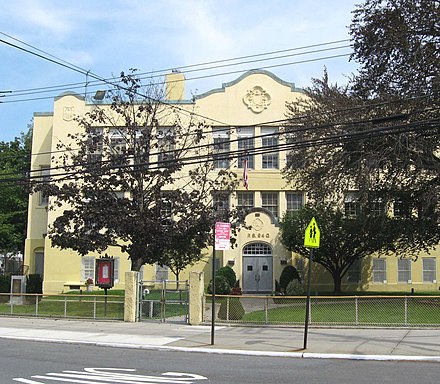
P.S. 94 on 42nd Avenue PS940 LNP 42Av jeh.JPG
P.S. 94 on 42nd Avenue

From the 1860s through the 1890s, small hard clams (quahogs) from Little Neck Bay were served in the best restaurants of New York and several European capitals. [12] Eventually, the term "littleneck" or "littleneck clam" came to be used as a size category for all hard clams, regardless of origin. [13] [14]

Hard clam A species of bivalve mollusc native to the east coast of North and Central America

The hard clam, also known as a quahog, round clam or hard-shellclam, is an edible marine bivalve mollusc that is native to the eastern shores of North America and Central America from Prince Edward Island to the Yucatán Peninsula. It is one of many unrelated edible bivalves that in the United States are frequently referred to simply as clams, as in the expression "clam digging". Older literature sources may use the systematic name Venus mercenaria; this species is in the family Veneridae, the venus clams.

Education

Little Neck is part of the New York City Department of Education's district 26, the highest performing school district for grades K-9 in all of New York City. The district includes 20 elementary schools and 5 middle schools. [15]

New York City Department of Education public school system of the municipal government of New York City, New York, USA

The New York City Department of Education (NYCDOE) is the department of the government of New York City that manages the city's public school system. The City School District of the City of New York is the largest school system in the United States, with over 1.1 million students taught in more than 1,800 separate schools. The department covers all five boroughs of New York City, and has an annual budget of nearly 25 billion dollars. The department is run by the Panel for Educational Policy and New York City Schools Chancellor. The current chancellor is Richard Carranza.

Little Neck is home to PS 94 David D. Porter, PS 221 North Hills, and PS 811 (a multiple handicap school, formerly known as PS 187, or the Marathon School). It is also home to Louis Pasteur Middle School 67Q, which serves about 900 students.

Notable residents

Related Research Articles

Ozone Park, Queens Neighborhood of Queens in New York, United States

Ozone Park is a neighborhood located in the southwestern section of the borough of Queens, in New York City, New York, United States. It is located next to the Aqueduct Racetrack in South Ozone Park, a popular spot for Thoroughbred racing. The neighborhood was known for its large Italian-American population. Over the years, it has become a very diverse community.
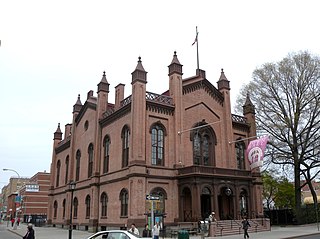
Flushing, Queens Neighborhoods of Queens in New York City

Flushing is a neighborhood in the New York City borough of Queens in the United States. While much of the neighborhood is residential, Downtown Flushing, centered on the northern end of Main Street in Queens, is a large commercial and retail area and is the fourth largest central business district in New York City.

Corona, Queens Neighborhoods of Queens in New York City

Corona is a neighborhood in the borough of Queens in New York City. It is bordered by Flushing and Flushing Meadows–Corona Park to the east, Jackson Heights to the west, Forest Hills and Rego Park to the south, Elmhurst to the southwest, and East Elmhurst to the north. Corona's main thoroughfares include Corona Avenue, Roosevelt Avenue, Northern Boulevard, Junction Boulevard, and 108th Street.

Throggs Neck Neighborhood of the Bronx in New York City

Throggs Neck is a neighborhood and peninsula in the southeastern portion of the borough of the Bronx in New York City. It is bounded by the East River and Long Island Sound to the south and east, Westchester Creek on the west, and Baisley Avenue and the Bruckner Expressway on the north.

Forest Hills, Queens Neighborhood of Queens in New York City

Forest Hills is a mostly residential neighborhood in the central portion of the borough of Queens in New York City. The north, east, and south boundaries are the Long Island Expressway, Grand Central Parkway, and Union Turnpike, respectively. Google Maps shows the western boundary running roughly along 102nd Street, 67th Avenue, and the Long Island Rail Road's former Rockaway Beach Branch; while the Encyclopedia of New York City defines the western boundary as Junction Boulevard and the former Rockaway Beach Branch. The area was originally referred to as "Whitepot".

Queens Village, Queens Neighborhood of Queens in New York City

Queens Village is a mostly residential middle class neighborhood in the eastern part of the New York City borough of Queens. The Queens Village Post Office serves the ZIP codes of 11427, 11428, and 11429. The neighborhood is part of Queens Community Board 13.

Kew Gardens, Queens Neighborhood of Queens in New York City

Kew Gardens is a neighborhood in the central area of the New York City borough of Queens. Kew Gardens, shaped roughly like a triangle, is bounded to the north by Union Turnpike and the Jackie Robinson Parkway, to the east by Van Wyck Expressway and 131st Street, to the south by Hillside Avenue, and to the west by Park Lane, Abingdon Road, and 118th Street. Forest Park and the neighborhood of Forest Hills are to the west, Flushing Meadows–Corona Park north, Richmond Hill south, Briarwood southeast, and Kew Gardens Hills east.
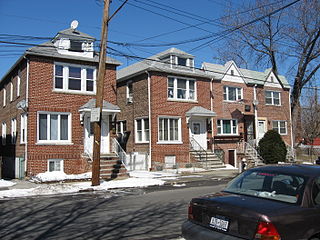
Pelham Bay (neighborhood), Bronx Neighborhood of the Bronx in New York City

Pelham Bay is a middle class residential neighborhood in the borough of the Bronx, in New York City. It is named for Pelham Bay Park, New York City's largest park, which lies on the neighborhood's northeastern border; and for Pelham Bay, a body of water in that park. The neighborhood is bounded roughly by Pelham Parkway on the north, the New England Thruway (I-95) on the east, the Bruckner Expressway (I-95) on the south, and the Hutchinson River Parkway on the west.

Rego Park, Queens Neighborhood in Queens in New York, United States

Rego Park is a neighborhood in the borough of Queens in New York City. Rego Park is bordered to the north by Elmhurst and Corona, the east and south by Forest Hills, and the west by Middle Village. Rego Park's boundaries include Queens Boulevard, the Long Island Expressway, Woodhaven Boulevard, and Yellowstone Boulevard. There is a large Jewish population in the neighborhood, which features high-rise apartment buildings and detached houses, as well as a large commercial zone.
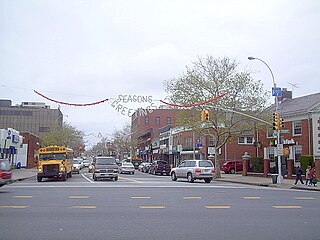
Bayside, Queens Neighborhoods of Queens in New York City

Bayside is a neighborhood in the New York City borough of Queens. The neighborhood is east of Flushing and is part of Queens Community Board 11. CNN Money ranked Bayside as one of the most expensive housing markets nationally when analyzing comparable detached homes throughout the United States. Despite its large housing stock of free-standing homes, it nationally ranks high to very high in population density. These homes give the neighborhood a similar feel to other wealthy Queens neighborhoods such as Douglaston–Little Neck and Whitestone.

Fresh Meadows, Queens Neighborhood of Queens in New York City

Fresh Meadows is a residential neighborhood in the northeastern section of the New York City borough of Queens. Fresh Meadows is located in the south part of Flushing and is bordered to the north by the Fresh Meadows Playground and Horace Harding Expressway, to the west by South Flushing and the sub-neighborhood of Hillcrest, to the east by Cunningham Park, and to the south by Union Turnpike and St. John's University. The neighborhood is part of Queens Community Board 8 and is covered by ZIP Codes 11365 and 11366.

Dongan Hills, Staten Island Neighborhood of Staten Island in New York City

Dongan Hills is a neighborhood located within the New York City borough of Staten Island. It is on the Island's East Shore. Dongan Hills is bounded by Laconia Avenue on the southeast, Jefferson Avenue on the southwest, Richmond Road on the northwest, and Old Town Road to the north. It is adjacent to New Dorp and Grant City to the southwest, Todt Hill to the northwest, Old Town/Concord to the northeast, and South Beach and Midland Beach to the southeast.

Glendale, Queens Neighborhoods of Queens in New York City

Glendale is a neighborhood in the west-central portion of the New York City borough of Queens. It is bounded by Forest Hills and Kew Gardens to the east, Ridgewood to the west, Woodhaven to the south, and Middle Village to the north.

Bedford Park, Bronx Neighborhood of the Bronx in New York City

Bedford Park is a residential neighborhood in the northwest Bronx, New York City, between the New York Botanical Garden and Lehman College. Its boundaries, starting from the north and moving clockwise are: Mosholu Parkway to the north, Webster Avenue to the east, East 196th Street to the south, and the Jerome Reservoir and Goulden Avenue to the west.
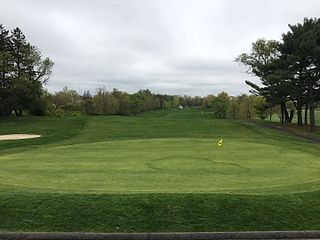
Douglaston Park

Douglaston Park is a public park and golf course located in the Douglaston section of Queens, New York City. According to The New York Times it is also the name of the surrounding residential area in Douglaston, one of five other distinct neighborhoods. More specifically, Douglaston Park, Queens is the area located between Northern Boulevard and Interstate 495.

South Ozone Park, Queens Neighborhood of Queens in New York, United States

South Ozone Park is a neighborhood in the southwestern section of the New York City borough of Queens. Adjacently north of JFK Airport, its boundaries extend from the Aqueduct Racetrack eastward to the Van Wyck Expressway. Its main thoroughfare is Rockaway Boulevard. The neighborhood is part of Queens Community Board 10.
Glen Oaks, Queens Neighborhood of Queens in New York, United States

Glen Oaks is a neighborhood in the easternmost portion of the New York City borough of Queens. The neighborhood is part of Queens Community Board 13.

The Queens Community Board 11 is a local government in the New York City borough of Queens, encompassing the neighborhoods of Bayside, Douglaston–Little Neck, Auburndale, East Flushing, Oakland Gardens and Hollis Hills. It is delimited by Utopia Parkway to the west, 26th Avenue and Little Neck Bay to the north, the Nassau County border to the east and Horace Harding Expressway, Clearview Expressway and Grand Central Parkway to the south.

Community boards of Queens

Community boards of Queens are New York City community boards in the borough of Queens, which are the appointed advisory groups of the community districts that advise on land use and zoning, participate in the city budget process, and address service delivery in their district.

References

  1. Perilous Crossings, accessed November 27, 2006
  2. Queens Community Boards, New York City. Accessed September 3, 2007.
  3. "History". Matinecock Masonic Historical Society. Archived from the original on 2012-02-06. Retrieved 2012-06-26.
  4. Walsh, Kevin (2006). Forgotten New York: Views of a Lost Metropolis. Collins Reference. ISBN   978-0060754006.
  5. Euler, Aline; Freiberg, Dyan (2008). The History and Ecology of Little Neck Bay, LI, NY. Douglaston, NY: Alley Pond Environmental Center.
  6. French, Mary (October 28, 2010). "Indian Cemetery, Little Neck". New York Cemetery Project. Retrieved 2012-06-26.
  7. Walsh, Kevin (August 2007). "ForgottenTour 31, Little Neck/Douglaston, Queens" . Retrieved 2012-06-26.
  8. Shaman, Diana (January 28, 2001). "If You're Thinking of Living In/Little Neck, Queens; A Century-Old Neighborly Community". The New York Times.
  9. "Little Neck Theatre Sold". The New York Times. February 7, 1929.
  10. "Little Neck Theatre Leased". The New York Times. April 15, 1963.
  11. "Little Neck Theatre in Little Neck, NY". Cinema Treasures. Retrieved July 26, 2012.
  12. Queens Borough Library Douglaston/Little Neck Branch Community Info Archived 2007-06-10 at the Wayback Machine
  13. "littleneck" Merriam-Webster Online Dictionary retrieved on 2009-05-05.
  14. "littleneck" Webster's New World College Dictionary retrieved from www.yourdictionary.com on 2009-05-05.
  15. Roleke, Krissy. "Bayside, NY: Queens Neighborhood Profile for Bayside", About.com. Accessed July 15, 2006.
  16. "They Came from Queens", Queens Tribune. Accessed November 4, 2007. "He once lived in Little Neck and attended Aviation High School."
  17. Grimes, William (September 21, 2010). "Jill Johnston, Avant-Garde Cultural Critic, Dies at 81". The New York Times.
  18. Alan Kalter, CBS. Accessed June 23, 2016. "Alan is a native New Yorker, born in Brooklyn and raised in Little Neck and Cedarhurst, New York."
  19. (in Chinese) 芳邻刘亦菲. October 22, 2006. Retrieved on June 24, 2008.
  20. Chang, Sophia. "George Tenet is welcome back home in Little Neck", Times Ledger, June 10, 2004. Accessed June 23, 2016.