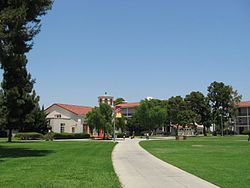
Long Beach City College (LBCC) is a publiccommunity college in Long Beach, California, United States. It was established in 1927 and is divided into two campuses, the Liberal Arts Campus (LAC) in Lakewood Village and the Trades, Technology, and Community Learning Campus (TTC) in central Long Beach on Pacific Coast Highway. It is the only college in the Long Beach Community College District.
Founded in 1927, Long Beach City College was initially housed at Wilson Classical High School in southeast Long Beach.[5] The 1933 Long Beach earthquake resulted in classes being held at Recreation Park until 1935, when the college moved into its Liberal Arts Campus in Lakewood Village at Carson Street and Clark Avenue.
During and after World War II, the college increased so rapidly that a new campus had to be established. This was realized in 1949 with the establishment of the Pacific Coast Campus, occupied on the former site of Hamilton Junior High School. As Long Beach City College grew in the 1970s, state law separated the college from the Long Beach Unified School District. In that decade and the 1980s, Proposition 13 signaled retrenchment for the college, with many popular classes and services folding.
Also during the 1980s, the arrival of refugees from Southeast Asia resulted in the need for extensive courses in the ESL program. This program became the largest at the college due to a later wave of amnesty applicants.
1987 saw the college acquire neighboring Veterans Memorial Stadium from the City of Long Beach. Even before it acquired the stadium, as far back as the early 1970s, the college was allowed to use its facilities as a practice field and to provide several hundred much-needed parking for students of the college. In recent years, the college has upgraded the stadium playing surface, its swimming pool facility, as well as established wireless internet and e-mail services in 2005.
Bond Measure E has seen the construction of a Child Development Center at the TTC campus, and construction for new buildings on both campuses are underway, including a new South Quad Complex Building on the formers LAC golf mall, a new Industrial Technology Building at the TTC campus, and a new East Campus for the Culinary Arts Program.[6]
From July to November 2025, LAC’s E building was demolished in preparation for a new student center. A groundbreaking ceremony for the new building was held on November 19, 2025.
Name
Long Beach Junior College opened its doors at Woodrow Wilson High School in 1927 to 503 students, and in 1935, the college moved to the campus on the corner of Carson and Clark. Reorganization brought together all post-high school education in 1944, resulting in the name becoming Long Beach City College, and splitting into the Liberal Arts Division, the General Adult Division, and Technical Institute Division. The Liberal Arts Division remained on the original Junior College campus, and became known as the Liberal Arts Campus (LAC). The General Adult Division and Technical Institute Division offered courses at surrounding educations centers, until a second LBCC campus was opened on the former site of Hamilton Junior High School in 1949 as a result of increased enrollment after World War II. This campus was originally called the Business and Technology Division Campus and eventually became known as the Pacific Coast Campus (PCC) while the Liberal Arts Campus remained the same. In 2024, coinciding with the campus' 75th anniversary, LBCC rebranded PCC as the Trades, Technology, and Community Learning (TTC) Campus.[7]
The campuses are located in Long Beach, Los Angeles County, California. The Liberal Arts Campus is situated north of Interstate 405 and south of State Highway 91, along the major roads of Carson Street, which divides the campus in two portions, Lakewood Boulevard, which borders the campus to the west, and Clark Avenue, which borders the campus to the east.
The Trades, Technology, and Community Learning Campus is situated north of Pacific Coast Highway, bordered by Orange Avenue to the west, Walnut Avenue to the east, and Mary Butler School to the north. Year-round, there is a mild climate moderated by ocean breezes from the Pacific.
Most students, faculty and staff commute to campus. Long Beach Transit serves both campuses, with routes 93, 101, 103, and 112 serving LAC, and routes 71, 171, 172, 173, 174, and 175 serving the TTC campus. Due to the increasing student enrollment, there have been issues regarding parking, and as a consequence, those with parking permits usually arrive early during the first few weeks of each semester to avoid traffic. Recent construction projects from Bond Measure E have aggravated the parking situation, but this will be temporary upon completion.
Student support services and programs
Long Beach City College offers a variety of student support services and programs:
The Liberal Arts Campus' cafeteria during a lunchtime jazz performance in 2007
Career & Job Services (LAC/TTC) - Career counselors assist with the exploration and development of career and employment goals
CalWORKs (TTC) - Supportive services to county public assistance (welfare) recipients in the form of dedicated CalWORKs counselors, case management, childcare, work-study[8]
Child Development Center (LAC/TTC) - Child care for to 2- to 5-year-old children of Long Beach City College students, faculty, and staff
Disabled Students Programs and Services (LAC/TTC) - DSPS provides many support services that enable students with disabilities to participate in the college's programs and activities including note-takers, readers, interpreters and assistance with registration.
English as a Second Language Office (TTC) - Provides bilingual information on college services and benefits by ESL Counselors and Advisors, offers the ESL test, and provides assistance with online registration
Extended Opportunity Programs & Services (LAC/TTC) - Retention program designed to assist qualified students with educational counseling, priority registration, assistance with transfer and assistance with textbooks/supplies
Cooperative Agencies Resources for Education (LAC/TTC) - Additional assistance for EOPS students who are single parents, head of household, have at least one child 13 years of age or younger and are participating in CalWORKs or GAIN
Honors Program (LAC/TTC) - Provides classes and programs to prepare high-achieving students for transfer to competitive four-year colleges and universities
International Students Program (LAC) - Services in immigration matters; academic, career and personal counseling; and housing assistance to international students
American Language and Culture Institute (LAC) - Provides English language preparation and an F-1 visa for international students
Transfer Center (LAC/TTC) - Helps new and transfer-bound students with registration and transfer workshops, LBCC online access, and assists in communication with university representatives
TRIO Go Project (TTC) - Academic, career, financial, and personal advising services for students who are either first-generation college students, low income and/or learning/physically disabled. It offers academic and transfer counseling services, tutoring, cultural enrichment, and field trips.
Puente (LAC) - Prepares educationally underserved students to transfer to four-year colleges and universities. It is an academic, counseling, and mentoring program helping students build the skills necessary for academic success and career goals
Student Success Centers (LAC/TTC)- Academic support and learning assistance for students across the disciplines
Long Beach City College offers a wide range of programs, including business, health, trade and industry, communications, and liberal arts, as well as a wide variety vocational programs spanning various occupational trades. The college has an honors program for its high-achieving students. The English as a Second Language (ESL) program is one of the largest on campus.
The college is divided into six schools:
School of Business and Social Science
School of Creative Arts and Applied Sciences
School of Health, Science and Mathematics
School of Language Arts
School of Physical Education and Athletics
School of Trade and Industrial Technologies
Commercial Music Program
The Commercial Music Program at Long Beach City College offered a certificate program aimed at "prepar[ing] students for an entry-level position as an audio engineer in fields such as: recording studio, live sound, mastering, music video, foley, television, film, theater, and multi-media". It also offered an associate degree.[10]
Many of the professors were and still are successful professionals in the music industry:
Due to budget restraints, the Commercial Music Program at Long Beach City College was one of 11 programs that were discontinued in 2013.[20][21] In 2022, LBCC re-opened the Commercial Music Program.
Long Beach City College is populated with many student-run clubs and organizations. The Associated Student Body (ASB), is the largest group on campus, and is the organization that funds most of the events geared toward students at the college. The ASB Student Senate overlooks the independent clubs as well as the men's and women's social service clubs that used to be under the now-defunct Associated Men's Students (AMS) and Associated Women's Students (AWS). LBCC is also known for having a nationally renowned volunteerservice program, as well as the oldest community college intramural athletics program in the nation.
There are campus-run radio and television stations, as well as a campus-run newspaper, named the Viking.
Traditional events include Homecoming Week, the Spring Sing variety show, and Mini Grand Prix, a three-person pushcart race tournament.
The campuses were well known for their high populations of resident domestic rabbits, though since 2011 the population has diminished substantially.[22][23] The rabbits were humanely trapped and spayed or neutered. Over 200 rabbits were happily adopted, while around three dozen of the now-fixed animals were too wild to become pets and have been allowed to continue roaming the campus.[24]
Long Beach City College has 21 athletic programs for men and women. The teams are known as the Vikings, and they have won 16 national and 93 state championships as of Fall 2025.[25] The mascot is a Viking named Ole. The Vikings are recognized as a powerhouse in some of the most competitive community college conferences in California, as well as the nation.
Veterans Memorial Stadium was acquired by the school in 1987 and has since been renovated
1950 Long Beach football national championship ring
The Long Beach City College Viking's 1950 football team celebrated what would be their first of five national championships:(1950, 1960, 1962, 1964, 1995)[27]
The 2005–06 season saw Long Beach City College win for the first-ever time the Pepsi/NATYCAA Cup, State Associations Division, from the National Association of Two-Year College Athletic Administrators (NATYCAA). This award represents the best junior college athletics program in the state of California. LBCC won the award by 20.5 points over second-place Mount San Antonio College, buoyed by state titles in men's water polo, women's soccer, baseball, and men's volleyball, for a total of 174.5 points.
This page is based on this Wikipedia article Text is available under the CC BY-SA 4.0 license; additional terms may apply. Images, videos and audio are available under their respective licenses.