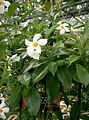
Grevillea, commonly known as spider flowers, is a genus of about 360 species of evergreen flowering plants in the family Proteaceae. Plants in the genus Grevillea are shrubs, rarely trees, with the leaves arranged alternately along the branches, the flowers zygomorphic, arranged in racemes at the ends of branchlets, and the fruit a follicle that splits down one side only, releasing one or two seeds.

Abutilon pictum, syn. Abutilon striatum (disputed), is a species of flowering plant in the family Malvaceae. It is native to southern Brazil, Argentina, Paraguay and Uruguay. The plant has become naturalised in Central America, and is used in horticulture. Common names include redvein abutilon, red vein Indian mallow, redvein flowering maple, Chinese-lantern and red vein Chinese lanterns.

Salvia splendens, the scarlet sage, is a tender herbaceous perennial plant native to Brazil, growing at 2,000 to 3,000 m elevation where it is warm year-round and with high humidity. The wild form, rarely seen in cultivation, reaches 1.3 m (4.3 ft) tall. Smaller cultivars are very popular as bedding plants, seen in shopping malls and public gardens all over the world.

Mandevilla laxa, commonly known as Chilean jasmine, is an ornamental plant in the genus Mandevilla of family Apocynaceae.

Chaenomeles speciosa, the flowering quince, Chinese quince, or Japanese quince, is a thorny deciduous or semi-evergreen shrub native to eastern Asia. It is taller than another commonly cultivated species, C. japonica, usually growing to about 2 m. The flowers are usually red, but may be white or pink. The fruit is a fragrant but hard pome that resembles a quince.
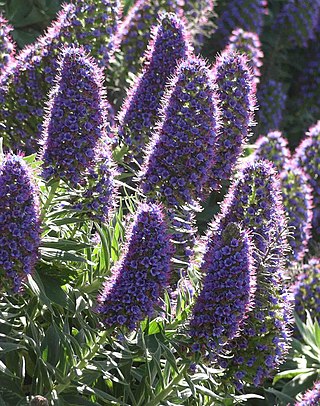
Echium candicans, the 'Pride of Madeira', is a species of flowering plant in the family Boraginaceae, native to the island of Madeira. It is a large herbaceous perennial subshrub, growing to 1.5–2.5 m.

Rhododendron viscosum, the swamp azalea, clammy azalea or swamp honeysuckle, is a species of flowering plant in the heath family Ericaceae. This deciduous shrub, growing to 2.5 m (8.2 ft) tall and broad, is native to the eastern United States. It has rounded matt green leaves. In early summer it produces funnel-shaped white flowers flushed pink. The flowers have prominent stamens and are strongly fragrant.

Chusquea culeou, the Chilean bamboo, is a species of flowering plant in the grass family Poaceae. An evergreen bamboo native to South America, unlike most species within the genus Chusquea, it is frost-tolerant and thus widely cultivated in temperate regions.

Mandevilla splendens, the shining mandevilla, is a species of flowering plant in the family Apocynaceae. It is an evergreen vine, native to Brazil.

Mandevilla sanderi, the Brazilian jasmine, is a vine belonging to the genus Mandevilla. Grown as an ornamental plant, the species is endemic to the State of Rio de Janeiro in Brazil. It is a rapidly growing, creeping, perennial plant, pruning shoots about 60 cm per year.

Musa basjoo, known variously as Japanese banana, Japanese fibre banana or hardy banana, is a species of flowering plant belonging to the banana family Musaceae. It was previously thought to have originated in the Ryukyu islands of southern Japan, from where it was first described in cultivation, but is now known to have originated in subtropical southern China, where it is also widely cultivated, with wild populations found in Sichuan province. Its specific name is derived from its Japanese common name, bashō (芭蕉).
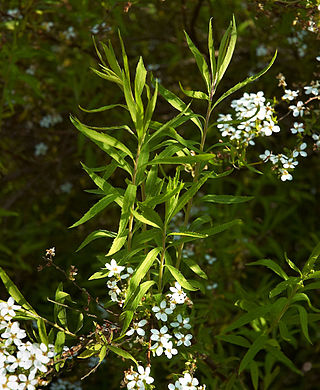
Spiraea thunbergii (珍珠绣线菊), Thunberg spiraea or Thunberg's meadowsweet, is a species of flowering plant in the rose family, native to East China and Japan, and widely cultivated elsewhere.

Itea virginica, commonly known as Virginia willow or Virginia sweetspire, is a small North American flowering shrub that grows in low-lying woods and wetland margins. Virginia willow is a member of the Iteaceae family, and native to the southeast United States. Itea virginica has small flowers on pendulous racemes.

Yucca gigantea is a species of flowering plant in the asparagus family, native to Mexico and Central America. Growing up to 8–12 m (26–39 ft) in height, it is an evergreen shrub which is widely cultivated as an ornamental garden or house plant, often referred to simply as yucca cane. The edible flower is the national flower of El Salvador locally called izote, and it is used extensively in Salvadoran cuisine.

Phlomis fruticosa, the Jerusalem sage, is a species of flowering plant in the family Lamiaceae, native to Albania, Cyprus, Greece, Italy, Turkey, and countries of the former Yugoslavia.

Teucrium fruticans is a species of flowering plant in the mint family Lamiaceae, native to the western and central Mediterranean. Growing to 1 m (3 ft) tall by 4 m (13 ft) wide, it is a spreading evergreen shrub with arching velvety white shoots, glossy aromatic leaves and pale blue flowers in summer.

Linaria maroccana is a species of flowering plant in the plantain family known by the common names Moroccan toadflax and annual toadflax. It is native to Morocco, but it can be found elsewhere growing wild as an introduced species, such as California. It is a readily available ornamental plant for the flower garden. This is an annual herb growing erect to approach a maximum height of 50 cm (20 in), its stem with linear leaves 2–4 cm (0.8–1.6 in) long. The inflorescence is a raceme of flowers occupying the top of the stem. At the base of each flower is a calyx with five narrow, pointed lobes. The flower is 2–4 cm (0.8–1.6 in) long with five lobes arranged into two lips with a spur at the end. The flower is often purple in color with white near the throat, but flowers of many different colors are bred for the garden. Dwarf cultivars are also available.
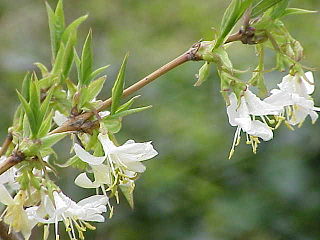
Lonicera fragrantissima is a species of flowering plant in the honeysuckle family Caprifoliaceae, known by the common names winter-flowering honeysuckle, fragrant honeysuckle, kiss-me-at-the-gate, and sweet breath of spring. It is native to China and has been an introduced species to other parts of the world. It was brought to the attention of western gardeners by Scottish plant hunter Robert Fortune, who was plant hunting in China for the Royal Horticultural Society. Fortune introduced Lonicera fragrantissima to England in 1845, and a few years later it was introduced to the United States. In 1853 the editor of American gardening magazine The Horticulturist wrote that the previous year he had been sent a specimen from a plant that had been flowering in the gardens of Hatfield House, the Marquess of Salisbury's stately home in Hertfordshire. The first mention of a specimen for commercial sale in an American plant catalogue is in 1860.
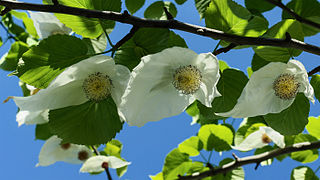
Davidia involucrata, the dove-tree, handkerchief tree, pocket handkerchief tree, or ghost tree, is a medium-sized deciduous tree in the family Nyssaceae. It is the only living species in the genus Davidia. It was previously included with tupelos in the dogwood family, Cornaceae. Fossil species are known extending into the Upper Cretaceous.

Hypericum kouytchense, the large-flowered St John’s wort, is a species of flowering plant in the family Hypericaceae, native to Western China. Growing up to 3 ft (0.91 m) tall and 5 ft (1.5 m) wide, it is a semi-evergreen rounded shrub with blue-green leaves and large yellow flowers with prominent stamens, appearing in midsummer. Flowers are followed by red seed capsules in autumn. Where conditions are favourable it can retain its leaves all year.