Omkareshwar Temple is a prominent Hindu temple dedicated to Shiva and is one of the twelve sacred Jyotirlinga shrines in India.[1] It is located on the island of Mandhata in the Narmada River near Khandwa in the Indian state of Madhya Pradesh. The island is traditionally believed to resemble the Devanagari symbol ॐ, from which the temple derives its name.[2]
The site consists of two major shrines: Omkareshwar, located on Mandhata island, and Mamleshwar (also known as Amaleshwar), situated on the southern bank of the Narmada River on the mainland.[3] Together, they are regarded as representing the complete manifestation of the Omkareshwar Jyotirlinga.
Madhya Pradesh is home to two Jyotirlingas, the other being Mahakaleshwar Jyotirlinga in Ujjain, located approximately 140km north of Omkareshwar.[4]
According to the Shiva Purana, once, Brahma and Vishnu had an argument in terms of supremacy of creation.[5] To test them, Shiva pierced the three worlds as a endless pillar of light, the jyotirlinga. Vishnu and Brahma split their ways to downwards and upwards respectively to find the end of the light in either directions. Brahma lied that he had discovered the end, while Vishnu conceded his defeat. Shiva appeared as the second pillar of light and cursed Brahma that he would have no place in ceremonies, while Vishnu would be worshipped until the end of eternity. The jyotirlinga shrines are believed to be those places where Shiva appeared as a fiery column of light.[6][7] Originally, there were believed to be 64 jyotirlingas of which 12 of them are considered to be the holiest.
Within the Omkareshwar Temple, the jyortlinga is described a "roundish black stone" representing the form of Shiva and near it is a white stone representing Shiva's consort, Parvati.[8]
As per a Hindu legend, Vindhya, the deity controlling the Vindhyachal mountain range was worshipping Shiva to propitiate himself from the sins committed. He created a sacred geometrical diagram and a Lingam made of sand and clay. Shiva was pleased with the worship and believed to have appeared in two forms, namely Omkareshwar and Amaleswara. Since the mud mound appeared in the form of Om, the island came to be known as Omkareswar. There is a shrine for Parvati and Ganapati in the temple.[10]
The second story relates to Mandhata and his son's penance. King Mandhata of Ikshvaku clan (an ancestor of Ram) worshipped Shiva here until the Lord manifested himself as a Jyotirlinga.[8] Some scholars also narrate the story about Mandhata's sons-Ambarish and Muchukunda, who had practiced severe penance and austerities here and pleased Shiva. Because of this, the mountain is named Mandhata.
The third story from Hindu scriptures reveals that there was a great war between the Devas (gods) and Danavas (demons), in which the Danavas won. This was a major setback for Devas and hence Devas prayed to Shiva. Pleased with their prayer, Shiva emerged in the form of Omkareshwar Jyotirlinga and defeated Danavas.
Philosophy of Omkaar - Advait Matt says Omkaar is composed of two words, Om (sound) and Akaar (srishti). Both are one not two since Advait means "not two". Om beej mantra of Srishti, itself is creator of Srishti.
Adi Shankara's Cave – Omkareshwar is said to be the place where Adi Sankara met his guru Govinda Bhagavatpada in a cave. This cave can be found even today just below the Shiva temple where an image of Adi Shankara has been installed.[11]
History
The temple is said to have been built by the Paramara Kings of Malwa in the 11th century CE. After the Paramara kings, the administration of the temple was taken over by the Chauhan rulers. In the 13th century CE, the temple suffered destruction and loot by Muslim invaders starting with Mahmud Ghazni. Nevertheless, the temple remained intact without complete destruction. The temple was under the Chauhan Kings during the entire Mughal rule, without much renovation. In the 18th century, the temple was rebuilt by the Holkar rulers. The construction of the same was started by the first Holkar Queen, Gautama Bai Holkar, and later completed by her daughter-in-law Devi Ahilyabai Holkar. The temple came under the British rule during the colonial era. After Independence in 1947, the Archaeological Survey of India (ASI) took over the responsibility of the temple with the help of the Khandwa administration.[12]
Location
It is situated in the Mandhata city (also known as Omkareshwar) in Khandwa district of Madhya Pradesh state in India. It is about 16km from Barwaha in Madhya Pradesh. Omkareshwar is formed by the sacred river Narmada. This is one of the most sacred rivers in India and is now home to one of the world's largest solar power plant.[13] The temple is situated on Mandhata or Shivpuri island on the banks of Narmada and Kaveri river (a tributary of Narmada). The island is 4 KM long and 2.6km2 (2,600,000m2) in area and can be approached by boats and bridge.[10]
This page is based on this Wikipedia article Text is available under the CC BY-SA 4.0 license; additional terms may apply. Images, videos and audio are available under their respective licenses.

 India
India 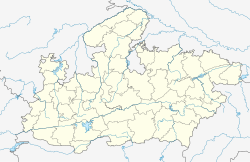


 Hinduismportal