The symbols included in the 2nd edition of the Guide are as follows. A number were adopted into Unicode 14 and 15 and have been available in SIL fonts since February 2023. Those not found in Unicode are marked with an asterisk.
Similarly ⟨ꭥ̶⟩, an unused proposal to replace Americanist ⟨ꭥ̇⟩.
The 'baby gamma' variant of the vowel letter ⟨ɤ⟩ is available as a character variant in fonts such as Gentium and Andika.
Several other symbols are graphic variants of Unicode characters:
p with a tail facing left (ɋ) and reversed o with ogonek (ǫ). The first is an allograph in Doke of ⟨ƍ⟩ (turned delta δ), and the latter a misanalysis by the Guide of the same letter.
double virgule ⫽, a close-kerned // or italicized ǁ, is an allograph of ⟨ǁ⟩. It might be adequately rendered with U+2AFD⫽DOUBLE SOLIDUS OPERATOR.
triple virgule ⫻, a close-kerned /// or italicized ⦀, used in a passing mention of retroflex clicks in the Cole article "Bushman Languages" in the 1966 Encyclopædia Britannica (4: 469). The symbol was removed from later editions. It might be adequately rendered with U+2AFB⫻TRIPLE SOLIDUS BINARY RELATION. This is an allograph of a triple pipe, for which Unicode recommends using character U+2980 TRIPLE VERTICAL BAR DELIMITER ⟨⦀⟩.
A couple are more distinct graphically, but without a corresponding semantic distinction:
superscript spacing diacritic ⟨←⟩, used to indicate clicks in Smalley (1963). This is similar to the subscript arrow U+02FF (˿) used to indicate clicks in the same way in the Uralic Phonetic Alphabet. It could be encoded as a space plus U+20D6: ⟨ ⃖⟩, though substituting a combining modifier for a spacing modifier like this is deprecated by Unicode, as it can cause complications.
hooktop j, an Americanist variant of ⟨ʄ⟩ in Smalley (1963) Manual of Articulatory Phonetics. Unlike ⟨ʄ⟩, in the Smalley letter the hook connects to the dot of the jay and so is detached from the body of the letter.
Common symbols not in Unicode
A couple of the symbols are found in Slavic sources:
gamma with a palatal tail turning left, approx. ⟨γ̡⟩, to replace γ̯ (noted in the guide as a 'prevelar slit spirant' or voiced fronted velar fricative [ɣ᫈])
gamma with a retroflex tail turning right, approx. ⟨γ̢⟩, to replace γ̣ (noted in the guide as a 'postvelar slit spirant' or voiced uvular fricative [ʁ])
Left-hook ('front-tailed') gamma
Right-hook ('back-tailed') gamma
Rare symbols
The following are not supported by Unicode as of version 16.[2]
Some of the symbols are idiosyncratic proposals by well-known scholars that never caught on:
A couple symbols were mentioned in the 1949 Principles of the International Phonetic Association as recent suggestions for further improvement and were never adopted:
h-m ligature, approx. ⟨hm⟩ or ⟨ɰ⟩ (turned ɰ) for [m̥]
turned small capital U ⟨ᴜ⟩ for a generic vowel; ⟨V⟩ is now generally used.
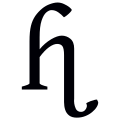
⟨ɦɳ⟩, a right-tail hooktop h (fusion of ⟨ɦ⟩ and ⟨ɳ⟩: ), found for the velar fricative in the Germanic 'fortis' voiceless spirant series fþɦɳ, contrasting with the voiced series ƀðᵹ and the Indo-European 'lenis' spirants ɸθχ in Prokosch (1939) A Comparative Germanic Grammar. (See esp. p.51.) Prokosch describes the symbol as a "modified h, since h is the usual spelling in all Germanic languages" (p.83), though other authors simply write these sounds fþh. Some fonts such as Helvetica incorrectly display ⟨ɧ⟩ as this form.
The majority of the non-Unicode symbols were proposed by George Trager to improve the Bloch & Trager system of vowel transcription and other conventions of Americanist notation, but were never adopted:
inverted (turned) small capital ᴀ ⟨ᴀ⟩ to replace æ̇; this had been the original IPA form of the letter that is now ⟨ɤ⟩.
small capital Ꜵ ligature ⟨Ꜵ⟩ (resembles an ᴀ-ᴅ ligature in guide) to replace ɒ̈
reversed small capital L ⟨ʟ⟩ (turned ᴦ or small-cap ⅃) for a labial lateral approximant; this is not a distinctive sound and the symbol was never used. However, it would potentially be used for an extIPAvelodorsal lateral.
The h-m ligature for [m̥]
Prokosch's right-tail hooktop h
The small-cap A-O ligature for [ɶ]
The proposed letter for [n̪]
References
↑Handbook of the International Phonetic Association, 1999, p. 31, 161.
↑Updated from Phonetic Symbol Guide at ScriptSource (⟨ꞹ⟩ was added to Unicode 11 as U+A7B9); additions in U14 and U15 are listed above.
This page is based on this Wikipedia article Text is available under the CC BY-SA 4.0 license; additional terms may apply. Images, videos and audio are available under their respective licenses.