Post-Internet music is a style of 21st century music addressing the Internet and Information Age as influenced by the post-internet art movement coined by artist Marisa Olson in 2006. In the early 2010s, Canadian musician Grimes used the phrase "post-internet music" to describe her work. The idea was later formally introduced by Irish composer Jennifer Walshe in 2015.
The term "post-internet music" was also used by publications to describe the work of composer Holly Herndon and London's PC Music record label and art collective founded by musician A. G. Cook. The London Contemporary Music Festival's "Requiem for Reality" event hosted "post-internet" music by Jennifer Walshe, James Ferraro, PC Music associate Felicita, Neele Hülcker and Brigitta Muntendorf. Additionally, post-internet music was initially associated with academia, art galleries and art school contexts. However, the phrase has since been used to describe several 21st century Internet related musical styles and microgenres.
The term "post-internet" was originally coined by artist Marisa Olson in 2006 to describe contemporary art that focused on the Internet's ubiquity in the 21st century.[1][2][3][4] However, its influence has extended into music as well as broader fashion trends.[5] In 2015, writing for Vice magazine, Robert Barry aimed to define post-internet music in an article entitled "So What Is Post-Internet Music, Anyway?".[6] He stated that at the time the idea of "post-Internet music" was scarce and usually applied to the work of Holly Herndon and London's PC Music record label and art collective founded by musician A. G. Cook.[6] According to Barry, Max Pearl and Michelle Lhooq, writing in THUMP, argued PC Music was "post-internet art" and there was a connection between their sound and the post-internet video work of Ryan Trecartin.[6][7] However, Barry ultimately credits Irish composer Jennifer Walshe with introducing the idea of "post-Internet music" on Facebook in the spring of 2015.[6]
Walshe described post-Internet music as "music written after the internet is as much a part of everyday life as electricity or indoor plumbing".[6] She added that post-internet music incorporates and showcases elements that make the songs in question impossible to have been written at any other time in history.[6] However, Sam Mackay, one of the curators of the London Contemporary Music Festival, argued, "It's not simply that such music couldn't have come about without the internet, but that it actually probes and reflexively approaches that situation".[6] In 2015, the LCMF's "Requiem for Reality" event was billed as a focus on exploring how the art world's "post-internet" ideas could work in the context of musical composition.[6] The event hosted music by Jennifer Walshe, James Ferraro, PC Music associate Felicita, Neele Hülcker and Brigitta Muntendorf.[6]
In 2016, High Brow Magazine wrote an article on popular music in the post-internet era, writer Sandra Canosa described "post-internet" as not implying being beyond the Internet but denoting that it is no longer a novelty and has become part of everyday life.[4] She added, "As with postmodern, post-rock, etc., the 'post' not only means that it comes after, but implies an awareness of its medium, sources, audiences and its limits."[4] Writer Peter Defraene stated for HumanHuman, "The movement then takes this self-awareness as its new subject. The result is a metastate of looking."[4][10][11][12][13][14][15]
In 2018, music and culture critic Adam Harper wrote an article entitled "Charting the evolution of post-internet music" for Red Bull Music Academy.[16] He stated that post-internet music concerned art that "addressed the effects of digital technology on modern ways of seeing and living".[16] He added that, "Just as not all books are about paper and not all radio shows are about electromagnetic radiation, the digital medium itself may be receding into the background as a style or subject matter for new electronic music".[16]
However, the phrase "post-internet music" has also been used as an umbrella term to describe several Internet related musical styles and microgenres stemming from 21st century online culture.[16][17][18]
Additionally, Harper remarked that post-internet art was usually "art that was based in relatively traditional gallery and art-school settings rather than an online culture itself, even if often drew from online culture."[16] He cites that a quantity of "post-internet music" has been released under similar circumstances, including on outmoded media such as vinyl or cassette, with Gatekeeper's Young Chronos appearing as an exception due to the album being released on The Pirate Bay and a USB flash drive.[16]
Characteristics
Early post-internet music often embraced ironic, nostalgic, self-referential internet aesthetics, defined by microgenres and subcultures such as seapunk and vaporwave,[19][20] other influences included the work of Holly Herndon and the PC Music label founded by A. G. Cook,[6] which gave way to bubblegum bass and hyperpop. These styles incorporated 1990s and early 2000s internet nostalgia, kitsch, online memes, and consumer culture into a new context.[16] They emerged primarily online and were more prevalent there than in traditional performance venues.[16]
History
Precursors
According to Vice magazine, the work of American composer Milton Babbitt has been described as a precursor to post-internet music, though not labeled a "post-internet artist", his work is thought of as fitting "the larger theme of analogue reality dissolving into digital simulation".[6] Writer Igor Toronyi-Lalic labeled him "the first [modern] composer to really apply mathematical principles to music".[6] He added that, "If the internet is anything, it’s about coding the real world. And Babbitt was doing that, trying to translate the real into the codified."[6]
In 2015, the London Contemporary Music Festival's "Requiem for Reality" event was billed as a focus on exploring how the contemporary artworld's "post-internet" ideas could work in the context of musical composition.[6] The event hosted music by Jennifer Walshe, James Ferraro, PC Music associate Felicita, Neele Hülcker and Brigitta Muntendorf.[6] By the late 2010s, post-internet music began to incorporate themes regarding the rise of social media and the increasing dominance of the internet in wider society.[30][16]
Criticism
Music critic Adam Harper states that "the whole notion of a musical expression that portrays a particular (past or present) cultural milieu with a degree of artistic distance – especially ironic distance – has been criticised as 'conceptual.' Conceptual music, it's argued or implied, is music about ideas or postures rather than emotions; its makers are veiled pretenders rather than authentic, expressive artists. Much of the criticism of what some would call post-internet music ('accelerationist' music is another term) has taken this angle."[16]
Some post-internet musicians have also collaborated with post-internet visual artists, such as Jon Rafman's work with Oneohtrix Point Never on a two-part music video for "Sticky Drama", from Lopatin's 2015 album Garden of Delete.[39][40] Ferraro had also experimented with post-internet related visual art, releasing the film "9/11 Simulation in Roblox Environment" in 2017.[41] His work has been compared to that of post-Internet figures such as Ryan Trecartin.[42]
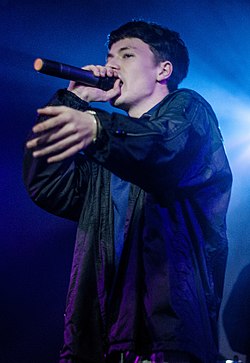
Swedish rapper Bladee, alongside his collective Drain Gang, has been described as defining "the malaise of post-internet alienation"
Soundcloud rap has been credited with emerging primarily on the internet.[46][47][48] Amarco referred to internet cloud rap artist Yung Lean, who visually drew influence from seapunk and vaporwave aesthetics,[49][50] as "by and large a product of the internet and a leading example of a generation of youths who garner fame through social media."[19] Additionally, rapper Sematary's sound has been described as "distinctly post-internet".[51]
During the 2000s, rock music microgenres such as shitgaze and blog rock would develop on the Internet.[66] By the 2010s, egg punk, originally known as devo-core, emerged as an Internet microgenre primarily based on the new wave band Devo.[67] Subsequently, incelcore, an online rock microgenre was pioneered by musician Negative XP in 2019 with the release of the compilation album MK Ultra Support Group.[68][69][70][71] The style has been described as drawing heavily from "internet culture, symbolism and terminology".[69] The genre has been described as an online subculture influenced by the "imagery, attitudes and irony" of internet image boards.[69] In 2026, writing for Pitchfork, music journalist Kieran Press-Reynolds defined the style as making use of 4chan's speaking culture.[68]
In August 2025, Press-Reynolds credited online musicians jaydes and Wifiskeleton with inspiring an "online indie music boom" or "new wave of SoundCloud 'indie rock'."[72] Press-Reynolds used the phrase "BandLab rock" to describe the style.[72] The genre is defined as a form of indie rock primarily distributed on SoundCloud, it grew in popularity on TikTok in 2025, with artists making use of "Alex G samples". Press-Reynolds noted that bedroom producers posted video tutorials on YouTube for "indie rock beats (without a real guitar)."[72] Notable acts included aeter, ayowitty and bunii.[72]
PC Music, the London art collective founded by A.G. Cook in 2013 has been described as "post-internet" by several publications.[73][74][75] The label led to musical styles such as bubblegum bass and hyperpop,[76][77][78] with the latter also being described as "post-internet".[79] Musician Cayenne of the Singoporean trio Sobs has been described by the NME as "post-internet pop".[80] In an article about hyperpop duo 100 gecs, British magazine Dazed stated "Fandom in the post-internet world is an odd thing – you would think that, if you loved something so much, you wouldn't dare to tinker with it [...] when Les and Brady released their debut album, 1000 gecs, last year, people were falling over themselves to remix it. Such are the times."[81]
In 2025, digital culture blogger Kieran Press-Reynolds was cited by Time and Mashable as discussing the corecore aesthetic in-depth.[82][83] Press-Reynolds told Mashable that at the time he first wrote about corecore, "most of the popular clips [...] was frenetic — they were these rapid-fire 15-second montages of surreal memes (like cute cats, alpha wolf edits) with intense music (Drain Gang and other internet rap) that didn't have much of a discernible meaning beyond the pleasurable rush of recognizable audiovisual material."[83]
See also
New Aesthetic– Artistic movement exploring the intersection of the digital and physical worlds
Dimes Square– New York City microneighborhood and Internet art scene
↑Dunham, Ian (2022). "SoundCloud Rap: An investigation of community and consumption models of internet practices". Critical Studies in Media Communication. 39 (1): 1–20. doi:10.1080/15295036.2021.2015537.
This page is based on this Wikipedia article Text is available under the CC BY-SA 4.0 license; additional terms may apply. Images, videos and audio are available under their respective licenses.